
Can Crews Find the Right Drencher in Smoke?

Not reliably. Urd's crew picked the section from memory; on Norman Atlantic, deck 3's valves were opened for a deck 4 fire. SOLAS 2026 now sets signage.
Not reliably, and the investigation record shows it. On Urd in 2014 the sprinkler section was chosen on one able seaman's certainty because smoke hid the markings. On Norman Atlantic that December, the alarm named deck 4 and the drencher valves found open were deck 3's. Since 1 January 2026 SOLAS requires section signage on new ro-pax ships; existing ships and car carriers are not covered.
Why is the right section hard to find?
Because the person at the valve cannot see the fire, and the person who can see it cannot see the numbers. A ro-ro drencher is split into sections, each fed by one valve. IMO's design guidelines put those valves outside the protected space, readily accessible without entering it, so whoever opens one is standing in a valve room or control station, working from an alarm panel, a drawing and whatever the fire team reports by radio.
Inside the space, section boundaries are usually marked on frames and the ship's side. Smoke collects under the deckhead first and lorries hide the side shell, so those markings go early. On Urd the Danish investigators found that smoke between the deckhead and the lorry roofs hid the section numbers painted along the sides, that choosing the valve required particular knowledge of the deck with no intuitive aids, and that the plan in the control station showed the sections in the opposite orientation to the person reading it.
The panel does not always help either. On older ships the detection loops were not necessarily laid out to match the drencher sections, so an alarm location still had to be translated into a section number by someone who knew the deck. Urd's detectors were a mix of heat and smoke heads left over from a 2001 conversion, and its first automatic alarm came from a detector about 20 m from the fire.
What happens when the section is wrong?
The water goes onto a deck that is not burning while the fire grows. Four ro-pax fires show the range, from a near miss to total losses.
- Urd, 2014: the 2nd engineer reached the sprinkler station unsure of the section; an able seaman there was sure it was section 6, and section 6 was opened at 07:50. He was right. The DMAIB still counted the episode as a weakness, and Stena Line added section markings at eye height and redrew the control-station plan.
- Norman Atlantic, 2014: at 04:18 a smoke detector alarm indicated fire on the deck 4 garage at frame 156. The muster list gave the drencher valves to the 1st engineer, who took his post and checked the fire's position with the bridge several times. The valves found open on board afterwards were those for deck 3. Italian investigators listed it as a human factor that influenced the emergency.
- Sorrento, 2015: DIGIFEMA's final report records that the drencher was opened in the wrong area, over four sections, with valves 15 to 18 found manually opened, before a power loss put it out of action.
- Lisco Gloria, 2010: a different failure in the same chain. The section valves were opened from the bridge, but the German BSU found the drencher pump control most probably set to manual, so no water came. Opening the right valve is not the end of the job until water is confirmed in the section.
What does SOLAS now require?
One numbering system, visible in smoke, from the deckhead to the valve chest. Resolution MSC.550(108), in force since 1 January 2026, added a new paragraph 7 to SOLAS II-2/20, titled 'Decision-making'. On passenger ships built on or after that date, ro-ro spaces with fixed water-spraying systems must carry signage and markings on the deckhead, bulkheads and vertical boundaries that identify each section. The signs must be adapted to typical patterns of crew movement, taking account of obstruction by cargo or fixed installations. Section number signs must be photoluminescent, and the numbering inside the space must be the same as the section valve identification and the section identification at the safety centre or continuously manned control station.
The same resolution closes the panel gap. Where a deluge system is fitted, detection must be identifiable to the same sections; the alarm interface must present information logically and unambiguously, with section numbering that coincides with the drencher and video systems; and the link between each camera and the drencher section covering its view must be displayed close to the video monitor.
The limits matter as much as the text. Paragraph 7 applies to passenger ships constructed on or after 1 January 2026, so the existing ro-pax fleet is not required to retrofit it. For those ships, IMO's 2019 interim guidelines in MSC.1/Circ.1615 recommend photoluminescent drencher section signs to ISO 15370, as guidance rather than a rule. And the paragraph opens with 'In passenger ships', so pure car and truck carriers, whose decks are larger and darker still, are outside it altogether.
What can an existing ship do now?
Most of paragraph 7 can be adopted voluntarily without a yard, and each item answers a failure in the record.
- Walk a fully loaded deck and look for the section numbers from where a fire team would actually be standing. If the signs are only on the frames above lorry height, add them at eye height on the routes crews use, as Stena Line did after Urd.
- Audit the numbering once, end to end: detection panel, CCTV labels, drencher valve tags, the plan in the valve station and the fire control plan. Any mismatch is a translation step someone has to make under pressure.
- Hang the section plan in the valve station the way the reader faces the ship, so forward on the drawing is forward in the room.
- Drill the whole chain, not just the valve: alarm, location, section, valve, then confirmation that water is flowing in that section. The 2023 revision of MSC.1/Circ.1430 sizes the pump of a manual-release deluge system for the two largest adjacent sections, so the drill should cover opening the neighbouring section too when a fire sits near a boundary.
- Put the valve task on the muster list with a named back-up, and practise it with the people who will be on board. Norman Atlantic's investigators recorded a crew with little time to familiarise on that ship.
Does the right section save the ship?
Not on its own. The Italian investigators' preliminary account of Sorrento recorded a fire starting in the same area of an open deck 4 as Norman Atlantic's, a drencher they then described as promptly activated, a quick fire team, and a ship lost anyway. A section valve is only as useful as the time it is opened, the pressure behind it and the size of the fire it meets. What signage and consistent numbering remove is one avoidable error between the alarm and the water, at the point where minutes count most.
How RoRoSAFE helps
Every wrong-section case starts with a location that has to be translated under smoke into a valve number. RoRoSAFE's alerts name the deck and bay of the vehicle that is heating, from infrared thermal and battery-vent gas sensing under each parked vehicle, and reach bridge and shore before visible smoke. That gives the person at the valve chest a location to map onto the section plan. It complements SOLAS detection, drenchers and section signage; it replaces none of them.
Pilot: one deck · installed alongside the berth · no drydock · 6 months of dashboard access
Sources
- 1. IMO — Resolution MSC.550(108), adopted 23 May 2024, in force 1 January 2026: SOLAS II-2/20.4.1.2 and 20.4.1.3 (detection identifiable to deluge sections; logical and unambiguous interface with matching section numbering), 20.4.4.2 (camera-to-section correspondence displayed by the monitor) and new 20.7 'Decision-making' (deckhead, bulkhead and vertical-boundary section signage adapted to crew movement and cargo obstruction; photoluminescent section numbers; numbering identical to valve and safety-centre identification; new passenger ships) (read in full).
- 2. Danish Maritime Accident Investigation Board — 'URD — Fire on 4 March 2014', case 2014006771: 07:43 alarm, 07:50 section 6 opened on an able seaman's identification, section numbers hidden by smoke, no intuitive aids, control-station plan drawn in the opposite orientation, mixed heat and smoke detection, eye-height markings and redrawn plan added afterwards (read in full).
- 3. Italian Ministry of Infrastructure and Transport, DIGIFEMA — 'Fires on board ro-ro pax ferries: Lessons learned', Lisbon, 25 September 2015: Norman Atlantic alarm at 04:18 for deck 4 garage frame 156; drencher valves assigned to the 1st engineer; valves found open corresponding to deck 3; human factors 'because wrong valves were opened'; crew familiarisation; preliminary note on Sorrento's prompt drencher activation (read in full).
- 4. Italian Ministry of Infrastructure and Transport, DIGIFEMA — 'Fire on Board Ro-Ro Pax SORRENTO, 28 April 2015: Final Report': drencher opened in the wrong area over four sections, valves 15 to 18 found manually opened, then lost with main power. Covered with its source in the linked Sorrento case study.
- 5. German Federal Bureau of Maritime Casualty Investigation (BSU) — Lisco Gloria fire, 8–9 October 2010: section valves opened from the bridge with the drencher pump control most probably set to manual, so no water reached the deck. Covered with its source in the linked Lisco Gloria case study.
- 6. IMO — MSC.1/Circ.1430/Rev.3, 27 June 2023 (copy published by the Hong Kong Marine Department): section control valves outside the protected space, readily accessible and clearly indicated (3.2); border-zone coverage by more than one section (5.5); manual-release deluge sized for two sections of at least 20 m by full breadth, pump for the two largest adjacent sections (Table 5-1) (read in full).
- 7. IMO — MSC.1/Circ.1615 (2019), interim guidelines for minimizing the incidence and consequences of fires in ro-ro spaces and special category spaces of new and existing ro-ro passenger ships: photoluminescent drencher section signs to ISO 15370, as guidance (copy published by the Turkish Maritime Administration).
Questions, answered
Why do crews open the wrong drencher section?+
Because the valves sit outside the burning space, so whoever opens one works from an alarm panel, a drawing and radio reports. Smoke under the deckhead hides section markings, lorries hide the ship's side, and on older ships detection zones and drencher sections may not share numbering. On Norman Atlantic in 2014 the alarm named deck 4 and the valves found open were deck 3's.
What does SOLAS II-2/20.7 require?+
Added by MSC.550(108) from 1 January 2026, it requires new passenger ships with fixed water-spraying systems in ro-ro spaces to mark each section on deckheads, bulkheads and vertical boundaries. Signs must suit crew movement and cargo obstruction, section numbers must be photoluminescent, and the numbering must match the section valves and the safety centre or manned control station.
Does the drencher signage rule apply to existing ships or car carriers?+
No. Paragraph 20.7 applies to passenger ships constructed on or after 1 January 2026, and it begins 'In passenger ships', so existing ro-pax ferries and pure car and truck carriers are outside it. For existing ro-pax ships, IMO's 2019 interim guidelines in MSC.1/Circ.1615 recommend photoluminescent drencher section signs to ISO 15370 as guidance.
How can an existing ferry make drencher sections easier to find?+
Check section signs from a fire team's position on a loaded deck and add eye-height markings where frames are hidden. Make one numbering run through the detection panel, CCTV, valve tags and plans. Orient the valve-station plan the way the reader faces. Drill the full chain from alarm to section to valve to confirmed water, including the adjacent section near a boundary.
Continue the thread
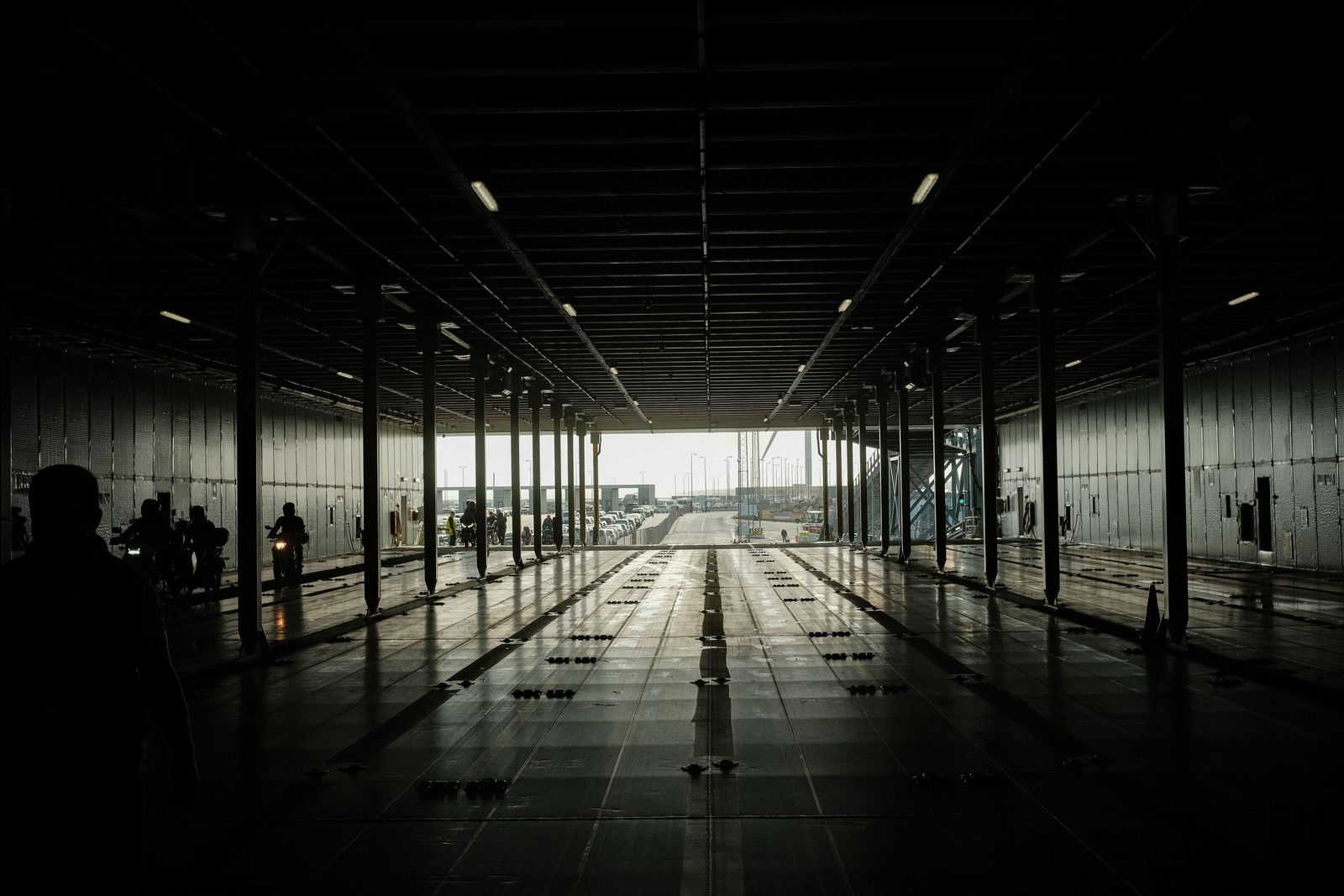
Norman Atlantic: Fighting the Wrong Deck
The 2014 Norman Atlantic fire killed around 31 people. The hold held 43 reefer trucks and 40 outlets, and the crew drenched the wrong deck.

Urd: The Fire That Fell From the Deckhead
In 2014 a corroded car-deck light on the ro-pax Urd dropped a burning diffuser onto a lorry. Passing engineers found it six minutes before detection.

Sorrento: The Reefer Fire the Wind Fed
In 2015 a reefer trailer fire on the ro-pax Sorrento, fed by wind through open sides, outran detection and drenchers. All 156 got off; the ship was lost.

Lisco Gloria: The Drencher That Gave No Water
The 2010 Lisco Gloria fire was detected within minutes and the drencher started — it delivered no water, and a 199 m DFDS ro-pax became a total loss.

PCTC Drencher Zoning and Fixed-First
Drenchers deliver 5–15 L/min/m² by deck height. Whether 'Fixed First' suppresses or floods a car deck depends on how precisely detection zones it.
Do Drencher Systems Stop an EV Deck Fire?
Fixed water drencher and mist systems can't extinguish a sealed battery pack — but full-scale tests show a correctly run drencher contains an EV deck fire.