
Do Drencher Systems Stop an EV Deck Fire?
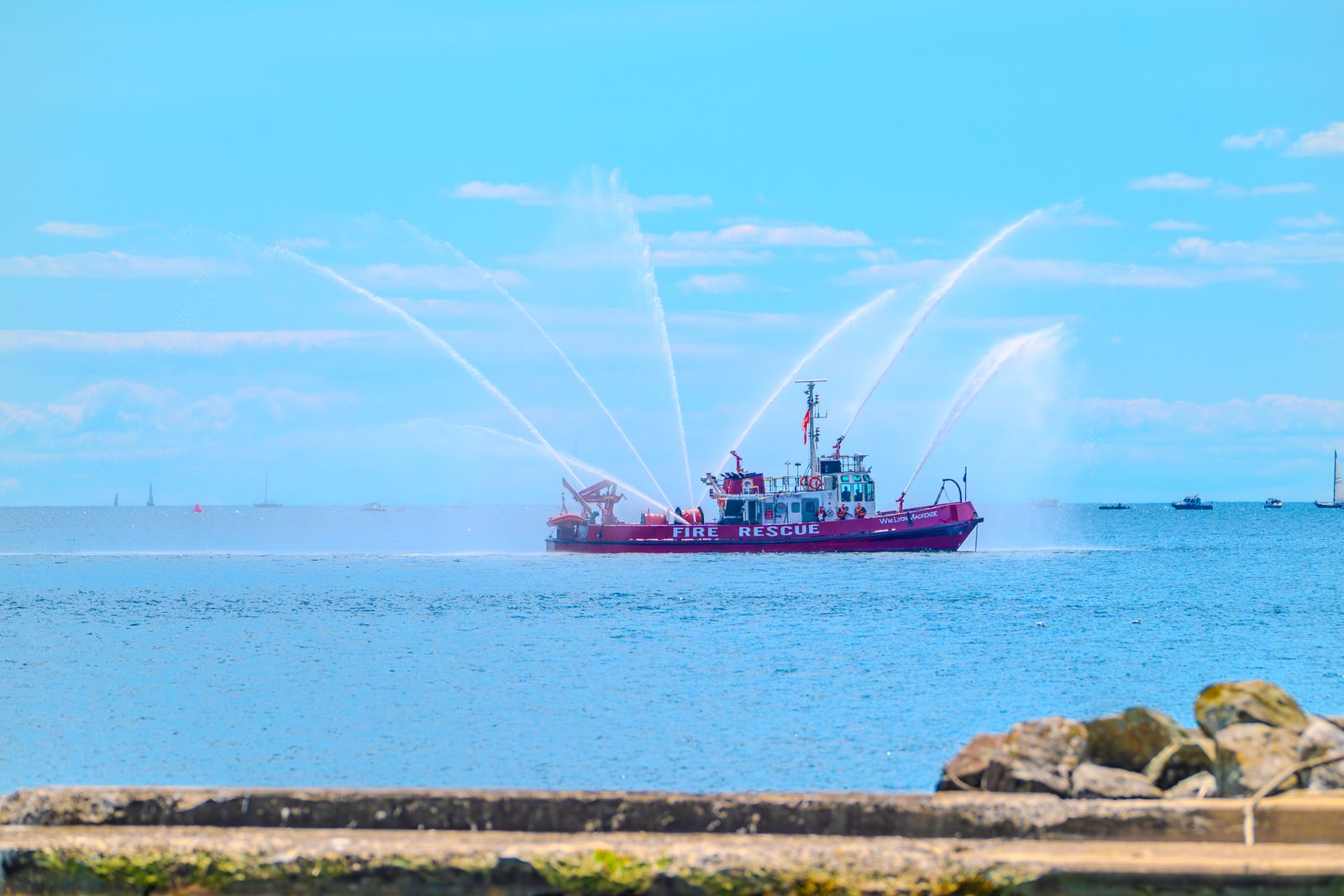
Fixed water drencher and mist systems can't extinguish a sealed battery pack — but full-scale tests show a correctly run drencher contains an EV deck fire.
They contain it; they do not put it out — and for a battery fire that distinction is the whole point. A fixed water drencher or mist system cannot reach the cells inside a sealed EV battery pack to interrupt thermal runaway. What full-scale testing shows it can do is cool the surrounding vehicles and deck and hold the fire in place, stopping it from spreading across a packed vehicle deck. On a ro-ro, containment is the win, not extinguishment.
What the fixed water system is actually for
Containment and boundary cooling, not extinguishment. SOLAS requires a fixed water-based system in ro-ro and vehicle spaces, and its job on any car-deck fire is to cool adjacent vehicles and structure and stop propagation — not to snuff the seat of the fire. For a lithium-ion pack that is even more clearly the right objective: water cannot penetrate a sealed, underbody battery casing to break the internal chain reaction, so trying to 'extinguish' the pack is the wrong target. Holding the fire to one or two vehicles until the runaway burns itself out is the achievable one, and it is the difference between an incident and a total loss on a deck holding hundreds of cars.
Does it work on a BEV fire? The test evidence says yes — if run right
Yes: a correctly designed and operated drencher contains a battery-electric-vehicle fire. The EU LASH FIRE project ran a fixed water-based drencher system against a BEV thermal-runaway fire on a simulated ro-ro deck and found it capable of containing the fire, concluding that the overall risk of carrying BEVs is equivalent to or lower than internal-combustion vehicles, provided the drencher is designed and operated in line with SOLAS. The two fires also burn on different clocks, which changes what the water must do: a fuel-spill fire from a petrol car develops very fast, peaks high and burns out quickly, while a fire starting in a BEV battery pack develops more slowly, does not peak as large, but burns much longer. A drencher does not need to knock down a huge peak on a BEV — it needs to sustain cooling over a long burn, which makes water supply, pump capacity and drainage the constraints that matter, not peak knockdown.
Drencher vs water-mist: volume versus efficiency
Both are SOLAS fixed water systems, but they solve the problem differently. A deluge or drencher system floods the deck at a high water density, delivering the direct cooling and volume a long BEV burn demands — and it is a drencher that produced the LASH FIRE containment result. A water-mist system uses fine droplets for efficient cooling and local oxygen displacement with far less water, an advantage in enclosed spaces and for added water weight, but its open question on a vehicle deck is whether the mist reaches the seat of a shielded, underbody battery beneath a car on a fully loaded deck. For an EV-heavy ro-ro deck, water density and reach are the properties that decide the outcome.
SOLAS 2026 makes water the primary fixed control
The regulation has moved the same way the test data points. Resolution MSC.550(108) amended SOLAS Regulation II-2/20, and Resolution MSC.555(108) amended the FSS Code — Chapter 7 (fixed pressure water-spraying and water-mist systems) and Chapter 9 (fixed fire detection) — for cargo ships and ro-ro passenger ships with keels laid on or after 1 January 2026, with existing ships to comply by their first survey on or after 1 January 2028. New provisions add fixed water-based monitors to protect weather decks carrying vehicles, and add heat detection alongside smoke detection in vehicle and ro-ro spaces. The pairing is deliberate: a fixed water system only contains a fire it is aimed at in time, so the same package that strengthens water suppression also strengthens detection.
What it means for owners and underwriters
Treat the fixed water system as a containment tool whose value is set by detection and water supply, not by any promise to extinguish. For owners, the SOLAS 2026 package is the floor; the operational questions are whether the system can be activated early and over the right zone, and whether it can sustain application through a long BEV burn without exhausting the supply or destabilising the ship with accumulated water. For underwriters, 'has a drencher' is not the risk answer — 'can activate it early over the right zone' is. That is where detection lead time and the water system meet, which is why the two are one system rather than two line items.
How RoRoSAFE helps
The test evidence says a drencher contains an EV deck fire if it is started early and in the right section. RoRoSAFE supplies that start: per-vehicle thermal and gas alerts that name the bay before visible smoke, so the crew opens the correct drencher section while the fire is still one vehicle. It is a detection layer that makes the water system work as tested.
Pilot: one deck · installed alongside the berth · no drydock · 6 months of dashboard access
Sources
- IMO — Resolution MSC.550(108) (amendments to SOLAS Regulation II-2/20, protection of vehicle, special category and ro-ro spaces) and Resolution MSC.555(108) (amendments to the FSS Code, Chapter 7 fixed pressure water-spraying and water-mist systems, and Chapter 9 fixed fire detection); via Lloyd's Register class news — applicable to ships with keels laid on/after 1 January 2026, existing ships by first survey on/after 1 January 2028; fixed water-based monitors for weather decks carrying vehicles; heat detection added alongside smoke detection.
- EU LASH FIRE project — full-scale test of a fixed water-based (drencher) system against a BEV thermal-runaway fire on a simulated ro-ro deck: the drencher contained the fire, and the overall BEV risk is assessed as equivalent to or lower than ICEVs when the drencher is designed and operated to SOLAS; BEV fires develop more slowly, peak lower and burn longer than ICEV fuel-spill fires.
- Fire Technology (Springer, 2023) — 'Water Spray Fire Suppression Tests Comparing Gasoline-Fuelled and Battery Electric Vehicles': comparative fire-development and water-spray control behaviour.
- EMSA — 'Safe Transport of AFVs on Ro-Ro Ships' (STARRS) study (2025): experimental and numerical assessment of fixed-firefighting effectiveness (including inert gas and high-expansion foam) against battery fires.
- Environmental Science & Technology (2023, doi 10.1021/acs.est.2c08581) — fire-extinguishing water from BEV and battery-pack fires contained higher concentrations of nickel, cobalt, lithium, manganese and fluoride than conventional-vehicle runoff, with high aquatic toxicity.
Questions, answered
Can a ship's drencher system put out an EV battery fire?+
Not in the sense of extinguishing the battery. Water cannot reach the cells inside a sealed, underbody pack to stop thermal runaway. What a fixed water drencher does is cool the surrounding vehicles and deck and contain the fire, stopping it spreading across a packed vehicle deck. Full-scale LASH FIRE testing showed a correctly designed and operated drencher can contain a BEV thermal-runaway fire.
Is a water-mist or a drencher system better for an EV deck?+
They trade off differently. A drencher floods the deck at high water density, giving the sustained cooling a long BEV burn needs — and it is a drencher that produced the LASH FIRE containment result. Water-mist cools efficiently with far less water, better in enclosed spaces, but reaching the seat of a shielded underbody battery on a full deck is its open question. Water density and reach decide the outcome.
How does a BEV fire differ from a petrol-car fire for suppression?+
The fires burn on different clocks. A petrol fuel-spill fire develops very fast, peaks high and burns out quickly; a BEV battery-pack fire develops more slowly, peaks lower, but burns much longer. So a fixed water system does not need to knock down a large peak on a BEV — it needs to sustain cooling over a long duration, making water supply, pump capacity and drainage the design constraints that matter.
What did SOLAS 2026 change for fixed water fire systems?+
IMO Resolution MSC.550(108) amended SOLAS II-2/20 and MSC.555(108) amended FSS Code Chapters 7 (water-spraying and water-mist systems) and 9 (fixed detection). For ships with keels laid on/after 1 January 2026 — and existing ships by first survey on/after 1 January 2028 — the changes add fixed water-based monitors on vehicle weather decks and heat detection alongside smoke detection in vehicle spaces.
Continue the thread

Can Water Suppression Worsen an EV Blast?
DNV found sprinklers can make a battery explosion worse by pocketing vent gas — a sharp question for the water-based systems now mandated on vehicle decks.

Can FSS CO₂ Extinguish a Li-Ion Fire?
A Li-ion cell in thermal runaway is self-oxidising. The FSS Code 45% CO2 concentration suppresses conventional fires but cannot extinguish the cell itself.
What Does SOLAS II-2/20 Ask of a Car Carrier?
Almost all of the 2026 amendment is written for passenger ships. A cargo ship gets one detection paragraph; the car-carrier package is still in draft.
Should Car-Deck Fans Stop in an EV Fire?
Yes — stopping the fans starves the fire and lets CO₂ work. But a sealed deck also traps battery vent gas, so when and how you reopen it matters as much.