
June Aster: Thirty Minutes to the Water
A cargo-hold explosion under a passenger deck killed 77 on the June Aster off Coron, 9 Sept 2026. Blackout took PA and VHF; the master jumped 30 min in.
The June Aster is the deadliest ro-ro fire in this corpus, and its cause is still open. On the evening of 9 September 2026, minutes from arrival at Coron, an explosion in the cargo hold of a 490 GT passenger-cargo ferry cut the ship's power, took the public-address system and VHF with it, and put fire along both sides of the hull before the master could tell 128 passengers anything. Thirty minutes after the steward's report, he was in the water. Seventy-seven people died.
This is a preliminary anatomy. The Philippine Coast Guard has not reported, the master was questioned only from 14 September, and every figure below is drawn from national press and official statements rather than an investigation record. It is written now because the regulatory response — three operator EV bans and a national circular in draft — is running ahead of the facts, and because the sequence that is already known says more about the ship than about the cargo.
The ship and the voyage
- MV June Aster — Philippine-flag passenger-cargo vessel operated by Atienza Interisland Ferries Inc.; MARINA records give 490.49 GT and a 2002 build.
- Passed a Philippine Coast Guard safety inspection in March 2026.
- Departed Baseco, Manila at 20:14 on 8 September 2026 for Coron, Palawan; due 18:00 on 9 September.
- Aboard: 128 passengers and 17 crew by the PCG's count — 145 people — against a ticket manifest of 132.
- Cargo hold: one electric vehicle, five motorcycles, a forklift, a pickup truck and general cargo, stowed together beneath the passenger accommodation.
The sequence, as far as it is known
From first report to abandonment took about half an hour, and the ship's own systems failed in the first minutes. Master Roel Sarmiento's account, given to GMA News on 17 September, is the only inside timeline so far: at 18:29 on 9 September, with the ship 1.2 nautical miles north-east of Barangay Marcilla, his steward came onto the bridge to report a fire. He ordered passengers brought up to the bridge with the doors opened and told the crew to ready hoses and extinguishers. When he looked to starboard, he saw 'intense flames covering the entire right side of the vessel, with fire also visible on the left'.
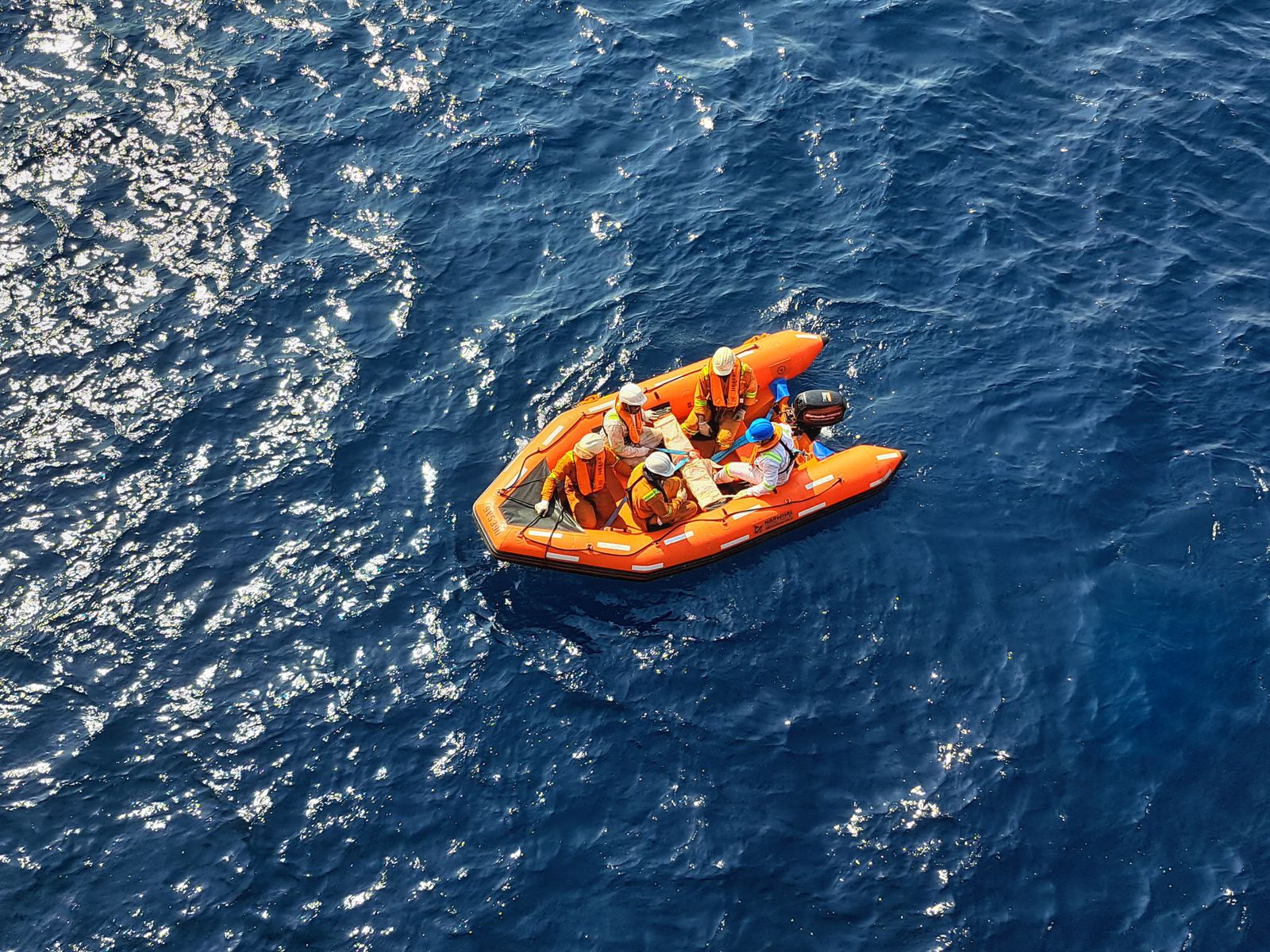
There was already a blackout. With no power the public-address system and the VHF were dead, so no announcement reached the passenger spaces and any distress call had to go by other means. He ordered the life rafts deployed and passengers to jump; he helped a mother over the rail. About thirty minutes in, crew shouted 'Captain, jump!'; a seaman gave him a lifejacket, he went over the side without wearing it, swam to a raft with about seven people in it, and was picked up by a fisherman.
Survivors describe the same first minute from below: a loud explosion from the cargo hold, the lights going out at once, smoke, then fire spreading faster than people could move. One passenger told reporters he tried to reach a lifejacket and could not because people were stepping on him; others jumped without one. Some bodies were later recovered in an embrace. Smoke and heat kept responders off the hull for close to forty hours; the PCG declared the fire out on the morning of 11 September and recovered bodies from the ship over the following days. By 20 September the count stood at 77 dead, 43 survivors and 8 missing, revised from 12 as recoveries continued.
What the explosion did before the fire did anything
It took the ship's ability to manage the emergency in the same second it started it. Three consequences follow from a blackout at the first event, and each shows in the accounts. First, no muster: the PA was the only way to reach 128 passengers in a small ship's accommodation at dusk, and it was gone; the master's order to bring passengers to the bridge could only travel by crew moving through smoke. Second, no external call from the bridge: VHF was down, so the PCG's first notice came late and second-hand, and the first rescuers were fishermen.
Third, no firefighting: hoses need the fire pump, the fire pump needs power or an emergency pump, and a crew of 17 with fire on both sides of a 490 GT hull within minutes had nothing to fight with. Whether the emergency generator started, whether an emergency fire pump existed and ran, and what fixed detection and extinguishing the hold carried are the questions the PCG's report has to answer. What is on the record is that the first notification of fire was a steward walking onto the bridge — a person, not a detector — by which point the fire had already reached the hull sides.
The hold, the cargo and the open cause
The EV is the suspect because it is the newest thing in the hold, not because anything found so far points to it. The hold held one EV, five motorcycles, a forklift, a pickup and general cargo — a mixed domestic load on a vessel that predates any EV guidance — with no reported segregation, declaration or state-of-charge control, because Philippine domestic rules require none. The PCG is examining 'several possibilities, including a terrorist attack or an explosion involving the EV', and the terrorism line is not rhetorical in this trade: SuperFerry 14 was bombed off Manila Bay in February 2004 with 116 dead, the deadliest terrorist attack at sea.
MARINA's 18 September statement is careful: 'no final finding has established that the electric vehicle onboard caused the incident'. A traction battery in thermal runaway produces a jet and a fire, and in an enclosed hold a deflagration of accumulated vent gas is possible; so does a fuel tank, a gas cylinder in general cargo, or a device. The 'loud explosion' the survivors describe is consistent with all four. The corpus's post on car-deck ignition sources records that every ro-ro fire with a proven cause began in a conventional vehicle's electrics; the honest position on the June Aster is that its cause is unknown and that the operators who banned EVs on 16–18 September did so on a possibility.
Why this is a Philippine casualty and not only an EV one
Because the sequence — small, old, mixed passenger-cargo tonnage, a hold under the accommodation, a manifest that does not match the headcount, a fire that outran the crew — is the Philippine domestic ferry record, not a new one. Doña Paz (December 1987; more than 4,000 dead after a collision and fire) and Princess of the Stars (June 2008; more than 800 dead) are the two worst peacetime ferry losses in modern history, and both were Philippine domestic ro-pax. SuperFerry 14 (2004) is the fire-with-an-explosion precedent.
The June Aster fits the pattern in every particular except the cargo, and the regulatory instinct to reach for the cargo first is what the pattern predicts: it is cheaper to ban a vehicle class than to re-fit a fleet. For the domestic operator the June Aster is an argument for two things the circular is unlikely to require — detection in the hold that alerts the bridge before a steward can, and emergency power that keeps the PA and VHF alive through a blackout. Both would have changed the thirty minutes whatever the ignition source.
What the case argues for
Treat the first thirty minutes as the design case. On a ro-pax, a cargo-hold fire is a life-safety event from the first second, and the June Aster shows what the sequence looks like when the ship's first warning is a human, the first system failure is total, and the first rescuers are whoever is fishing nearby. For an operator: the controls the DOE circular will impose on EVs — declaration, SOC, stowage, no charging — are worth adopting now, but the finding that matters for the next fire is whether the ship can detect a hold fire early enough for the crew to act, and stay in communication when it cannot.
For an underwriter writing Philippine domestic tonnage: the June Aster is a fleet-age and survivability question before it is a cargo question, and the questionnaire should ask about emergency power, detection coverage of holds under accommodation, and manifest accuracy ahead of EV policy. For the investigator: the value of a published, causal PCG report is that it either indicts the EV with evidence or clears it — and the Philippines' neighbours will write their rules from whichever the report does.
How RoRoSAFE helps
June Aster's cause is still open, and the explosion came before the fire. What the case shows is how little time an occupied ship can have. RoRoSAFE is built to give the earliest possible warning of a vehicle fire on ro-ro and ro-pax decks, flagging heat and battery-vent gases at the vehicle before visible smoke. It does not claim to prevent an explosion of unknown cause.
Pilot: one deck · installed alongside the berth · no drydock · 6 months of dashboard access
Sources
- 1. GMA News — 'It happened so quickly: M/V June Aster captain recounts deadly ferry fire' (17 September 2026): Master Roel Sarmiento's account — departure 20:14 on 8 September; steward's fire report at 18:29 on 9 September; passengers ordered to the bridge; hoses and extinguishers readied; blackout disabling VHF and PA; flames along the starboard side and visible to port; life rafts deployed; jumped ~30 minutes in; rescued by a fisherman. PCG figures of 77 dead, 8 missing, 43 survivors.
- 2. GMA News — 'PCG: Captain of MV June Aster has liability over fire incident in Coron' (12 September 2026): Commodore Noemie Cayabyab, PCG spokesperson — 'the captain has a responsibility and a liability'; fire started in the cargo hold; cause yet to be determined. Philstar — 'MV June Aster captain turns up five days after ferry fire off Coron' (15 September 2026).
- 3. Philippine News Agency — 'Rescued June Aster crew member dies, toll climbs to 77' (20 September 2026): 77 dead, 43 survivors, 12 missing of 132 on the manifest. Philstar — 'Missing in Coron ferry fire down to 84; 2 passengers missed trip' (11 September 2026); Malay Mail — death toll 76, bodies found in an embrace (13 September 2026).
- 4. Philstar — 'Possible EV link in June Aster fire prompts ferry bans, safety review' (19 September 2026): hold cargo (one EV, five motorcycles, forklift, pickup, general cargo); PCG examining 'a terrorist attack or an explosion involving the EV'; Montenegro (16 September) and Island Water (17 September) bans; DOE coordination with MARINA. Newsbytes.ph (19 September): Starhorse ban; DOE on the absence of EV-specific domestic rules.
- 5. MARINA — Official Statement, 18 September 2026: investigation ongoing; no final finding that the EV caused the incident; support for DOE-led standards for EV and hybrid carriage on domestic passenger vessels.
- 6. Vessel particulars (490.49 GT, built 2002, PCG safety check in March 2026) as reported in press citing MARINA records; survivor accounts (explosion, immediate blackout, smoke, lifejackets) via NBC News, Inquirer and Philstar reporting of 10–13 September 2026.
- 7. Historical context — Doña Paz (20 December 1987) and Princess of the Stars (21 June 2008), Philippine domestic ro-pax losses; SuperFerry 14 bombing (27 February 2004, 116 dead).
- 8. Companion RoRoSAFE analyses — 'What Will the Philippines' EV Ferry Rule Say?' (the regulatory response), 'What Causes EV Fires in RoRo Ships?' (the proven-cause record) and 'Euroferry Olympia: When the Deck Had People' (the ro-pax life-safety argument).
Questions, answered
What caused the MV June Aster fire?+
Not yet determined. Survivors heard an explosion from the cargo hold — which held one electric vehicle, five motorcycles, a forklift, a pickup and general cargo — followed by an immediate blackout and fast-spreading fire. The Philippine Coast Guard is examining possibilities including an EV battery event and a terrorist attack; MARINA has said no finding attributes the fire to the EV.
How many people died on the June Aster?+
By 20 September 2026 the Philippine Coast Guard's count was 77 dead, 43 survivors and 8 missing, revised down from 12 as bodies were recovered. The vessel carried 128 passengers and 17 crew against a ticket manifest of 132. It is the deadliest ro-ro fire examined in this corpus and among the worst Philippine ferry disasters since Princess of the Stars in 2008.
Why could the crew not warn the passengers?+
The explosion caused an immediate blackout that disabled the public-address system and the VHF radio, according to the master's account. Orders to bring passengers to the bridge could only be passed by crew moving through smoke, no announcement reached the accommodation, and within about thirty minutes the fire had spread along both sides of the hull and the master ordered life rafts deployed and passengers to jump.
What has changed since the fire?+
Montenegro Shipping Lines, Island Water and Starhorse Shipping Lines banned EVs and hybrids from their vessels between 16 and 18 September 2026, and the Department of Energy is drafting a joint memorandum circular with the DOTr, MARINA, the PCG and the Bureau of Fire Protection on EV carriage aboard domestic passenger vessels — all before any finding on the cause.
Continue the thread
What Will the Philippines' EV Ferry Rule Say?
After the June Aster fire (77 dead, cause open), DOE and MARINA are drafting the first binding EV-carriage rule for ferries: SOC cap, stowage, no charging.
Euroferry Olympia: When the Deck Had People
The 2022 Euroferry Olympia fire began in a garage and killed 11 truck drivers on the vehicle decks — proof a car-deck fire is a life-safety event.
Norman Atlantic: Fighting the Wrong Deck
The 2014 Norman Atlantic fire killed around 31 people. The hold held 43 reefer trucks and 40 outlets, and the crew drenched the wrong deck.
Sincerity Ace: The Fire With No Public Report
Five crew died when the Sincerity Ace burned 1,800 nm off Oahu in 2018. Panama investigated, the cause stayed unknown, and no report was published.

What Causes EV Fires in RoRo Ships?
Rarely the EV. Every car-deck fire with a proven cause began in a conventional or used car's electrics; a battery starts one by one of four routes.
When Should a Car-Carrier Crew Abandon Ship?
When the fixed system stops holding. Min Jiang Kou put 22 crew in lifeboats in August 2026; AMVER ships had them aboard within 23 hours.

The First Ten Minutes After an EV Alarm
Detection buys time only if the crew knows what to do with it. On a vehicle carrier the decisive variable isn't the alarm — it's the rehearsed response.
Should EVs Charge on a Passenger Ferry?
Denmark and operators like Havila restrict or ban EVs on passenger ferries. The real questions: onboard charging, and how low a state of charge is safe.