
Should EVs Charge on a Passenger Ferry?
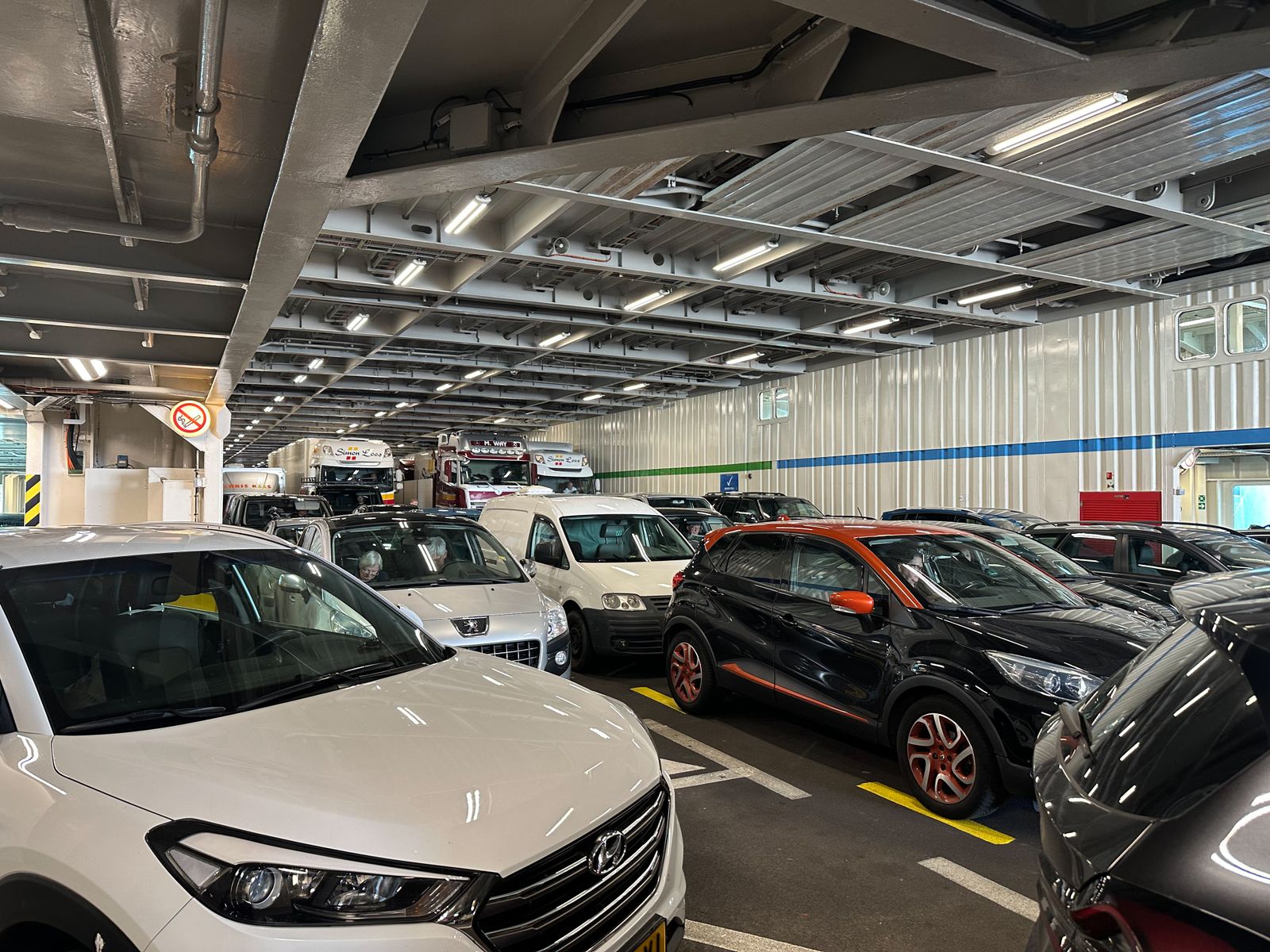
Denmark and operators like Havila restrict or ban EVs on passenger ferries. The real questions: onboard charging, and how low a state of charge is safe.
Two questions hide inside 'are EVs safe on a ferry,' and they have different answers. Charging an EV during the crossing — plugging it in on the vehicle deck — is being restricted or banned outright by flag states and operators after onboard incidents. The state of charge an EV is loaded at is being capped lower than on deep-sea ships. On a passenger vessel both answers are driven by one fact: people are aboard, metres from the deck.
The ferry answer is stricter because passengers are aboard
On a car carrier a crew can, in principle, contain a vehicle-deck fire at sea; on a RoPax the same fire is an evacuation problem, with passengers within metres of the deck. That is why ferry policy runs ahead of deep-sea policy. Havila Kystruten went furthest, banning electric, hybrid and hydrogen vehicles from its Bergen–Kirkenes coastal ships in January 2023 after a Proactima AS risk analysis concluded an alternative-fuel-vehicle fire would need external rescue the vessel could not provide. Alaska Marine Lines stopped carrying EVs and plug-in hybrids in 2025 for the same reason. These are blunt instruments, but they share a premise: a fire you cannot extinguish before passengers are at risk is one you would rather not carry.
Onboard charging: from bans to a paid service
Charging during the voyage is the sharper hazard, and the response is fragmented. Denmark's flag-state authority banned EV charging while onboard, and after further incidents several major RoPax operators added their own onboard-charging bans; some persist, while others now offer deck charging as a paid service and revenue line. Charging is treated separately from carriage for a physical reason: an active charge input plus a connector under load adds an ignition path that a parked, powered-down vehicle does not have — on a deck that is hard to reach and, on a ferry, close to people. There is no single international rule, so the answer today depends on the flag and the operator you sail with.
State of charge: ferries cap it lower than deep-sea
Where deep-sea car carriers commonly accept EVs at 50% state of charge or below, passenger ferries are going lower. Anek Lines requires an EV battery not to exceed 40%, and the European Maritime Safety Agency recommends a charge level below 30% to reduce the energy available to a thermal runaway. The logic is the same as at deep-sea loading — a lower charge means less stored energy to release if a cell fails — but it is tightened because the evacuation margin on a passenger vessel is smaller. State of charge is only one axis of the risk, not the whole of it, but it is the one a ferry can actually check at the ramp.
The counter-argument: bans may be the wrong tool
Not everyone accepts that EVs justify special treatment. Interferry, the international ferry association, argued in its April 2025 brochure 'E-cars on Board – A Safe Passage' that battery-electric vehicles do not present a greater fire risk than conventional vehicles — a position broadly consistent with the EMSA STARRS experimental study, which found EV and internal-combustion vehicle fires comparable in several respects. If that holds, an outright EV ban trades away decarbonising traffic against a risk a petrol car also carries. The disagreement is genuine, and it is why the regulatory direction is not toward blanket bans but toward assessing and managing the risk.
Where the framework is heading
Toward assessment and detection, not exclusion. IMO's interim guidelines (MSC.1/Circ.1615) and EMSA's Guidance on the Safe Carriage of AFVs in RoRo Spaces — with dedicated RoPax chapters — ask each ship to run a risk assessment under the ISM Code covering charging, state of charge, stowage and response, rather than impose one rule for the fleet. For a passenger operator that does not want to reach for a ban, the practical lever is the warning window: EMSA and Vehicle Carrier Safety Forum response guidance both assume a fire caught early, and on a ferry that must also begin evacuating, minutes of detection lead time are what separate a contained incident from the scenario the bans are written against. That is the case for treating detection, not exclusion, as the primary control on a passenger vessel.
How RoRoSAFE helps
Bans and state-of-charge caps lower the odds of a fire; neither tells the crew which vehicle is failing. RoRoSAFE is built for ro-pax decks as well as PCTCs. It watches every parked vehicle with thermal and battery-vent gas sensing and alerts before visible smoke. With passengers aboard, that early, located warning is what an evacuation decision needs.
Pilot: one deck · installed alongside the berth · no drydock · 6 months of dashboard access
Sources
- The Maritime Executive — Havila Kystruten bans electric, hybrid and hydrogen vehicles (policy dated 13 January 2023) from its Bergen–Kirkenes coastal RoPax ships, citing a Proactima AS risk analysis that alternative-fuel-vehicle fires would require external rescue.
- Alaska Public Media — Alaska Marine Lines ending carriage of electric vehicles and plug-in hybrids (2025) on fire-risk grounds.
- EMSA — Guidance on the Safe Carriage of Alternative-Fuel Vehicles in RoRo Spaces (RoPax chapters 1–2), and the EMSA STARRS ('Safe Transport of AFVs on Ro-Ro Ships') experimental and numerical study on EV/ICE fire behaviour.
- Interferry — 'E-cars on Board – A Safe Passage' brochure (April 2025): battery-electric vehicles do not present a greater fire risk than conventional vehicles.
- IMO — MSC.1/Circ.1615 Interim Guidelines for the carriage of alternative-fuel vehicles in ro-ro spaces; UK MCA MGN 653(M); and operator/flag policy — Anek Lines' 40% state-of-charge cap and Denmark's flag-state onboard-charging ban.
Questions, answered
Can you charge an electric car on a ferry?+
It depends on the flag state and the operator — there is no single international rule. Denmark's flag authority banned onboard EV charging, and several major RoPax operators added their own bans after incidents. Others offer deck charging as a paid service. Charging is treated more strictly than simply carrying the vehicle, because an active charge input adds an ignition path on a confined deck near passengers.
Why do ferries limit EV state of charge?+
Because a lower charge means less stored energy to release if a cell enters thermal runaway. The European Maritime Safety Agency recommends a charge level below 30%, and some operators such as Anek Lines cap it at 40% — lower than the 50%-or-below common on deep-sea car carriers. The margin is tighter on a passenger vessel because a fire there is also an evacuation problem.
Which ferry operators ban EVs?+
Havila Kystruten banned electric, hybrid and hydrogen vehicles from its Norwegian coastal ships in January 2023, and Alaska Marine Lines stopped carrying EVs and plug-in hybrids in 2025, both citing the inability to extinguish such a fire on board. These are blunt instruments — outright exclusions — and the industry disagrees on whether they are the right tool.
Are EVs actually more dangerous than petrol cars on a ferry?+
It is contested. Interferry's April 2025 brochure and the EMSA STARRS study both indicate battery-electric and internal-combustion vehicle fires are comparable in several respects. That is why the regulatory direction — IMO MSC.1/Circ.1615, the EMSA Guidance, MCA MGN 653(M) — favours per-ship risk assessment under the ISM Code over blanket EV bans.
Continue the thread
The Argument Over State-of-Charge at Loading
EMSA recommends 20–50% on a PCTC and lines have made 50% a booking condition. What still does not exist is an international requirement.
Is Battery Health a Car Carrier's Blind Spot?
State-of-charge policy governs EV loading, but battery State of Health — how the cells aged — is a fire-risk axis no car-carrier manifest captures.

What Is EMSA's STARRS Study on RoRo EV Fire?
EMSA's STARRS study, run by Bureau Veritas and RISE, is building the missing fire-test evidence for EVs and alternative-fuel vehicles on ro-ro ships.