
What Should a Ferry's EV Carriage Policy Say?

Declare it at booking, check it at the ramp, park it near water, keep it off and empty, watch it all crossing. Lite Shipping covers part of that.
Five things, in the order an electric car meets them: declare it at booking, check and mark it at the ramp, park it where water reaches and crew can work, keep it switched off with nobody in it and no charging, and give the crew a plan, the kit and a way to see trouble early. Lite Shipping's new Philippine rules cover part of that. UK, EU, CHIRP and Korean guidance supply the rest.
Why write a policy rather than a ban
Because a ban only works as far as the gate can enforce it, and it leaves every other fire source aboard. After the June Aster fire, several Philippine operators refused EVs outright, while Lite Shipping chose to carry them on conditions: stowed in well-ventilated areas, switched off for the voyage, nobody left inside, and dedicated lithium-ion firefighting equipment aboard. The UK Maritime and Coastguard Agency's MGN 653(M) recommends exactly this approach: an operator-developed checklist or flow chart, applied consistently.
Before the car boards
Know what is coming and what condition it is in. MGN 653 recommends driver self-identification of EVs during booking. CHIRP Maritime's 2026 guidance adds a booking declaration that the vehicle is undamaged and has no known battery fault, and asks for the number and type of EVs and hybrids before loading. The useful record for the bridge is the EV flag, battery size, state of charge, state of health, condition and position on deck.
State of charge belongs in the booking terms. No international rule sets it for ferries. EMSA's guidance recommends 20–50% on pure car and truck carriers, many short-sea and deep-sea lines now require a maximum of 50%, and IUMI's 2025 guidance says to keep it as low as practically possible. At the ramp, MGN 653 suggests wing-mirror cards so patrols can spot EVs quickly, and thermal-imaging checks of the floor pan before embarkation. A car that shows damage near the battery should be inspected by a competent person, carried on the weather deck, or refused.
Where it parks
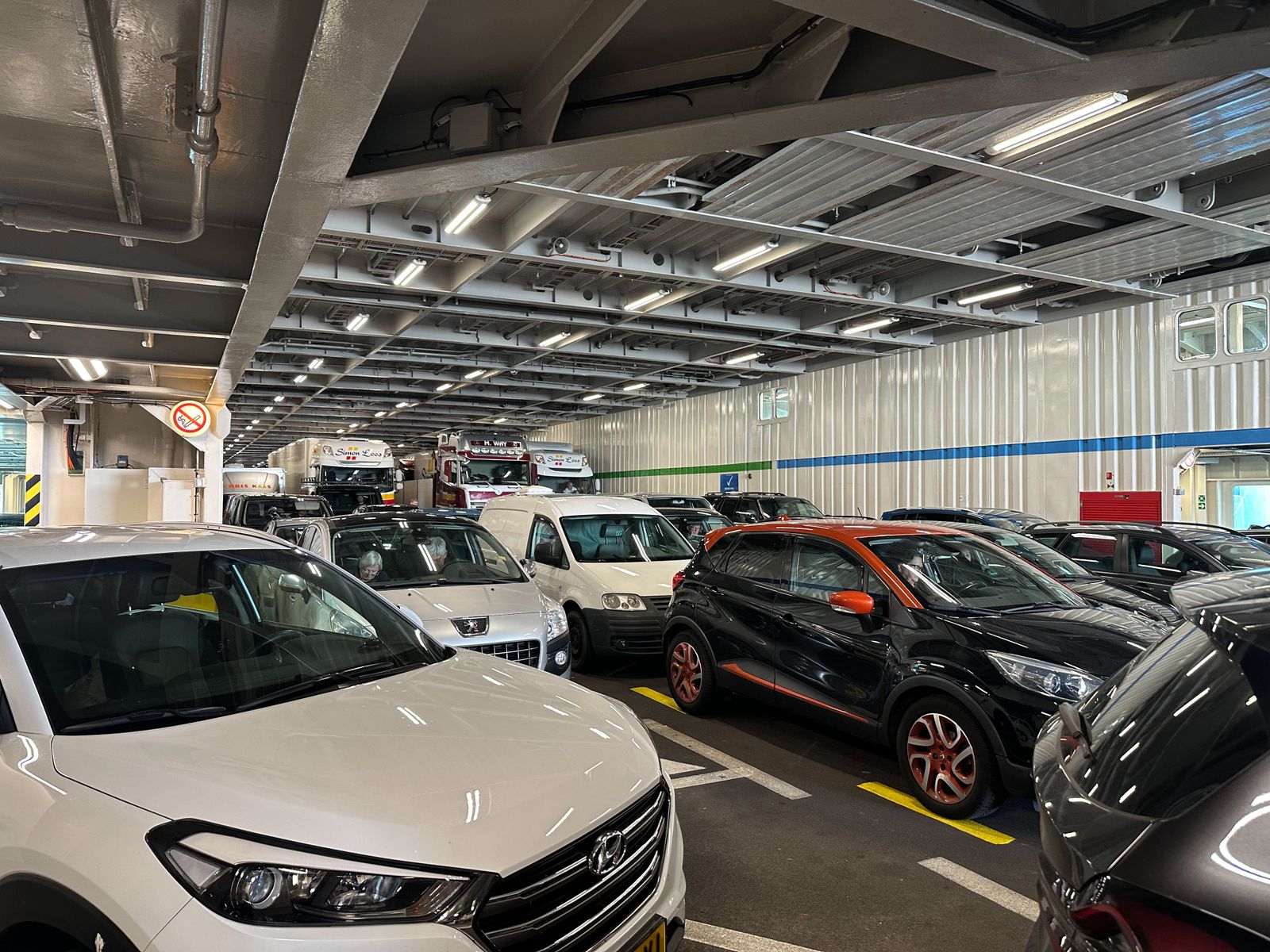
Where water reaches and crew can work. MGN 653 lists the options: under drenchers, on weather decks, or away from dangerous goods, and on a weather deck for damaged EVs and for small e-bikes and e-scooters, which should never travel in a car boot. CHIRP asks operators to keep EVs out of mixed stowage blocks and to know where each one is. Lite Shipping's 'well-ventilated' condition points the same way: an EV should not sit in a dead-air corner where vent gas collects.
Access matters as much as position. Danish full-scale tests found an EV fire blanket needs space around the car and at least two crew to fit it, and under-car spray devices must be slid beneath the vehicle. A policy that parks EVs bumper to bumper against a bulkhead has made its own equipment hard to use.
During the crossing
Off, empty and watched. Lite Shipping requires EVs to stay switched off and bars drivers and passengers from remaining inside, which keeps people away from a vehicle deck where battery gas can build before any flame appears. Charging should be refused unless the ship has a dedicated, risk-assessed arrangement; MGN 653 limits it to a dedicated part of the deck, and small EVs should never be charged on board. Denmark has banned onboard EV charging outright.
Patrols should look specifically at the battery area of each EV, as MGN 653 recommends, but a patrol sees a deck only every so often. CHIRP's guidance asks for continuous monitoring with CCTV, infrared and thermal imaging and gas detection, because early detection is what turns the rest of the policy into something the crew can act on.
When something goes wrong
Follow a rehearsed plan, with the equipment it names. MGN 653 asks for an EV fire response plan in the ship's safety management system and EV scenarios in fire drills. Korea's Article 97, in force for passenger car ferries since 1 April 2026, sets a minimum kit: two firefighter's outfits, a smothering cover and a water-spray device that reaches under, beside or inside a car. An EV fire can need around 10,000 litres of water against about 4,000 for a petrol car, so the drencher, not the portable kit, is what contains the deck.
CHIRP's first actions are to alert the bridge, withdraw from the area, isolate power, stop vehicle movements and start boundary cooling, and to treat the battery as able to re-ignite for hours or days. The policy should therefore also say who monitors a wetted or damaged EV after the fire is out, and for how long.
How RoRoSAFE helps
Every ferry EV policy ends with the same line: the crew must find the failing car early. RoRoSAFE watches every parked vehicle with infrared thermal and battery-vent gas sensing, alerts before visible smoke and names the deck and bay. It installs alongside the berth without drydock or drilling, and complements the ship's SOLAS detection and drencher, so the policy's monitoring step runs for the whole crossing, not just between patrols.
Pilot: one deck · installed alongside the berth · no drydock · 6 months of dashboard access
Sources
- 1. Insider PH — 'Lite Shipping allows EVs aboard vessels, sets safety rules': EVs stowed in well-ventilated areas and switched off throughout the voyage; drivers and passengers not allowed to remain inside; dedicated firefighting equipment for electrical and lithium-ion fires aboard; operators may add protocols.
- 2. UK Maritime and Coastguard Agency — MGN 653(M) Amendment 1 (August 2023): 2.1 driver self-identification at booking; 2.3 wing-mirror cards; 2.4 stowage under drenchers, on weather decks or away from dangerous goods; 3.8 patrols watching battery areas; 3.9 thermal-imaging checks of floor pans; 3.12–3.14 ≈4,000 L vs ≈10,000 L of water; 3.23–3.24 drills and SMS response plan; 4.3–4.4 small EVs on the weather deck, never charged aboard; 5.3–5.4 damaged EVs inspected, weather-deck stowage; 6.6 charging in a dedicated part of the deck; 8.2 operator checklist or flow chart.
- 3. CHIRP Maritime — 'Electric Vehicles on Roll-On and Roll-Off Passenger Ferries: Capability and Preparedness' (22 April 2026): advance and booking declarations, check-in visual checks, damaged-EV procedures, EV flag, kWh, SoC, SoH and deck position, segregation from mixed stowage blocks, no charging at sea unless approved, continuous monitoring, first actions and re-ignition.
- 4. EMSA — Guidance on the Safe Carriage of Alternative-Fuel Vehicles in Ro-Ro Spaces (v1.2, April 2025): 20–50% state of charge on PCTCs; lines' 50% maximum via ECG; IUMI — 'Risk mitigation for the safe ocean and short-sea carriage of electric vehicles' (September 2025): SoC as low as practically possible.
- 5. Republic of Korea, Ministry of Oceans and Fisheries — Standard for Ship Fire-Fighting Appliances, Article 97 (korea.kr notice, 13 April 2026), as summarised in this site's post on Korea's ferry rules.
- 6. Danish Institute of Fire and Security Technology — ELBAS project conclusions (February 2023): fire blanket needs space and at least two crew; Danish onboard-charging ban as reported in this site's post on charging EVs on passenger ferries.
Questions, answered
Can you take an electric car on a ferry?+
Usually, but it depends on the operator. Most ferry companies carry EVs on conditions, such as declaring the vehicle at booking, keeping it switched off and not charging it on board. Some have banned EVs and hybrids outright, including several Philippine operators after the 2026 June Aster fire. Always declare an EV when booking and check the operator's current policy.
What state of charge should an EV have on a ferry?+
There is no international rule for ferries. EMSA's guidance recommends 20–50% for vehicles on car carriers, many shipping lines cap it at 50%, and the marine insurers' association IUMI says to keep it as low as practically possible. A lower state of charge reduces the energy available if a battery fails.
Can you charge an electric car on a ferry?+
Generally not. UK guidance says charging, if offered at all, should be confined to a dedicated part of the deck, and small EVs such as e-bikes and e-scooters should never be charged on board. Denmark has banned onboard EV charging, and many operators refuse it because an active charge adds an ignition path on a crowded deck.
Why can't passengers stay in their cars during the crossing?+
Because a failing battery can release flammable, toxic gas before any flame appears, and a vehicle deck is hard to escape from once a fire starts. Rules such as Lite Shipping's keep people out of vehicles during the voyage, and most ferries close the vehicle decks at sea so the crew can manage a fire without passengers in the space.
Continue the thread

Do Ferry EV Bans Make the Car Deck Safer?
Only partly. A ferry EV ban removes the hardest fire to fight, not the common ones, and June Aster now points at chemical cargo no EV ban covers.
Should EVs Charge on a Passenger Ferry?
Denmark and operators like Havila restrict or ban EVs on passenger ferries. The real questions: onboard charging, and how low a state of charge is safe.

The Argument Over State-of-Charge at Loading
EMSA recommends 20–50% on a PCTC and lines have made 50% a booking condition. What still does not exist is an international requirement.

What Does CHIRP Tell Ferry Crews on EV Fires?
CHIRP's 2026 ro-pax guidance says plan for consequence: treat a failing EV battery as a gas release before a fire, and never approach early signs.

How Is Korea Equipping Ferries for EV Fires?
With kit first: since April 2026, Korean car ferries carrying EVs must hold dedicated gear. A risk study says detection and cooling matter more.
Are E-Bikes the Ferry Deck's New Fire Risk?
Yes, but not for pack size: grey-market cells, undeclared boarding and boot stowage. MGN 653 and USCG MSIB 003-25 now say weather deck, no charging.

Do EV Fire Blankets Work on a Ferry Car Deck?
Partly. A blanket smothers flames and slows spread to the next car, but the battery keeps venting beneath it, and a packed deck leaves little room.

Was the June Aster Fire an EV Fire?
No, on the evidence so far. Fire investigators point to bleaching powder mixed with asphalt cargo, and neither inquiry has implicated the EV.