
Mutiara Sentosa II: Smoke, Then the Sea

A vehicle-deck fire on an Indonesian ferry killed five in August 2026, by smoke and drowning, not burns. Its lifesaving gear sat aft, by the fire.
On the morning of 2 August 2026, fire broke out on the vehicle deck of the Indonesian ro-pax ferry Mutiara Sentosa II, north of Madura. About 270 people and 181 vehicles were aboard, most of the vehicles trucks. Five people died. Police forensic examiners found that none died of burns: they breathed smoke, then drowned or became exhausted in the water. The cause has not yet been established.
Indonesia's National Transportation Safety Committee (KNKT) is investigating, and the wreck is believed to be on the seabed in about 50 metres of water. This anatomy sets out what is on the record so far: the ship, the sequence, how the five died, the lifesaving equipment and the operator's earlier fires. It marks clearly what remains unconfirmed.
The ship and the voyage
- Built in 1992 as Ferry Osaka; about 160 m long and 25 m wide; in Indonesian service with PT Atosim Lampung Pelayaran for roughly a decade.
- Route: Surabaya, East Java, to Makassar, South Sulawesi.
- Manifest: 232 passengers and 39 crew, 271 in all. Of the passengers, 219 were drivers or travelling with vehicles, and 13 were ordinary passengers. The ship was certified for up to 600 passengers.
- Vehicles: 181, including 103 large trucks, 31 tractor-trailers, 6 medium trucks, 25 cars, 15 motorcycles and one piece of heavy machinery.
It was, in other words, a freight ferry carrying mostly trucks and their drivers, the cargo mix that dominates the recorded causes of ro-pax vehicle-deck fires.
The sequence, as far as it is known
The fire is reported to have started between about 06:00 and 07:00 local time. One survivor told local media that he first saw flames near a truck on the lower vehicle deck, and that two vehicles were already burning when crew went to check. The crew reported to the transport ministry that the fire came from the aft part of the ship. Basarnas, the national search and rescue agency, described it as starting low in the middle of the ship and spreading aft with the wind. Neither account names a cause.
The Tanjung Perak harbourmaster's office reported the accident at 08:24, and the operator notified the authorities at about 08:25. Rescuers temporarily lost contact with the master. The ferry's position was confirmed at about 09:45, roughly 19 nautical miles north of Buruan on Sapudi Island, and passing merchant ships began arriving at about 10:00. Passengers gathered at the bow as smoke and flames advanced, and some jumped into the sea. Nine vessels joined the rescue, and one cargo ship is reported to have picked up more than 100 people. Basarnas closed the search on 4 August. It said the ship was no longer on the surface, and KNKT's investigators put the wreck in open water about 50 metres deep.
The time between the first flames and the formal alert is the clearest gap in the record. On these timings it could be as much as two and a half hours. That is an estimate, not a finding. When the bridge learned of the fire, and why the alert took the time it did, are among the questions KNKT will have to answer.
How did the five die?
From smoke and the sea, not from flame. The East Java police disaster-victim identification team named all five on 3 August. Its medical chief said forensic examination showed no deaths from burns. Some victims are believed to have lost consciousness after breathing thick smoke before going into the water. Others reached the sea but could not survive there, through exhaustion, being unable to swim, or swallowing seawater.
That pattern repeats across ro-pax fires with people aboard. Smoke from a vehicle-deck fire reaches stairwells and open decks long before flame does. Once it cuts people off from the boats, the decision to jump is made in conditions nobody planned for. On June Aster, a month later in the Philippines, survivors also described smoke and darkness within minutes.
What happened to the lifesaving equipment?
It was in the wrong place, and possibly not there at all. Two days after the fire, the deputy transport minister said port authority records showed six lifeboats and 25 liferafts. That equipment, he said, was aft, where the fire was, and could not be used in the conditions.
KNKT's head gave a different account to parliament's Commission V on 19 August. Based on crew interviews, he said investigators had found no lifeboats aboard, although the ship's Safety and Fire Control Plan called for two. The ship carried 37 liferafts with a combined capacity of about 920 people, one rescue boat and four marine evacuation systems. Asked whether the company knew the lifeboat requirement, the operator's director of operations replied: "We didn't know, sir."
Has this operator had fires before?
Yes, two at least. On 19 May 2017, the company's Mutiara Sentosa I caught fire near the Masalembu Islands on a voyage from Surabaya to Balikpapan, and five people died. Reports of KNKT's investigation say the fire began in a tarpaulin-covered truck. Beyond the 134 registered passengers and 37 crew, there were 26 people aboard who were not on the manifest, along with 80 vehicles. In 2023, the operator's Mutiara Berkah I caught fire while berthed at Merak, with no clear public cause. Indonesia's vehicle-deck fires did not stop with Mutiara Sentosa II. On 20 October 2026, another operator's ferry, KMP Batumandi, caught fire on its upper vehicle deck as it approached Merak from Bakauheni with 420 passengers and 40 crew. Everyone was evacuated, several people were treated in hospital, and KNKT is investigating that fire too.
Manifest accuracy is a common thread. After the 2026 fire, officials found five children who were not on the manifest, and early counts of the missing ran to 41 before survivors on rescue ships were tallied. The transport minister has said the operator will be evaluated once KNKT's findings are in. The East Java police, examining the criminal side, said on 27 August that they had questioned 22 witnesses and suspected discrepancies in the passenger and cargo manifests.
What does the case argue for?
Four things, and only one of them is about detection.
- Knowing what is in the trucks. A tarpaulin-covered truck was named in 2017, and a truck is the leading lead in 2026. Covered loads can hide undeclared or hazardous cargo, which is why cargo declarations and checks at the ramp matter on freight ferries.
- Closing the gap to the alarm. A fire that is burning for an hour or more before a formal alert leaves no time to fight it or to evacuate in order. The bridge needs a located alarm early, and the shore needs to hear it at the same time, not after contact with the master is lost.
- Designing escape for a deck fire. If all the lifesaving equipment sits in one area of the ship, a single vehicle-deck fire can cut it off. The VCSF's 2026 drill guidelines warn that smoke and heat can disrupt the usual abandon-ship routes.
- Enforcing the basics on domestic ferries. Lifeboats required by the ship's own safety plan, an accurate count of who is aboard and certificates that match the ship are not detection questions. Here they decided who reached the water and who could be found.
How RoRoSAFE helps
Detection would not have put lifeboats aboard or corrected the manifest. What it addresses is the first hour: a truck burning on a lower deck while the alert was still to come. RoRoSAFE places infrared thermal and battery-vent gas sensing under each parked vehicle and sends tiered bridge and shore alerts that name the deck and bay before visible smoke. Its tamper-evident logs leave investigators a record of when each sign appeared. It complements SOLAS detection and suppression; it replaces neither.
Pilot: one deck · installed alongside the berth · no drydock · 6 months of dashboard access
Sources
- 1. Xinde Maritime News, 'Five dead as fire engulfs Indonesian ferry: vehicle deck, delayed alert and safety failures under investigation' (3 August 2026). It gives vessel particulars (built 1992, ex-Ferry Osaka, about 160 × 25 m), the operator, the route, the manifest of 232 passengers and 39 crew with the driver and passenger split, the 181 vehicles by type, the 06:00–07:00 outbreak, the survivor account of a truck on the lower deck, the 08:24 harbourmaster report, the 09:45 position, rescue ships and Meratus Pematang Siantar's 100-plus rescues, and the 2017 Mutiara Sentosa I and 2023 Mutiara Berkah I fires.
- 2. ANTARA News, 'Indonesia concludes SAR operations for Mutiara Sentosa II ferry fire' (4 August 2026). CNN Indonesia, 'Operasi SAR Ditutup, Kebakaran KMP Mutiara Sentosa II Diusut KNKT' (5 August 2026), and 'Penyebab Penumpang KMP Mutiara Sentosa Tak Pakai Sekoci Saat Kebakaran' (5 August 2026): the deputy minister on the fire reported from aft, and six lifeboats and 25 liferafts on port authority records, unusable in the conditions; Basarnas on a lower-midships origin spreading aft. RRI Surabaya (August 2026): KNKT investigator Aleik Nurwahyudy on the wreck in about 50 m of open water.
- 3. East Java Regional Police (Polda Jatim) DVI, via Jawa Pos, Metro TV and ANTARA Jatim (3 August 2026): five victims identified; no deaths from burns; smoke inhalation, then drowning or exhaustion in the water. Kompas, 'Burns were not the cause of death of the five passengers on the KMP Mutiara Sentosa II'.
- 4. detikNews, 'Temuan KNKT: KM Mutiara Sentosa II yang Terbakar Ternyata Tak Punya Sekoci' (19 August 2026): KNKT head Soerjanto Tjahjono to DPR Commission V on no lifeboats aboard against two in the Safety and Fire Control Plan, 37 liferafts (about 920 capacity), one rescue boat and four marine evacuation systems; the operator's director of operations Asep Suparman, 'We didn't know, sir'; Commission chair Lasarus on 600-passenger capacity.
- 5. Gebrak.id (2 August 2026): Transport Minister Dudy Purwagandhi on evaluating the operator after KNKT's findings; five children found who were not on the manifest. Suara Surabaya and Metro TV on reconciled totals (238 accounted for, 233 survivors).
- 6. Shipwreck Log, 'KM Mutiara Sentosa 1' (May 2017): fire on 19 May 2017 off Masalembu, from a vehicle on the car deck, five dead. KNKT figures for the 2017 voyage (134 registered passengers, 37 crew, 26 unregistered, 80 vehicles; a tarpaulin-covered truck) as cited by Xinde Maritime News.
- 7. Indonesian National Police (inp.polri.go.id), 'The KM Mutiara Sentosa II fire investigation is ongoing; data discrepancies' (27 August 2026): 22 witnesses questioned; suspected manifest discrepancies. Baird Maritime and CNN Indonesia (20 October 2026): KMP Batumandi fire approaching Merak, 420 passengers and 40 crew evacuated, KNKT and police investigating.
- 8. Vehicle Carrier Safety Forum, 'Fire Drill Guidelines for Vehicle Carrying Vessels', version 1.0 (2026): smoke and heat can disrupt the usual abandon-ship routes and muster points.
Questions, answered
What happened to the Mutiara Sentosa II?+
On 2 August 2026, a fire broke out on the vehicle deck of the Indonesian ro-pax ferry during a voyage from Surabaya to Makassar, north of Madura. About 270 people and 181 vehicles, mostly trucks, were aboard. Five people died. The ship is no longer afloat and is believed to lie in about 50 metres of water. KNKT is investigating the cause.
How did the five Mutiara Sentosa II victims die?+
Not from burns, according to East Java police forensic examiners. Some are believed to have been overcome by smoke before going into the water, and others drowned or became exhausted at sea after jumping. The finding mirrors other ro-pax fires, where smoke reaches stairs and open decks long before flame and forces people into the water.
Did the Mutiara Sentosa II have lifeboats?+
The official accounts conflict. Port authority records cited by the deputy transport minister listed six lifeboats and 25 liferafts, located aft near the fire and unusable. KNKT's head later told parliament that investigators found no lifeboats aboard, although the safety plan required two, plus 37 liferafts, one rescue boat and four evacuation systems.
What caused the Mutiara Sentosa II fire?+
It has not been established. A survivor described flames near a truck on the lower vehicle deck, and the crew reported the fire coming from aft, but KNKT has not confirmed which vehicle ignited or how. The same operator's Mutiara Sentosa I burned in 2017, with a tarpaulin-covered truck reported as the origin, and five people died then too.
Continue the thread
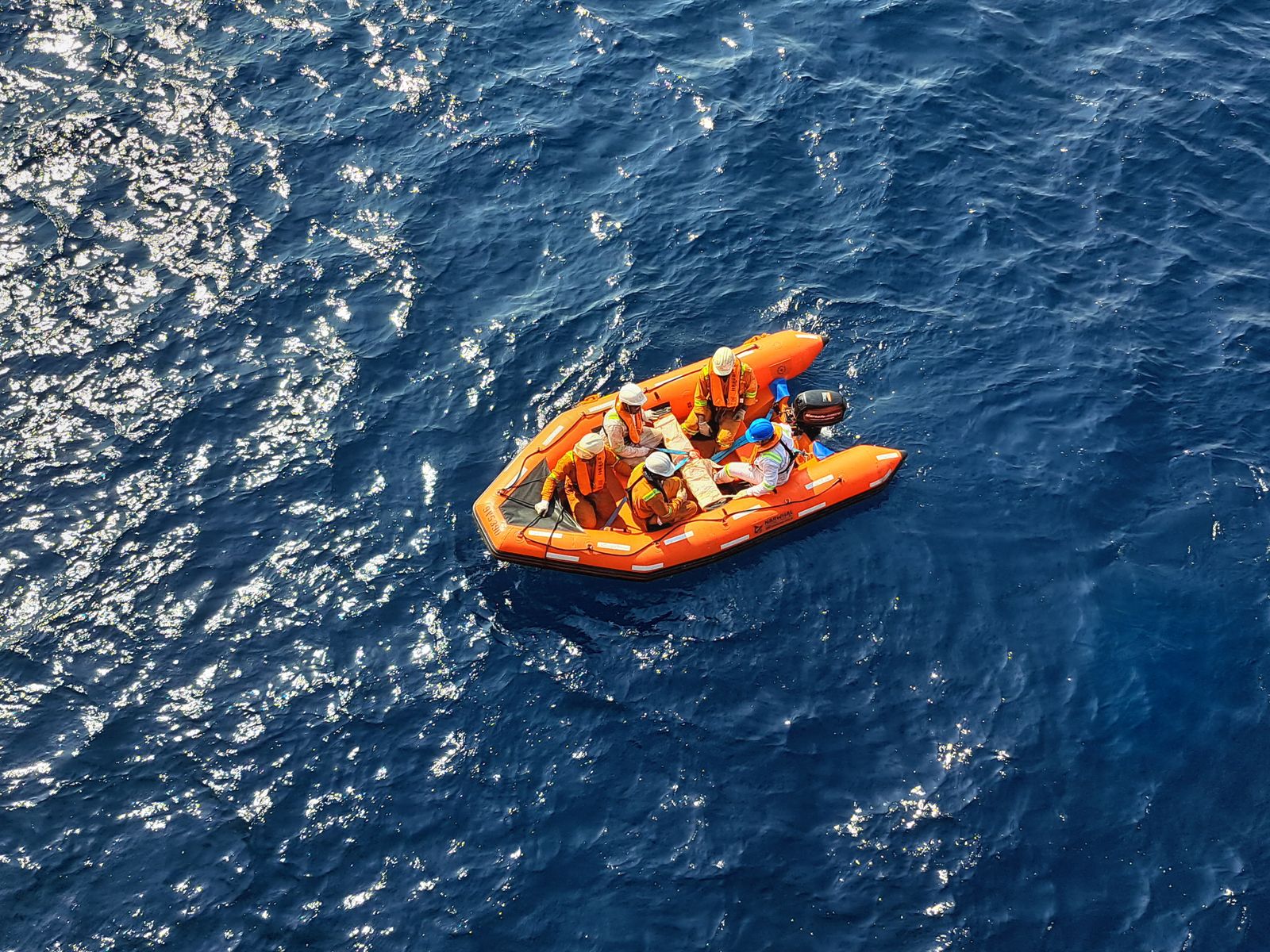
June Aster: Thirty Minutes to the Water
A hold fire killed 77 on the June Aster off Coron in Sept 2026. Fire investigators now point to bleaching powder mixed with asphalt, not the EV.
Euroferry Olympia: When the Deck Had People
The 2022 Euroferry Olympia fire began in a garage and killed 11 truck drivers on the vehicle decks — proof a car-deck fire is a life-safety event.
Are Trucks the Bigger Fire Risk on a Ro-Pax?
On ro-pax ships, most fires with a known cause began in trucks, their cargo or reefer units, not cars. What drives freight fires, and where EVs fit.

Do SOLAS Fire Rules Cover Domestic Ferries?
Not directly. SOLAS covers international voyages; a domestic ferry answers to its flag state, so 2026 vehicle-deck rules reach it only if copied.

What Happens to a Ferry Line After a Fatal Fire?
Its sister ships stop. In October 2026 the Philippine labour department grounded six June Aster sister ferries over safety paperwork, not the fire.
Can a Lorry Fire Black Out a Ferry?
It did on Stena Scandica. A 2022 lorry fire was out within an hour, but it burned unprotected cables overhead and left the ferry drifting for 6.5 hours.

What Should a Car-Carrier Fire Drill Test?
Whether the fixed system goes in within 15 minutes. New VCSF guidelines swap the routine monthly drill for six fire scenarios of rising severity.

Seaworld Marine 2: A Truck Fire Turned Back
A reefer truck caught fire 40 min out of Jeju. An alarm, the fixed system and a turn back to port held it to three trucks; four went to hospital.