
Can a Hose Put Out a Car Fire on Deck?

Only early. A hose can halve the heat reaching the next car if a crew gets there in minutes; on a smoke-filled deck or an EV pack, it rarely can.
Sometimes, and only early. A hand-held hose can knock down a single burning car and cut the heat reaching its neighbours, if a crew gets to it within minutes and can see what it is spraying. On a packed, smoke-filled car deck it usually cannot, and on an electric car it cools the body but rarely reaches the burning cells. K LINE's first live car-burn test, in October 2025, is a reminder of how quickly that window closes.
What did K LINE's live burn test?
How fast a real car fire grows, and what car-carrier nozzles can do against it. On 17 October 2025 Kawasaki Kisen Kaisha burned a scrapped petrol car in the fire-test building at Kashiwa Tech's technical centre in Bando, Ibaraki Prefecture, the company's first test with an actual burning vehicle. Twenty-five people practised with the standard hose nozzles carried on its car carriers and with a newly developed nozzle designed to spray better. The Maritime Disaster Prevention Center demonstrated a specially shaped nozzle that puts water directly inside a vehicle.
K LINE said the main lesson was how quickly a vehicle catches fire, and that it plans further tests on other vehicle types, including electric vehicles. It published no timings and no comparison between the nozzles, so the test is evidence of intent and of the speed problem rather than a performance result.
What can a hand-held hose do to a car fire?
Cut the heat that spreads it, if the operator works it well. RISE Research Institutes of Sweden tested hand-held systems for ro-ro spaces in 2018 and 2019 against a 4 MW steel car mock-up, with steel walls 0.6 m away standing in for the neighbouring cars. The best systems cut the heat reaching the sprayed side by roughly two-thirds, a reduction coefficient of 0.64; on the far side of the car, the best reached 0.34. Flow rates ran from 22 to 350 litres a minute, through hoses from 12 mm to 38 mm.
Technique mattered as much as hardware. Oscillating the spray up, down and over the car cooled both sides; low-pressure systems with large droplets did not reach the far side at all, and free-standing water-curtain nozzles had to be placed on at least two sides of the burning car to stop spread. RISE found a smaller, semi-rigid hose much easier to handle in a ro-ro space, at some cost in pressure and reach, and noted that high-flow systems tire operators and need more people. A high flow rate can compensate for poor technique, it concluded, but with the right tactics very large flows are not needed.
Why can't the crew reach the car?
Because a loaded car deck fills with smoke faster than a team can dress out and get there. On the car carrier Honor in February 2017, the chief mate tried to enter the burning garage deck with dry-chemical extinguishers within ten minutes of the alarm and was turned back twice by thick black smoke. The NTSB concluded that the closely stowed, lashed cars would have made it virtually impossible for crew in firefighting gear, carrying extinguishers or charged hoses, to move through the space. The crew released CO₂ 37 minutes after the first alarm instead.
Geometry makes it worse. RISE's simulated ro-ro space parked cars 30 to 60 cm apart, and a hose team needs room to approach at an angle, oscillate and back off. SOLAS requires vehicle and ro-ro spaces to carry water-fog applicators and portable foam applicator units for this first attack. The equipment is aboard; the access often is not. A ferry's vehicle deck with drivers' cars in lanes and crew a minute away is a different problem from deck 9 of a 6,000-car carrier at night.
What changes when the car is electric?
The hose can cool the car, but not the cells. An EV battery sits in a sealed, armoured pack under the floor, and water sprayed on the body does not reach cells in thermal runaway. Polish full-scale tests in 2018 used an average of 2,500 to 6,000 litres to extinguish an EV battery, and Tesla's emergency guidance plans for 3,000 to 8,000 US gallons, about 11,000 to 30,000 litres, applied directly to the pack. That is why the nozzles worth watching put water inside: K LINE's inside-vehicle nozzle, and cutting extinguishers that pierce the pack, which Swedish trials reported extinguishing a battery with about 750 litres in under ten minutes.
Water also has a cost at sea. RISE warned that long, high-flow firefighting can threaten a ship's stability, and found that more water was not always better at stopping spread; the Al Salam Boccaccio 98 capsized in 2006 after firefighting water built up on its vehicle deck. For EVs, the LASH FIRE project found that fixed drencher systems meeting current requirements contained a battery-electric car fire to about the level of a petrol car fire. That is a stronger argument for starting the drencher early than for a long hose attack.
Where does the hose fit in a car-deck fire plan?
In the first minutes, on a reachable deck, at a car the crew can find. That is the case where the hose works: one vehicle, smoke still high, a team able to stand off at an angle and work the spray over the burning car and its neighbours. For operators it means drilling with the nozzles actually carried and in real lane widths, ideally on real vehicles as K LINE did; planning to cool the cars on both sides, not only the burning one; and setting a time and smoke limit after which the team withdraws and the fixed system takes over. On a car carrier, the hose's main job is often boundary cooling while the CO₂ decision is made.
All of that depends on the first alarm pointing at a car, not a zone. A team sent to the right bay with a charged hose is in the situation RISE tested. A team sent to search a deck is in the one the NTSB described on Honor.
How RoRoSAFE helps
A hose works when the crew reaches one burning car in the first minutes, and that depends on knowing which car. RoRoSAFE watches every parked vehicle with infrared thermal and battery-vent gas sensing, alerts before visible smoke and names the deck and bay on the bridge and ashore, so the team goes straight to the right lane. It complements the ship's fixed detection, drencher and CO₂ systems rather than replacing them.
Pilot: one deck · installed alongside the berth · no drydock · 6 months of dashboard access
Sources
- 1. K LINE — 'Fire Extinguishing Test Conducted Assuming a Vehicle Fire in a Car Carrier' (press release, 7 November 2025); Marine Insight — 'K LINE conducts first real vehicle fire test to improve car carrier safety' (10 November 2025); Hellenic Shipping News: test on 17 October 2025 at Kashiwa Tech's technical centre, Bando City, Ibaraki; scrapped gasoline car; 25 participants; standard and newly developed nozzles; Maritime Disaster Prevention Center inside-vehicle nozzle demonstration; further tests planned including EVs.
- 2. RISE Research Institutes of Sweden — Vylund, Mindykowski and Palmkvist, 'Methods and equipment for fire fighting with alternative fuel vehicles in ro-ro spaces', RISE Report 2019:90 (BREND project), read in full: 4 MW propane-fired car mock-up; steel walls at 0.6 m; reduction coefficients 0.64 (sprayed side) and 0.34 (far side); hand-held flow rates 22–350 l/min; vehicles 30–60 cm apart in the field test; oscillation and two-sided water curtains; hose handling; warning on water volume and ship stability.
- 3. NTSB — Marine Accident Brief NTSB/MAB-18/07, 'Fire on board Vehicle Carrier Honor' (24 February 2017): two entries with dry-chemical extinguishers turned back by smoke; space virtually impossible to traverse with charged hoses; CO₂ released 37 minutes after the pre-warning alarm. As analysed in this site's Honor case study.
- 4. IMO — SOLAS regulation II-2/20.6.2, portable fire-fighting appliances in vehicle, special category and ro-ro spaces; MSC.1/Circ.1239; USCG Marine Inspection Notice 01-08 on portable foam applicators.
- 5. Bezpieczeństwo i Technika Pożarnicza, Vol. 52 Issue 4 (2018), pp. 108–117: full-scale EV battery fire tests, 2,500–6,000 litres. Tesla Emergency Response Guide: 3,000–8,000 US gallons applied to the battery. Swedish Civil Contingencies Agency cutting-extinguisher trials (about 750 litres, under 10 minutes) as reported by Auto Express (May 2023).
- 6. LASH FIRE (EU Horizon 2020, coordinated by RISE) — drencher tests on battery-electric vehicle fires, via Baird Maritime, 'Efficacy of vessel drencher systems in relation to battery electric vehicle fires'. Al Salam Boccaccio 98 (2006) as set out in this site's case study.
Questions, answered
Can a fire hose put out a car fire on a ship?+
Early on, yes, if the crew can reach the car. Swedish tests by RISE found the best hand-held systems cut the heat reaching a neighbouring car by about two-thirds when the operator oscillated the spray over the vehicle. On a packed deck filled with smoke, crews often cannot get close enough, and the fixed drencher or CO₂ system has to do the work.
Why can't crews fight car carrier fires by hand?+
Because cars are stowed close together and lashed, and smoke fills the deck within minutes. On the car carrier Honor in 2017, the chief mate was turned back twice by smoke within ten minutes of the alarm, and the NTSB found it would have been virtually impossible for crew with charged hoses to move through the space.
Does water put out an electric car fire on a ship?+
Water cools an electric car and stops the fire spreading, but spray on the body rarely reaches battery cells in thermal runaway inside the sealed pack. Road tests have used thousands of litres to extinguish one battery. Nozzles that put water inside the vehicle or pierce the pack use far less, and fixed drenchers can contain an EV fire.
What did K LINE's 2025 vehicle fire test show?+
On 17 October 2025, K LINE burned a scrapped petrol car in a test building in Ibaraki, Japan, and had 25 people practise with standard car-carrier hose nozzles and a newly developed one. A specially shaped nozzle that sprays inside the vehicle was also shown. K LINE said the test showed how quickly a vehicle catches fire and plans EV tests next.
Continue the thread

Are Crews Trained to Fight an EV Fire?
Mostly not. STCW firefighting training is generic — and a battery in thermal runaway can't be put out by routine crew firefighting at all.

Integrating Water-Mist Lances With Detection
SOLAS has required a container-piercing water mist lance since 2016. On a vehicle deck, a lance works only if detection gets crews to the right car early.
Do Drencher Systems Stop an EV Deck Fire?
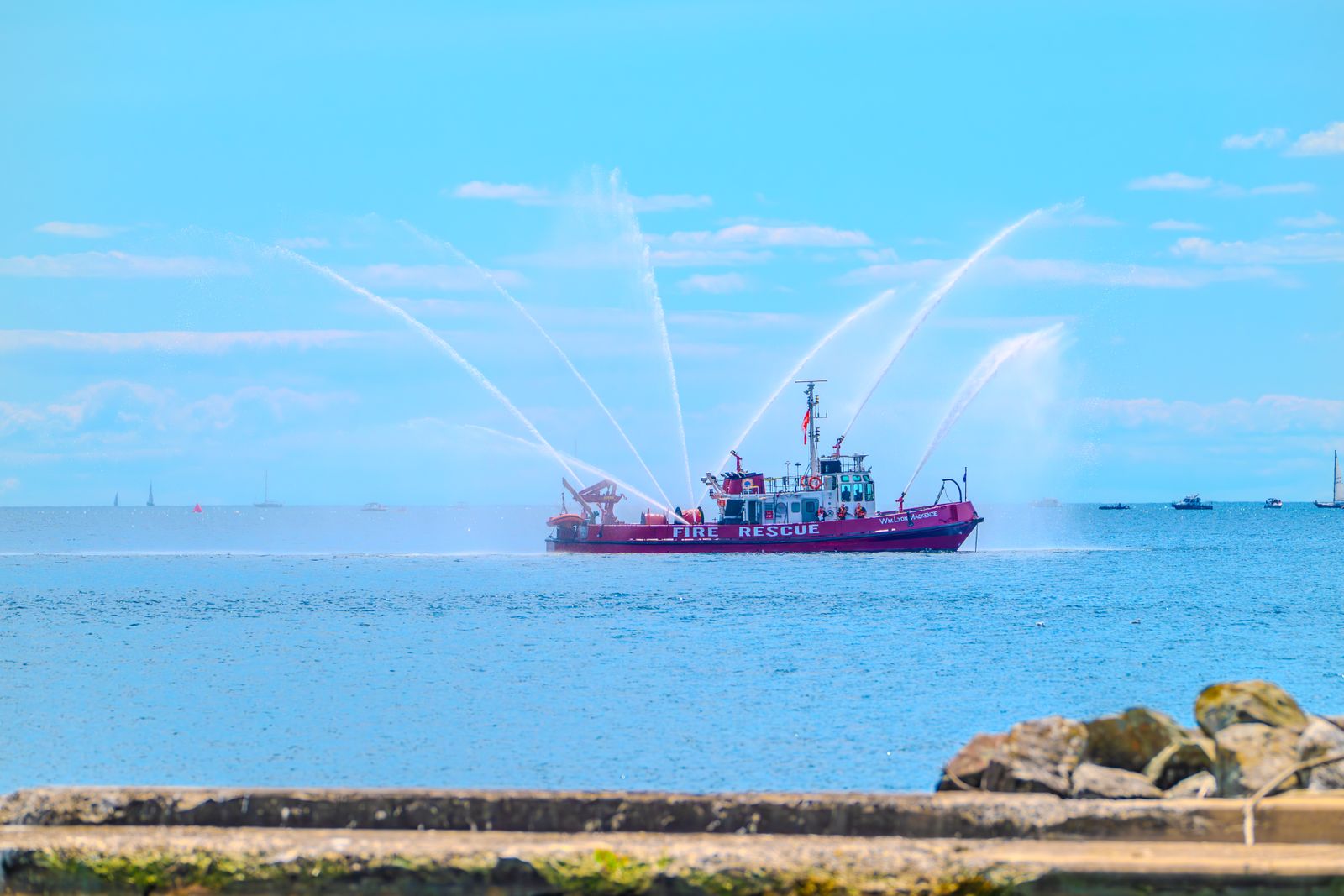
Fixed water drencher and mist systems can't extinguish a sealed battery pack — but full-scale tests show a correctly run drencher contains an EV deck fire.

Do EV Fire Blankets Work on a Ferry Car Deck?
Partly. A blanket smothers flames and slows spread to the next car, but the battery keeps venting beneath it, and a packed deck leaves little room.
Honor: Thirty-Seven Minutes to CO₂
The 2017 Honor fire is the fastest documented CO₂ release on a car carrier — alarm 0302, gas 0339. It emptied the ship's CO₂ and still cost $700,000.
Al Salam Boccaccio 98: Sunk by Firewater
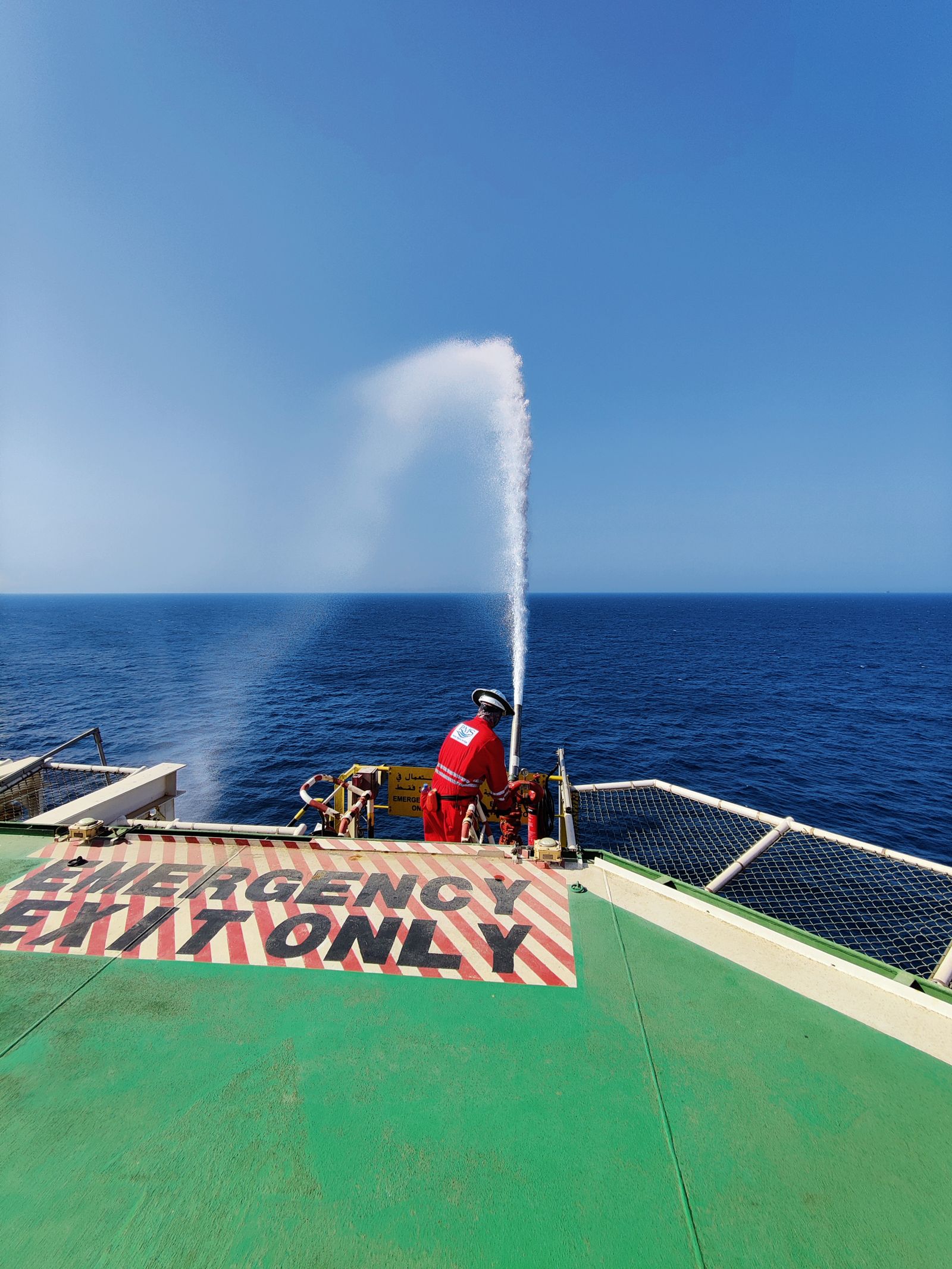
A car-deck fire the crew fought. Blocked scuppers held the water, free surface took the stability, and 1,031 of 1,418 aboard were lost.

The First Ten Minutes After an EV Alarm
Detection buys time only if the crew knows what to do with it. On a vehicle carrier the decisive variable isn't the alarm — it's the rehearsed response.
Is a Car Deck's Stow Plan a Fire Plan?
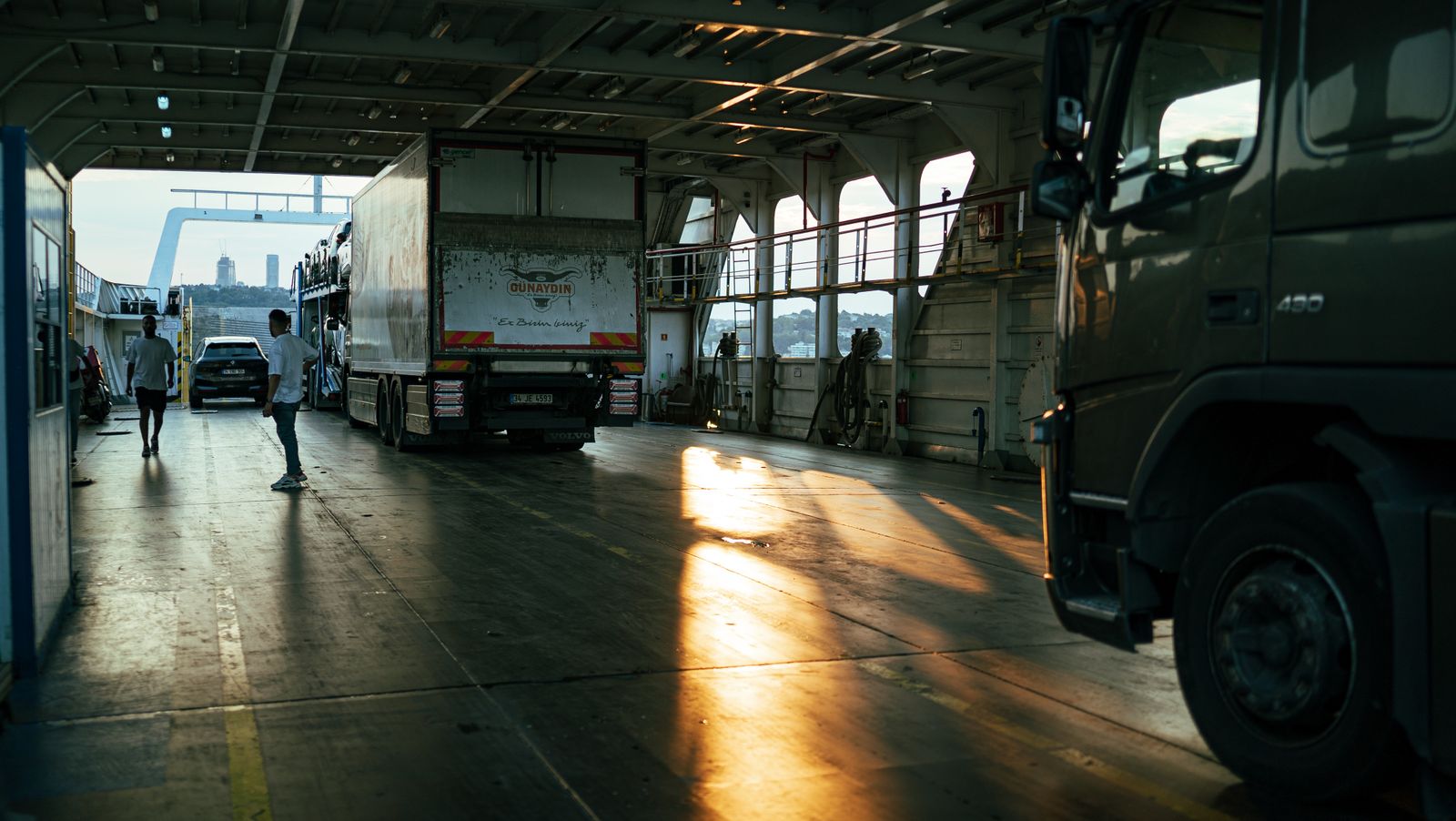
On a packed car deck, crews can't reach an established fire — which is why 'fixed first' exists. Where an EV is stowed decides what can be fought.