
Can High-Expansion Foam Stop an EV Fire?

It can control the flames around an EV but not the runaway inside its pack. On Fremantle Highway, fixed foam ran 40 minutes with no effect on the fire.
Not on its own. High-expansion foam can smother the flames around a burning EV, but it does not stop thermal runaway inside the pack and cools less than water. On Fremantle Highway in 2023 the fixed foam ran about 40 minutes, draining its tank from 14 m³ to 1 m³, with no positive effect on the fire.
This matters because foam is one of only three fixed systems SOLAS II-2/20 offers for closable car-carrier decks, alongside CO₂ and water. Some pure car and truck carriers are built with it, and insurers list high-expansion foam capability among the EV mitigations they look for. An owner choosing or relying on foam needs to know which part of an EV fire it handles.
How does high-expansion foam fight a car-deck fire?
By filling the space. A high-expansion system aerates a foam solution with fans, drawing either air from inside the protected space or air from outside, and floods the deck with a light foam that smothers the fire and absorbs some heat. Chapter 6 of the FSS Code, as revised in 2012, requires enough foam-generating capacity to fill the largest protected space within 10 minutes. Vehicle decks 3 m high or less that are reasonably gas-tight may use two-thirds of the design filling rate, provided they still fill in 10 minutes.
SOLAS II-2/20.6.1.1 allows the system only in vehicle and ro-ro spaces that are not special category spaces and can be sealed from outside the cargo spaces. A 2025 submission to IMO, MSC 110/18/12, argued that the FSS Code's wording blurs that line and proposed aligning it, saying foam should not be used where passengers could be present or where a space cannot be sealed. Foam is therefore a car-carrier system: Japan noted at IMO that outside-air high-expansion systems have been used for car carriers.
Why doesn't foam stop thermal runaway?
Because the reaction is inside the cells, behind the pack casing, where foam does not reach. RISE's summary for the Swedish Club in April 2023 rated high-expansion foam as able to handle an EV fire on a ship, with two qualifications: it does not affect the thermal runaway, and it controls the fire rather than ending it. The same presentation states that an initiated thermal runaway cannot be extinguished from the outside.
Cooling is the other limit. RISE's Lion Fire report on battery fires at sea notes that agents with less heat capacity, such as high-expansion foam and nitrogen, provide less cooling than plain water, though extinguishment may still be achieved if the system is designed correctly. The Maritime Technologies Forum, a group of flag states and class societies, adds that foam tends to break down under heat and impact. Air pockets then form and the EV may re-ignite, and water reaching the deck through the nozzles after the concentrate is spent can wash the remaining foam away.
What happened when Fremantle Highway released its foam?
It ran as designed and changed nothing. Panama's flag-state report describes a three-zone foam system; zone C, covering deck 8 where the fire started, was started at about 23:31, some 21 minutes after the first alarm. Before release the crew checked the cargo vents were open, since some served as purging vents for the foam. The fire teams then reported more smoke and heard explosions, one strong enough to deform deck 12.
The system ran for about 40 minutes and foam was seen coming out of the cargo decks, but it had no positive effect. Water from the system formed free surfaces on the decks and, with vehicles shifting as their lashings burned, the ship took a 10° list at about 01:22. Panama lists the foam's failure under inadequate specifications and design criteria, a contributing factor, and notes that cooling an EV battery takes large amounts of water: an estimated 10,000 litres or more, against about 4,000 for a petrol or diesel car.
What do tests show so far?
That foam can put out an EV fire in a small space under good conditions, and that nobody has yet shown it at deck scale. The Maritime Technologies Forum's March 2025 report cites SSE 9/INF.4, an IMO paper on lithium-ion vehicle fires with an outside-air high-expansion system, as showing extinguishment in a limited space under ideal conditions, and says tests in large spaces should be conducted. IMO's SSE 10 noted that further discussion might be needed, including revision of the test and approval provisions in the FSS Code and in the system guidelines, MSC.1/Circ.1384.
EMSA contracted a study in 2025 to support real-scale testing of fixed systems against battery fires, naming inert gas and high-expansion foam; its published report so far is a technical and regulatory review. China's ship-deck test series reported to IMO in SSE 7/INF.11 used low-expansion foam, not high-expansion: the flames were not put out immediately because the foam could not reach the battery pack, though they died down as it cooled them, and the packs did not re-ignite.
How does foam compare with CO₂ and drenchers?
It sits between them. In the Maritime Technologies Forum's comparison, CO₂ smothers but does not cool and is a single discharge, so visible fire can go out while the batteries keep heating and re-ignite when air returns. High-expansion foam smothers and cools, though less than water, and can discharge several times. Water-based systems cool continuously with an unlimited supply, at the cost of stability risk from water left on deck. The Forum concluded that a water-based system would be a better solution for car carriers, since EV fires need cooling to stop the fire spreading.
What should operators with foam systems do?
Treat foam as fire control that buys time, and plan for what it cannot do:
- Release early. The Forum stresses early activation triggered by early detection, because an EV fire is harder to contain once developed; Fremantle Highway's foam went in 21 minutes after the first alarm.
- Write down the vent sequence: which purging vents open for discharge, when they close afterwards, and who closes them, since open vents fed Fremantle Highway's smoke to the crew.
- Watch stability during and after discharge. Monitor list, keep scuppers clear and have the ballast plan ready, as Fremantle Highway's 10° list showed.
- Do not read a quiet deck as a cold battery. Foam that breaks down can let an EV re-ignite, so keep boundary cooling and monitoring going after the flames are out.
- Ask class what fire scenario the system was approved against, and follow the SSE work on revising MSC.1/Circ.1384 and the FSS Code test provisions.
How RoRoSAFE helps
Foam works best when it goes in early, and it cannot see which car started the fire. RoRoSAFE gives the bridge that early, located warning: infrared thermal and battery-vent gas sensing beneath each parked vehicle, with tiered bridge and shore alerts naming the deck and bay before visible smoke. It complements the ship's fixed foam, CO₂ or drencher system rather than replacing it, and holds no class type approval yet.
Pilot: one deck · installed alongside the berth · no drydock · 6 months of dashboard access
Sources
- 1. Panama Maritime Authority — Safety investigation report R-016-2024-DIAM, fire on board Fremantle Highway (25–26 July 2023), made public as an attachment to Dutch parliamentary paper 31409 no. 495 on 27 January 2026: three-zone foam system, zone C started about 23:31 after cargo vents checked open as purging vents; smoke increase and explosions, deck 12 deformed; foam ran about 40 minutes, tank from 14 m³ to 1 m³, no positive effect; 10° list at about 01:22; foam failure listed under inadequate specifications and design criteria; 10,000 L versus 4,000 L water estimate.
- 2. Maritime Technologies Forum — 'Safe Carriage of Electric Vehicles', March 2025, section 6 and Table 1: comparison of CO₂, high-expansion foam and water-based systems; foam quantity of five times the largest protected space or 30 minutes; foam breakdown, air pockets and re-ignition; SSE 9/INF.4 result in a limited space under ideal conditions; SSE 10 note on revising FSS Code chapter 6 and MSC.1/Circ.1384; early activation with early detection; water-based systems preferred for PCTCs.
- 3. IMO — MSC 110/18/12 (Bahamas, Cook Islands, Türkiye and IACS), 2025: text of SOLAS II-2/20.6.1.1 to 20.6.1.3 and FSS Code chapter 6, including paragraphs 3.2.2.2 and 3.3.2.2 (fill the largest protected space within 10 minutes; two-thirds of the design filling rate for gas-tight decks of 3 m or less); FP 54/3/3 (Japan) on outside-air systems used for car carriers; proposal that foam not be used where passengers could be present or in spaces that cannot be sealed.
- 4. RISE Research Institutes of Sweden (F. Evegren) — 'Fire in electric vehicles onboard', Swedish Club webinar, 26 April 2023: drencher yes; high-expanding foam yes, does not affect the thermal runaway, controls the fire; carbon dioxide unclear; an initiated thermal runaway cannot be extinguished from the outside.
- 5. RISE — Report 2018:77, 'Lion Fire: Extinguishment and mitigation of fires in Li-ion batteries at sea' (Andersson, Arvidson, Evegren et al.): agents with less heat capacity, such as high-expansion foam and nitrogen gas, provide less cooling but extinguishment may be achieved if designed correctly.
- 6. EMSA — 'Transportation of Alternative Fuelled Vehicles (AFV)': ongoing research on the effectiveness of inert gas and high-expansion foam systems against battery fires; study contracted in 2025 to support real-scale testing. STARRS study page: first report is a technical and regulatory review.
- 7. IMO — SSE 7/INF.11 (China), 'Fire test research on ships carrying lithium-ion battery vehicles': low-expansion foam tests on NCM and LFP vehicle mock-ups; flames not extinguished immediately because the foam could not reach the battery pack; no re-ignition.
- 8. IUMI — best practice and recommendations for the safe carriage of electric vehicles, 1 September 2023: high-expansion foam capability among the named mitigations. As covered in RoRoSAFE's post 'Who Can Refuse to Carry Your EVs?'.
Questions, answered
Can high-expansion foam put out an EV fire on a ship?+
It can control the flames, but it does not stop thermal runaway inside the battery pack. RISE rates high-expansion foam as able to handle an EV fire while noting it does not affect the runaway, and the Maritime Technologies Forum says extinguishment has only been shown in a limited space under ideal conditions. On Fremantle Highway the fixed foam ran about 40 minutes without effect.
Why did Fremantle Highway's foam system fail?+
Panama's flag-state report says the foam was released about 21 minutes after the first alarm, ran for about 40 minutes and emptied the concentrate tank from 14 m³ to 1 m³, but had no positive effect on the fire. It lists the foam's failure under inadequate specifications and design criteria, and notes that cooling an EV battery needs large amounts of water.
Is foam better than CO₂ for an EV fire on a car carrier?+
Partly. CO₂ smothers but does not cool and is usually a single discharge, so batteries can keep heating and re-ignite. High-expansion foam smothers, cools less than water and can discharge several times, but breaks down under heat. The Maritime Technologies Forum judged water-based systems the better option for car carriers because they cool continuously.
Where can a high-expansion foam system be fitted under SOLAS?+
SOLAS II-2/20.6.1.1 allows it in vehicle and ro-ro spaces that are not special category spaces and can be sealed from outside the cargo spaces. A 2025 IMO submission, MSC 110/18/12, proposed aligning the FSS Code with that rule and said foam should not be used where passengers could be present. In practice it is a car-carrier system.
Continue the thread

Does Fluorine-Free Foam Work at Sea?
F3 foam replaces banned AFFF, but it underperforms with seawater and non-aspirated nozzles — the marine case. And no foam stops an EV battery fire.

Can a Car Carrier Shut Its Vents Once It Burns?
Often not. Fremantle Highway's vents shut only by hand, and their smoke cut off the lifeboats. SOLAS accepts manual closure; remote is optional.

What Did Fremantle Highway's Fire Alarms Show?
Where, not what. Four smoke alarms in a minute put the fire beside 24 BMW EVs on deck 8, but the crew suspected a fault. Foam came 21 min later.

Can FSS CO₂ Extinguish a Li-Ion Fire?
A Li-ion cell in thermal runaway is self-oxidising. The FSS Code 45% CO2 concentration suppresses conventional fires but cannot extinguish the cell itself.
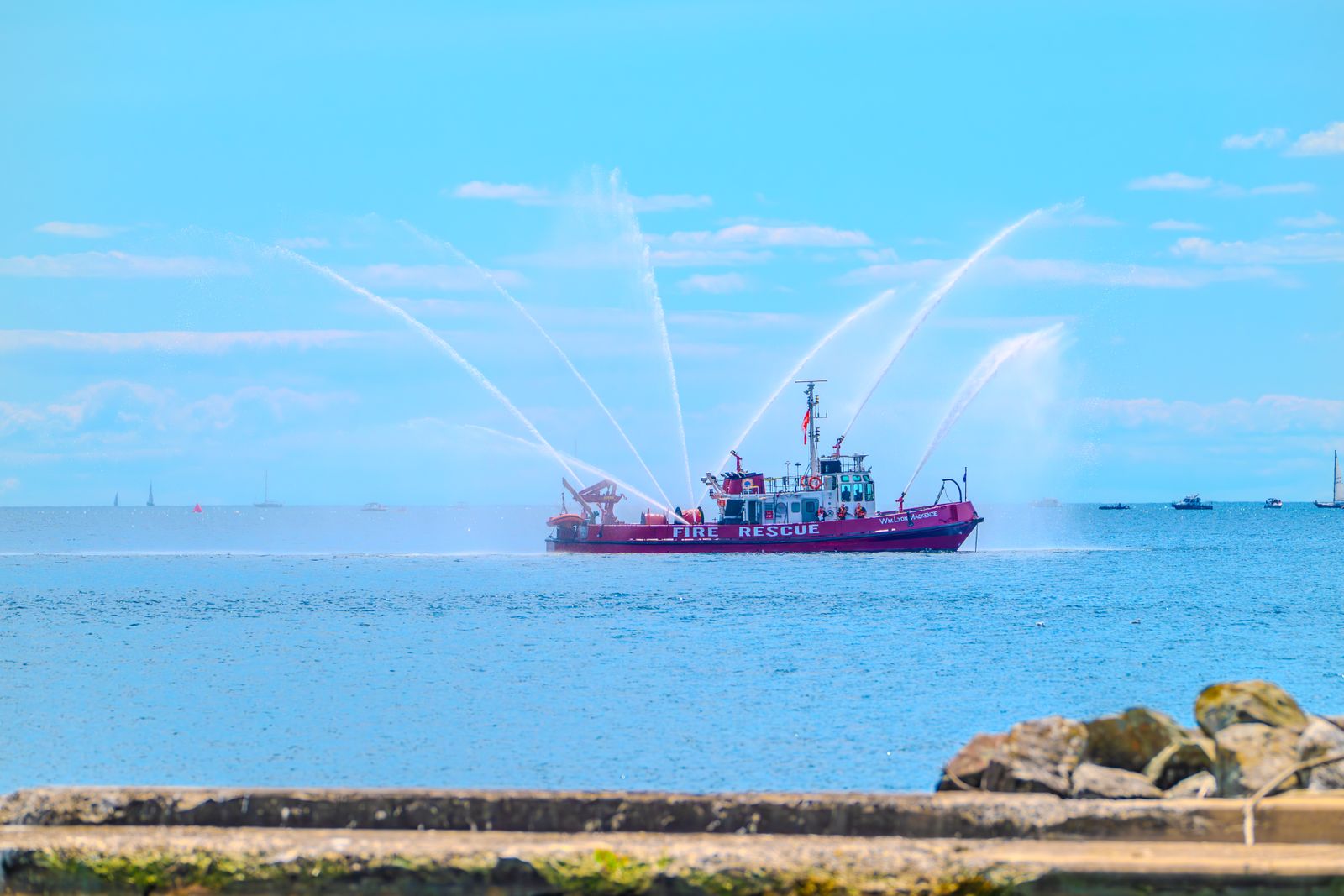
Do Drencher Systems Stop an EV Deck Fire?
Fixed water drencher and mist systems can't extinguish a sealed battery pack — but full-scale tests show a correctly run drencher contains an EV deck fire.

Does an EV Fire Burn Bigger Than a Petrol Car?
Not at its peak: full-scale tests put EV and petrol car fires in the same 4–7 MW band. A battery fire grows slower, burns longer and can reignite.