
Britannia Seaways: The Lashings That Let Go

In a 2013 North Sea storm a tank container broke loose on Britannia Seaways, struck sparks off the deck and lit petrol leaking from jerrycans.
On 16 November 2013, a tank container worked loose on the weather deck of Britannia Seaways in a storm off western Norway. It slid into a flatrack of fuel jerrycans and split them. When the ship rolled 20–30° in a turn, the sliding steel struck sparks off the deck and lit the leaking petrol. Flames rose up to 30 m. The crew, joined by soldiers who were on board as passengers, contained the fire. No one was hurt.
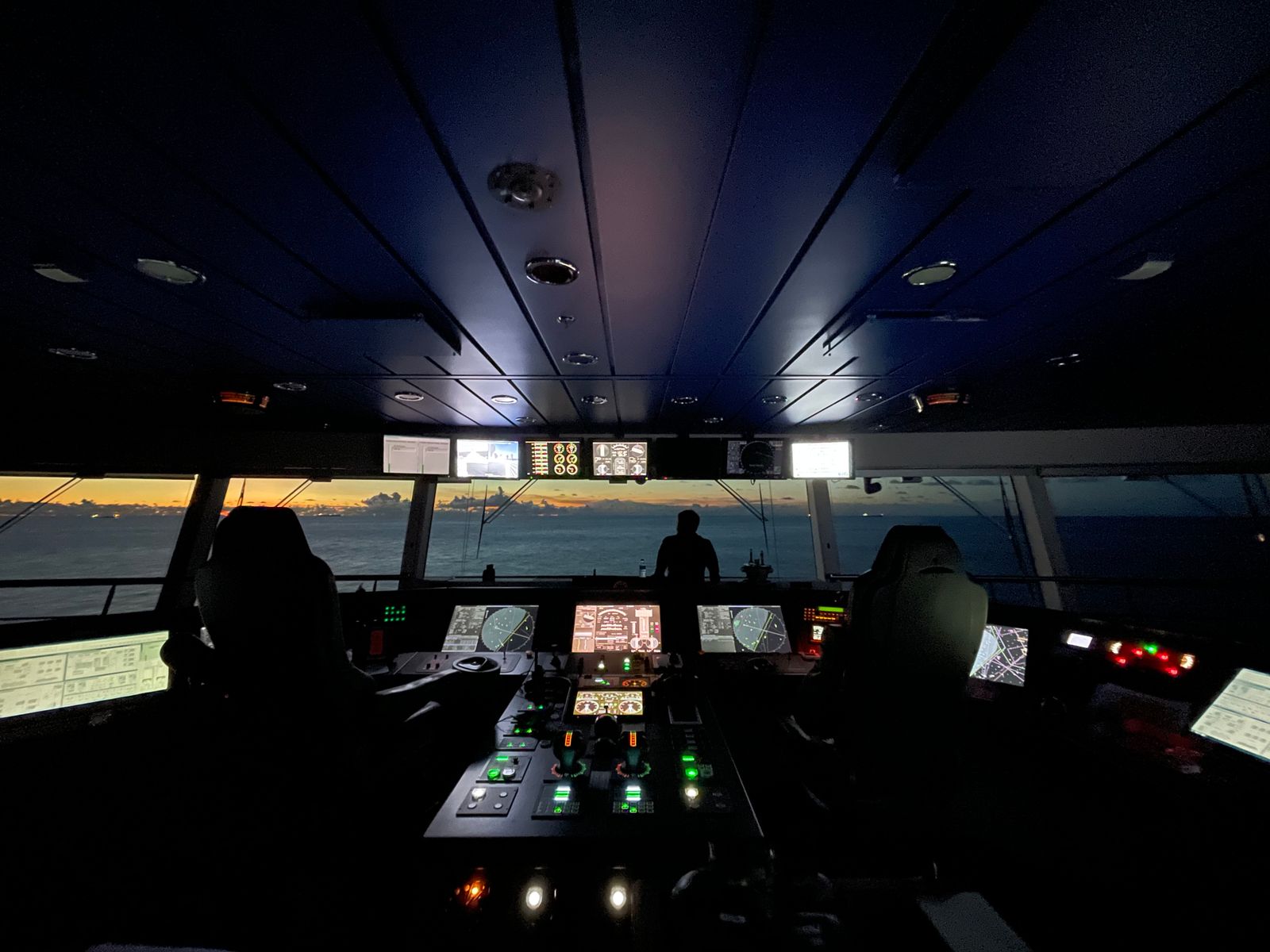
The Danish Maritime Accident Investigation Board (DMAIB) published its report in July 2014. Its officers watched the ignition happen from the bridge. That makes it a clear case of a fire where detection was not the problem. Cargo securing was the problem, and so, according to the board, was the fire alarm system, once the fire had started.
What happened
The ship took two days to get into trouble and about 13 hours to get out of it. Britannia Seaways, a 197.8 m, 24,196 GT ro-ro cargo ship built by Fincantieri in 2000, left Sørreisa in northern Norway for Bergen on a military exercise. She carried 20 crew and 12 army personnel as passengers. On the forward weather deck, stowed in a single layer, were 23 military vehicles, six 20 ft tank containers, 11 flatracks carrying other containers, and nine flatracks of 20-litre jerrycans.
- 14 Nov, 18:10. Departure from Sørreisa. Gale and storm forecast. The master raises the lashing on each weather-deck vehicle from three to at least four.
- 15 Nov, morning. Crew and soldiers re-inspect the cargo and add lashings. At about 10:00 the weather turns and the master bans all access to the weather deck.
- 16 Nov, ~09:00. From the bridge, a tank container next to a jerrycan flatrack is seen to have shifted about one foot. The master judges it unsafe to send crew forward.
- 16 Nov, 16:00. In the Off Runde traffic separation scheme, 6–8 m waves on the beam roll the ship 20–30°. Three tank containers start sliding 30–40 cm from side to side.
- 16:30. The chief engineer reports a smell of fuel. It is assumed that the seas washing over the bow are diluting it.
- Just before 19:00. Sparks or flames are seen at two lorries, one feeding a reefer unit. Weather-deck reefer power is cut, and the forward sprinkler section is started to wash away any leaked fuel.
- 19:10. During a turn to port to keep clear of an oil field, the containers slide and strike sparks. The petrol ignites and jerrycans explode within seconds. Mayday.
- ~22:30. No visible flames. 23:08: a petrol-vapour explosion is found in an electrical store under the forecastle.
- 17 Nov, 08:00. Fire finally out. The ship arrives in Bergen at 15:20 with her machinery in manual control.
How did a loose lashing become an ignition source?
Two things went wrong together: the cargo moved, and the cargo was fuel. About 630 jerrycans held some 9,500 L of petrol (UN 1203, flash point −43 °C). About 1,350 more held some 20,000 L of aviation fuel (UN 1863, flash point 38 °C). Each flatrack carried 70 jerrycans of petrol and 150 of jet fuel, secured with web-lashing straps. Once the first tank container slackened, each roll swung it into the next flatrack. It knocked jerrycans loose, damaged them and left them leaking onto a wet steel deck.
The board recorded several possible ignition sources: electrical sparks from vehicle and tank-container batteries, the damaged reefer feed, and friction. It concluded the petrol was lit by friction, observed as powerful sparks from tank containers sliding steel on steel. Once the fire started, it made the cargo shift worse. Heat burned or melted the web lashings on every other unit on the forward weather deck. Those units then slid as well, split more fuel containers and fed the fire.
Why couldn't the crew re-secure the cargo?
Because the deck was too dangerous to stand on, and the manual gave them nothing to work from. Once the ship was rolling 20–30° in 6–8 m seas, sending crew forward to tension lashings would have risked injury. So a shift spotted at 09:00 could only be watched for ten hours. The board was blunt about the cargo securing manual. It said the manual was of little or no use, written for compliance and not for crews. It relied on terms like 'good seamanship' and 'appropriate', and on force calculations a crew could not check shortly before sailing. DFDS had tried to write a more practical manual. Such a manual proved almost impossible to get approved unless it followed the IMO model guidelines (MSC/Circ.745 as amended). The army personnel who did the lashing had no maritime experience.
Why did the master refuse the helicopter evacuation?
Because the course that made the evacuation possible would have turned the fire on the ship. A rescue helicopter arrived at 20:25. JRCC Stavanger asked for the 12 passengers to be taken off. The helicopter needed the ship at about 2 knots, or on a northerly heading. At 2 knots she lost steerage and began rolling again. A northerly course would have driven the wind-blown flames aft onto the firefighters and the superstructure. The master kept the ship heading south-east, so the flames, heat and smoke blew over the port side and away from the ship. The JRCC accepted his decision. The soldiers stayed, and volunteers later took hoses alongside the exhausted crew, one soldier and one crew member per hose. The board credits this, and the master's direct view of the fire from the bridge, for the outcome.
What did the fire alarm system add?
According to the board, mostly noise. Countless fire alarms sounded on the bridge throughout the event, and there was no way to silence the sounders. For a period, one crew member did nothing but acknowledge fire alarms to stop the noise. The board concluded that the fire alarm system 'proved to provide little or no overview' and became a burden on the officers rather than an aid. The worst knock-on came from below deck. A flatrack sliding from side to side damaged a ventilation duct, which let petrol and seawater into an electrical store. When the rising water shorted a switchboard, the petrol vapour exploded. The blast blew out two watertight doors and took down the integrated machinery control and alarm system. With it went remote control of the bilge valves. About 40 cm of water collected in the lower hold, and the ship took a 2° list. The sprinklers and the firefighting vessel's monitors were stopped at 03:28 to limit free-surface water. After the flames were out, thermal imaging from the helicopters found hot spots in the containers. Shore firefighters' piercing spears did not fit the ship's couplings, so they cut into the containers with angle grinders.
What does it mean for ro-ro decks now?
This case cuts across the usual battery-fire story. Nothing on this deck was an EV. The ignition was mechanical, the fuel was packaged liquid, and the crew saw it start. The lessons that carry over are about what turns a small event into a large one. Cargo that can shift in a seaway will eventually be the cause, whatever powers it. Lashings that fail in heat release the rest of the stow once a fire starts. And an alarm system that floods the bridge with alerts gives the crew no sense of where the fire is. The officers here ran the fire well because they could see all of it from the wheelhouse. On an enclosed vehicle deck nobody has that view. There the alarm panel is the only view the bridge has, so the location an alarm gives matters as much as its timing.
How RoRoSAFE helps
No detection system would have changed how this fire started. It began on an open weather deck, in fuel, with officers watching, and the cause was cargo securing in a storm. RoRoSAFE is built for the enclosed decks where nobody has that view: a thermal and battery-vent gas cell under each parked vehicle, with tiered bridge and shore alerts that name the deck and bay. It complements, never replaces, the ship's SOLAS detection and suppression.
Pilot: one deck · installed alongside the berth · no drydock · 6 months of dashboard access
Sources
- 1. Danish Maritime Accident Investigation Board (DMAIB) — Marine Accident Report, 'BRITANNIA SEAWAYS — Fire on 16 November 2013', case 2013024446, issued 25 July 2014: ship and voyage particulars, weather (westerly storm 25 m/s, 10 m waves), cargo inventory, timeline, firefighting, electrical-store explosion, alarm findings, conclusions and preventive actions.
- 2. DMAIB report page, 'BRITANNIA SEAWAYS — Fire on 13 November 2013' (the page title carries an earlier date; the report itself gives 16 November 2013 as the date of the fire).
- 3. IMO — MSC/Circ.745, Guidelines for the preparation of the Cargo Securing Manual, as amended by MSC/Circ.812, MSC/Circ.1026 and MSC/Circ.1355 (the model the ship's manual followed).
- 4. IMO — International Maritime Dangerous Goods (IMDG) Code: UN 1203 (motor spirit/petrol) and UN 1863 (aviation fuel), Class 3 flammable liquids; flash points as given in the DMAIB report.
Questions, answered
What caused the Britannia Seaways fire?+
Cargo shifting in a storm. A tank container on the forward weather deck worked loose, slid into a flatrack of fuel jerrycans and split them. When the ship rolled 20–30° in a turn on 16 November 2013, sliding steel containers struck sparks off the deck and lit the leaking petrol. The DMAIB found this friction ignition more likely than the electrical sparks also seen on deck.
How much fuel was on Britannia Seaways' weather deck?+
About 84,500 litres. Roughly 630 jerrycans held 9,500 L of petrol, about 1,350 jerrycans held 20,000 L of aviation fuel, and tank containers plus a tank lorry held about 55,000 L of jet fuel. The containers were about three-quarters full. Military vehicles, flatracks of other containers and dangerous goods shared the same forward weather deck.
Why were the soldiers on board not evacuated by helicopter?+
Because the helicopter needed the ship at about 2 knots or on a northerly heading. At 2 knots she lost steerage and rolled. Heading north would have blown the flames aft onto the firefighters and the superstructure. The master kept a south-easterly course so smoke and flames blew over the port side, the JRCC accepted, and the soldiers later helped fight the fire.
What did the DMAIB say about the fire alarm system?+
That it gave little or no overview of the emergency. Countless fire alarms sounded on the bridge, the sounders could not be silenced, and one crew member spent a period only acknowledging alarms to stop the noise. The board found the system became a burden on the officers rather than an aid, and noted it had raised the same problem in other investigations.
Continue the thread

Lashing the Cargo Isn't Protecting It
Lashing stops vehicles moving; it does nothing about ignition. With a 2026 PSC campaign on cargo securing, budget and drill the two separately.

Do Dangerous Goods Make a Ro-Ro Fire Worse?
They can. Declared dangerous goods sail segregated under the IMDG Code; the bigger risk is the undeclared trailer parked next to everything else.
How Many Alarms Can a Bridge Team Absorb?
EEMUA 191 caps steady state at one alarm per ten minutes. Marine sets no equivalent rate target, and 2026 multiplies the addressable points.

Corona Seaways: The Key Left in the Ignition
In 2013 a used truck's live starter cable set Corona Seaways' deck alight. Unlocked louvres leaked CO₂, and the first release gave 9 of 19.8 tonnes.

Sorrento: The Reefer Fire the Wind Fed
In 2015 a reefer trailer fire on the ro-pax Sorrento, fed by wind through open sides, outran detection and drenchers. All 156 got off; the ship was lost.
Golden Ray — Anatomy of a Stability Capsize
The Golden Ray capsized 40 minutes out of Brunswick in 2019 — a ballast-entry error, a $62.5M hull, and an $842M-plus wreck removal.