
Should Ferries Still Have Open Ro-Ro Decks?

The fire record says no: all four total losses in DNV GL's review had open decks. But a ban failed EMSA's cost test, and SOLAS 2026 still allows them.
The fire record says no, the cost analysis says not always, and IMO has kept them. All four total losses in DNV GL's review of 35 ro-ro deck fires from 2005 to 2016 had open ro-ro spaces, and Italian investigators and the EU both pushed for a ban on new passenger ships. SOLAS amendments in force since January 2026 regulate the openings instead.
What makes an open deck different?
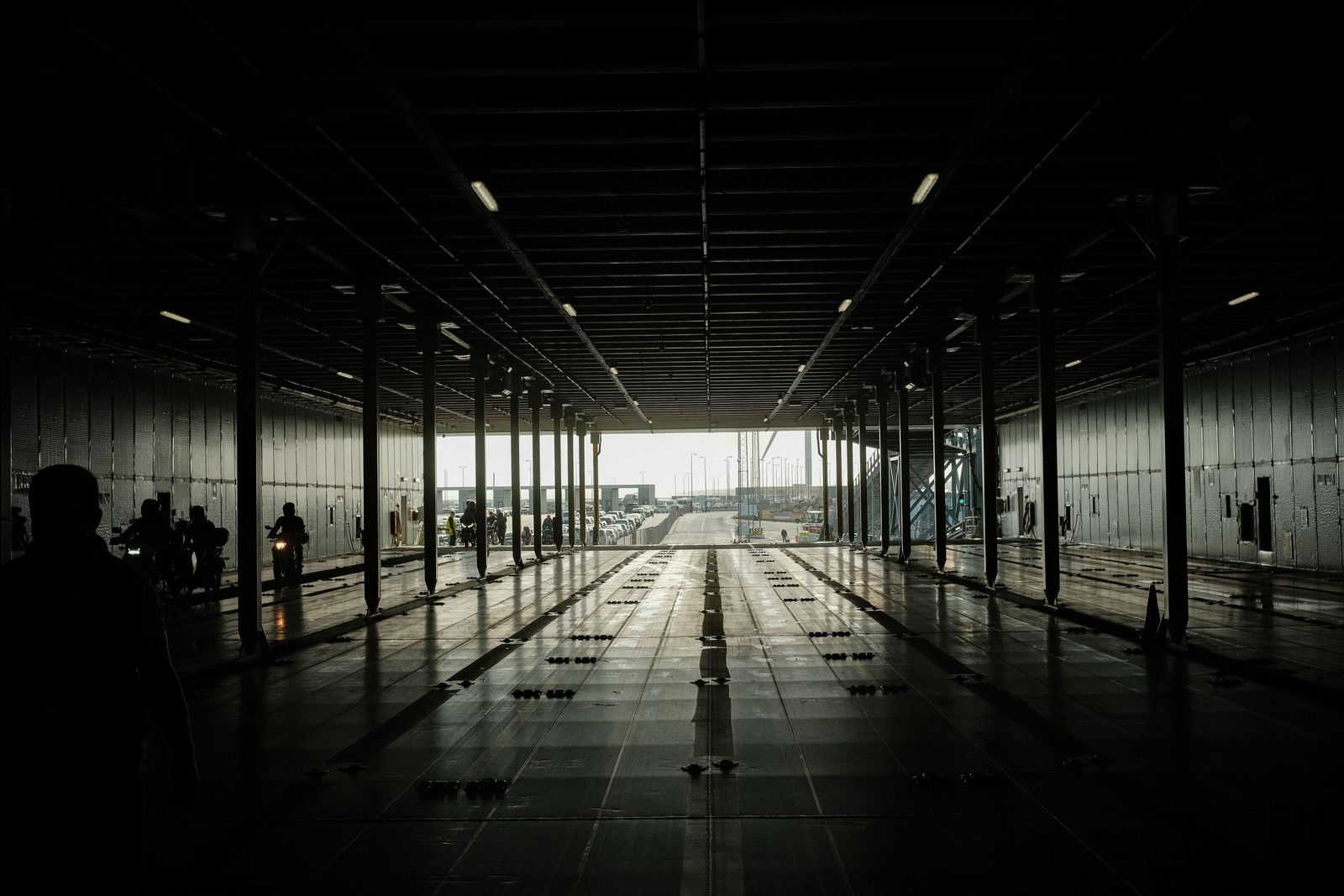
It cannot be starved of air. SOLAS treats a ro-ro space as open when permanent openings make up at least 10% of the area of its sides, and EMSA's FIRESAFE study notes these spaces were developed to give more deck for cargo that needs heavy ventilation, such as dangerous goods and live animals.
FIRESAFE's simulations show what that costs in a fire. On a closed deck of 140 m by 25 m, a fire reached about 30 to 35 MW and then died of oxygen starvation if the ventilation was shut straight away, and about 45 MW if it was shut after 30 minutes. On the same deck with open sides, natural ventilation would not limit the fire before it reached dimensions that threaten the whole ship.
Fighting it is harder too. DNV GL describes a well-ventilated fire under a tight steel deck that reflects heat and collects fire gases. Crosswinds can disturb the drencher, smoke detectors may be unreliable in parts of the space, and IMO's interim guidelines say they should be supplemented with flame or heat detectors. Flames and smoke leaving the side openings can reach lifeboats, escape routes and the air intakes for the engine room and emergency generator.
Why did investigators want a ban?
Because the worst fires kept happening on these decks. In DNV GL's April 2016 paper, Norman Atlantic, Sorrento, Lisco Gloria and the cargo ro-ro UND Adriyatik were all open-space designs and all total losses, while the two ro-pax fires it classed as major had closed spaces. DNV GL added an important caveat: it assumed those four outcomes would have been far better if the fixed system had worked properly, so the deck design was not the only cause.
In September 2015 the Italian investigators presented their possible safety recommendations from Norman Atlantic, and the first read that open ro-ro cargo spaces on new passenger ships should not be permitted. The EU took up the point. A draft submission for IMO's SSE 7 meeting, agreed in substance by the Council's shipping working party in November 2019, called a ban on side and end openings arguably the most important measure for new ships in terms of risk reduction, and said it should be considered for mandatory implementation. Its draft SOLAS text offered two bracketed options, one of them that permanent openings on passenger ships 'shall not be permitted'.
Why did the ban not happen?
Mainly because of the cargo it would cost. EMSA's FIRESAFE II study, a Formal Safety Assessment published in December 2018, tested each option against a limit of €7M per fatality averted. Banning side openings on a new standard ro-pax came out at about €12.8M, a GCAF factor of 1.83, with only a 3% confidence of falling under the limit. On an existing ship the figure was about €19.4M. Rolling shutters, which close only when there is a fire, also failed, at factors of 2.01 for new ships and 5.14 for existing ones.
The authors flagged a weakness in their own number. The cost assumed the ship kept its layout and lost cargo space every year for 40 years, rather than being redesigned around closed decks, and it came from a single operator's estimates. With a factor below 2, they recommended investigating the ban further, using a new layout or added safety systems so that no cargo was lost. The picture also changed with ship type: closing side and end openings was cost-effective on a new passenger-focused ferry (factor 0.39), which has few openings to begin with.
The EU's own draft conceded existing ships, saying the costs were too high to justify mandatory closure. For new ships, the outcome reported from SSE 9 in March 2023 was that side openings would continue to be allowed in new designs, provided the superstructure above carries A-60 protection.
What does SOLAS require now?
It protects what sits near the openings, rather than removing them. Under MSC.550(108), on passenger ships built on or after 1 January 2026, openings in the sides, ends or deckhead must not endanger survival craft, embarkation and assembly stations, or accommodation, control stations and occupied service spaces above the ro-ro space.
- Openings are not permitted on decks directly below those areas, or within a safety distance of at least 6.0 m measured horizontally.
- That does not apply to openings with closing arrangements such as ramps and doors.
- Openings are accepted below accommodation, control stations and service spaces if the ship's side is A-60 across an area 6.0 m forward and aft of the opening and at least two deck levels above it.
- Air intakes for propulsion, power generation and emergency power must be placed to minimise contamination by a ro-ro space fire.
The 6 m figure comes from FIRESAFE II's fire modelling, which used radiant heat limits of 5.0 kW/m² for life-saving appliances and 2.5 kW/m² for people. Note what this rule does and does not do: it buys evacuation time and keeps lifeboats usable. It does nothing to the fire's air supply. Ships built before 2026 stay under their previous requirements, with IMO's interim guidelines recommending the same 6 m distance as guidance.
So what should owners do?
Treat the ban as unfinished business on new designs, and buy the cheap measures on existing ships. FIRESAFE II's own results point the way.
- Newbuildings: price a closed-deck layout at concept stage, when the cargo penalty can be designed out. That is the case the study said it did not model, and DNV GL advises checking lifeboats, intakes and every other safety system if an open design is chosen anyway.
- Existing ships: close the few openings next to lifeboats. Closing only four openings on the generic standard ro-pax came out at a GCAF factor of 0.07, against 2.77 for closing every side opening.
- Weather decks: fixed fire monitors were among the study's best results, at factors of 0.05 to 0.13 on a standard ro-pax.
- Procedures: efficient drencher activation routines scored close to zero on cost. DNV GL warned that the window for action on an open deck may be under 10 to 15 minutes.
One limit applies to all of this. The FIRESAFE work dates from 2016 to 2018 and was not built around battery cargo, so its numbers are a starting point, not a final answer.
How RoRoSAFE helps
On an open deck, wind and fresh air shorten the time a crew has, and smoke may not reach a deckhead detector the way it would on a closed deck. RoRoSAFE puts infrared thermal and battery-vent gas sensing under each parked vehicle, alerting bridge and shore with the deck and bay before visible smoke. It complements SOLAS detection and drenchers, installs alongside the berth without drydock, and holds no class type approval yet.
Pilot: one deck · installed alongside the berth · no drydock · 6 months of dashboard access
Sources
- 1. DNV GL — 'Fires on Ro-Ro Decks', paper no. 2016-P012, April 2016: 35 fires from 2005 to 2016; all four total losses of the open ro-ro space type; open-space fire behaviour, detection limits and shorter response window; caveat on fixed-system performance; advice on open designs (read in full).
- 2. EMSA — FIRESAFE study, EMSA/OP/01/2016, by SP, Bureau Veritas and Stena Rederi: origin of open ro-ro spaces, ventilation simulations (sections 2.7.2 and 4.2.2) and the rolling shutters option (relevant sections read).
- 3. EMSA — FIRESAFE II, Combined Assessment Final Report, version 1.1, December 2018, by Bureau Veritas, RISE and Stena: €7M criterion, Tables 12, 13 and 17 (GCAF, costs and confidence for ban or closure of openings, shutters, fire monitors and closing openings near life-saving appliances), section 11 recommendations (relevant sections read).
- 4. Italian Ministry of Infrastructure and Transport, DIGIFEMA — 'Fires on board ro-ro pax ferries: Lessons learned', Lisbon, 25 September 2015: possible safety recommendations after Norman Atlantic, including no open ro-ro cargo spaces on new passenger ships (read in full).
- 5. Council of the European Union — document 14319/19, 22 November 2019: draft submission to IMO SSE 7 on SOLAS chapter II-2, sent for endorsement; paragraphs 6 to 9 on ban or closure of openings; radiant heat criteria and safe distances; draft text for regulation 20.3.1.5 (read in full).
- 6. Shippax — 'IMO Sub-Committee on Ship Systems and Equipment (SSE 9) outcome', 21 March 2023: side openings continue to be allowed in new designs, given A-60 protection above.
- 7. IMO — Resolution MSC.550(108), in force 1 January 2026: SOLAS II-2/20.5, structural fire protection and arrangement of openings (read in full).
- 8. IMO — MSC.1/Circ.1615 (2019), interim guidelines: supplementing smoke detection in open ro-ro spaces; 6 m distances from side openings (read in full; copy published by the Turkish Maritime Administration).
Questions, answered
What is an open ro-ro space?+
A ro-ro space open at one or both ends, with permanent openings totalling at least 10% of the area of its sides. Unlike a closed deck, it cannot be sealed to starve a fire of oxygen. Unlike a weather deck, it typically has a steel deck above, which DNV GL says reflects heat and collects fire gases.
Are open ro-ro decks banned on new ferries?+
No. Italian investigators and the EU pushed for a ban on new passenger ships, but SOLAS as amended by MSC.550(108) still allows openings. From 1 January 2026, new passenger ships must keep openings at least 6.0 m from survival craft, muster stations and similar areas, or fit closing arrangements, or give the ship's side A-60 protection below accommodation.
Why was the open-deck ban judged not cost-effective?+
EMSA's FIRESAFE II study put the cost of banning side openings on a new standard ro-pax at about €12.8M per fatality averted, against a €7M limit. The cost was mainly lost cargo space over 40 years, assuming no redesign. The authors said that assumption was very influential and recommended studying a layout that loses no cargo.
What can an existing ferry with open decks do?+
Closing every side opening was too expensive in FIRESAFE II, but targeted steps did well. Closing only the openings next to lifeboats scored a cost factor of 0.07 on the generic ship, and fire monitors on weather decks and drencher activation routines also passed easily. IMO's interim guidelines recommend flame or heat detection alongside smoke detectors in open spaces.
Continue the thread

FIRESAFE II: Open-Deck Detection Lessons
EMSA's 2018 study full-scale tested two detection technologies, not five, and named ventilation as what both delays and displaces an alarm.

Sorrento: The Reefer Fire the Wind Fed
In 2015 a reefer trailer fire on the ro-pax Sorrento, fed by wind through open sides, outran detection and drenchers. All 156 got off; the ship was lost.
Norman Atlantic: Fighting the Wrong Deck
The 2014 Norman Atlantic fire killed around 31 people. The hold held 43 reefer trucks and 40 outlets, and the crew drenched the wrong deck.

Lisco Gloria: The Drencher That Gave No Water
The 2010 Lisco Gloria fire was detected within minutes and the drencher started — it delivered no water, and a 199 m DFDS ro-pax became a total loss.

What Does SOLAS II-2/20 Ask of a Car Carrier?
Almost all of the 2026 amendment is written for passenger ships. A cargo ship gets one detection paragraph; the car-carrier package is still in draft.

Can an A-60 Deck Hold a Car-Deck Fire?
Often it never gets the chance: decks between vehicle decks are usually bare steel, and EMSA found fire can climb one in about 10 minutes unchecked.