
How Long Must a CO₂-Flooded Space Stay Sealed?
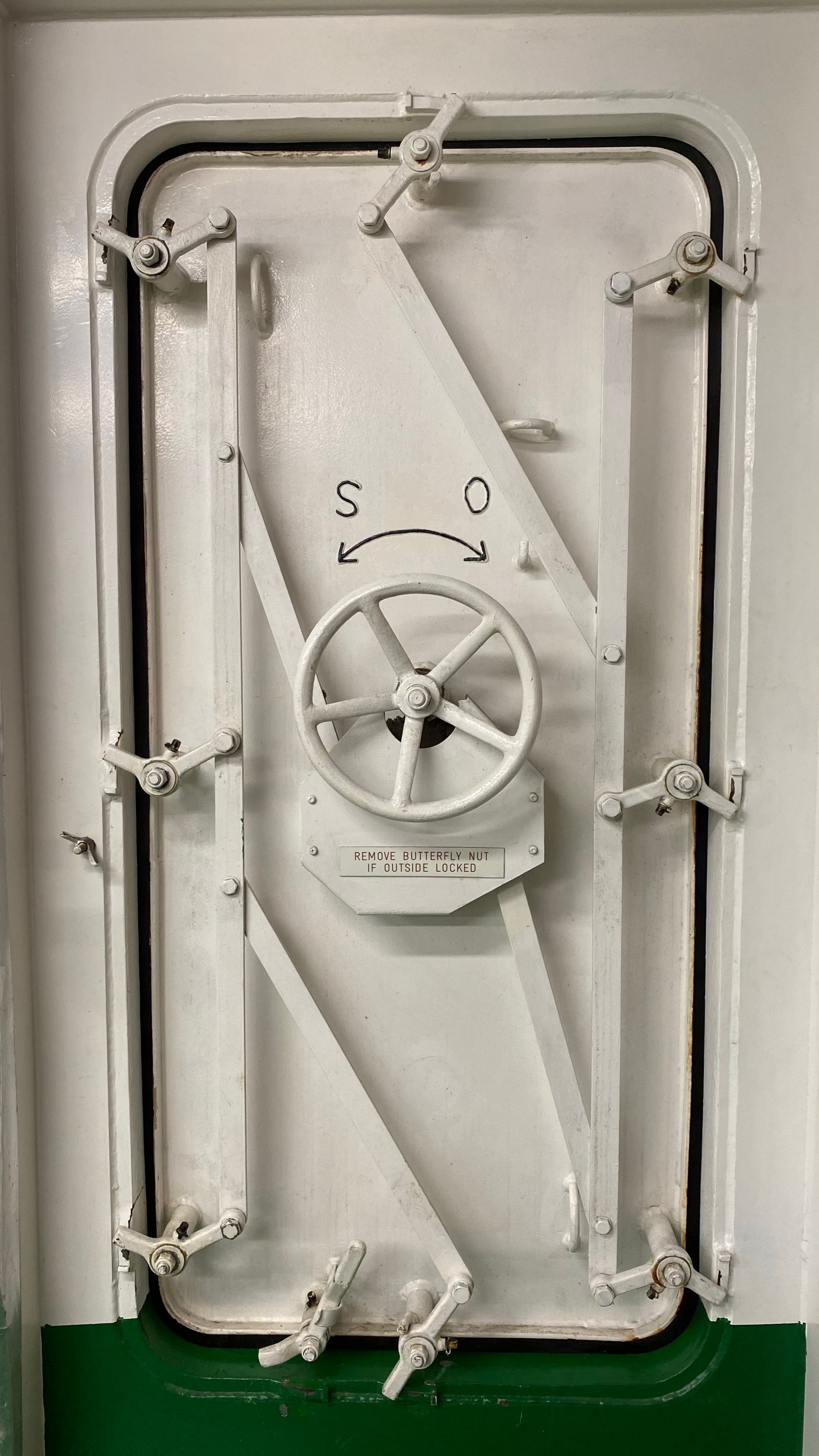
Until boundaries reach ambient — hours to days. The FSS Code sets no hold time, NFPA 12 sets 20 minutes, and re-entry at 3 hours has re-ignited fires.
Until the boundaries have cooled to ambient and stayed there — which on a machinery-space fire is measured in hours to days, not minutes. The FSS Code specifies how much CO2 to carry and how fast to discharge it, but sets no hold time at all. NFPA 12 sets a 20-minute floor for deep-seated fires. The casualty record shows that re-entering at three hours re-ignites the fire, and the Min Jiang Kou showed in September 2026 that a sealed, abandoned hull can flare 32 days on.
This matters because the hold time is the one variable in a CO2 release that the crew controls after the gas is gone, and most safety management systems either leave it undefined or state it as a clock time with no measurement behind it. Get it wrong in one direction and a contained fire becomes a re-ignition with the extinguishing agent already spent; get it wrong in the other and the ship sits dark and unassessed while heat migrates into adjacent cargo decks. Either error is a total-loss pathway on a PCTC.
What the FSS Code requires — and what it does not
The FSS Code is a discharge specification, not a hold specification. Chapter 5 requires a machinery-space CO2 system to carry free gas equal to 40% of the gross volume of the largest protected space excluding the casing, or 35% including it, whichever is greater, and to discharge 85% of that gas within two minutes. For vehicle and ro-ro spaces that are not special category spaces the quantity is 45% of the gross volume of the largest space capable of being sealed, with two-thirds of it delivered within ten minutes. Those numbers govern knockdown: how fast the oxygen fraction is pushed below what a hydrocarbon flame needs. Nothing in Chapter 5 states how long the concentration must then be held, what boundary temperature justifies opening the space, or who decides.
The omission is deliberate in the sense that the code treats CO2 as a flame-suppression agent whose job ends when the flames go out, and leaves the remainder to seamanship. In practice that leaves the hold time to the vessel's SMS, where it usually appears — if at all — as an unqualified instruction to wait a number of hours, or to wait until arrival in port.
What NFPA 12 says about hold time
NFPA 12 — the landside standard most marine CO2 systems are designed against — makes the hold time explicit and ties it to the fire type. For surface fires (flammable liquids, the usual engine-room scenario at ignition) it requires a minimum 34% design concentration. For deep-seated fires — those that have penetrated into the depth of a solid combustible, such as cable insulation, lagging or accumulated oily deposits — it requires 50% or higher, rising to 65–75% for specific hazards, and a mandatory holding period: the inerting concentration must be maintained for a minimum of 20 minutes to permit cooling and complete extinguishment, with 30 minutes or longer for record storage and similar hazards.
Two things follow. First, 20 minutes is a floor set for an enclosure that is leak-tight enough to hold concentration, tested by a door-fan integrity check, with a known fuel load. A machinery space on a ship after a fire is none of those things. Second, an engine-room fire that has burned for any length of time before release is no longer a pure surface fire; it has ignited lagging, cable trays and deposits, and the deep-seated case applies. The 20-minute figure is therefore the shortest time anyone should consider, and it assumes the concentration was actually held — something a ship almost never measures.
Why the hold time is really a temperature problem
Because CO2 does not remove heat, only oxygen, and the re-ignition risk is set by whichever of the two returns first. A sealed machinery space after release contains a large mass of steel, machinery and insulation at temperatures well above the auto-ignition point of the fuels around it — diesel auto-ignites at roughly 210–260 °C, lubricating oils somewhat higher — and that stored energy leaves only by conduction through the boundaries. The boundaries are designed to slow exactly that: an A-60 division must keep the unexposed-side average temperature rise below 140 °C, and any single point below 180 °C, for 60 minutes under the standard fire test. A bulkhead that reads 60 °C from the cargo-deck side is telling you very little about the space behind it.
Meanwhile the concentration is decaying. CO2 leaks through the same routes fire propagates along: cable penetrations, ventilation flaps that did not seat, door seals distorted by heat. The TSB's Tecumseh investigation found multiple unsealed deck cable penetrations between the engine room and the engine control room — routes for fire in one direction and for gas in the other. Every hour the space sits sealed, the oxygen fraction is drifting back up while the steel cools slowly toward the point where it no longer matters. The hold time is over when the second curve wins, and the only way to know is to measure the boundary. The MAIB put the criterion in one sentence in its Safety Digest 2/2022: the engine compartment 'needed to remain sealed until the deckheads achieved an ambient external temperature'.
What the casualty record says about re-entry
It says that three hours is too early, and that opening the space is what re-ignites it. On the bulk carrier Tecumseh (TSB M19C0403) a fuel-hose failure ignited the port main engine at 1406 on 15 December 2019 in the Detroit River; the chief engineer released CO2 immediately. About two hours later smoke escaping the closed flaps increased.
About three hours after release two crew re-entered from the steering-gear flat with a charged hose; the TSB found that re-entry 'allowed fresh air to enter the engine room, which most likely re-ignited the fire', and shore firefighters were still working the following day. On a UK high-speed ferry (MAIB Safety Digest 2/2022) the crew sealed the compartment and released CO2 correctly; a shore fire officer then opened the starboard engine access hatch without consulting them, 'causing rapid reignition of the fire with significant flames and smoke', and the compartment had to be flooded with water. The counter-example is the vehicle carrier Courage (NTSB MAB-17/24), where fire teams boundary-cooled, monitored space temperatures and 'did not attempt to re-access the space, which could have caused a reflash'.
The Min Jiang Kou adds the far end of the range. Its CO2 release on 6 August 2026 held the engine-room fire for roughly ten hours before increasing smoke forced the crew off — consistent with either a deep-seated fire beyond the gas's reach or a concentration that leaked away — and, with nobody aboard to cool or monitor the boundaries, the hull recorded a deck temperature rise on 7 September, 32 days later.
What a defensible re-entry decision looks like
A measured criterion, not a clock time. The elements are few and none of them is exotic:
- Boundary temperatures at several points — deckhead above the space, the casing where it passes through the vehicle decks, the adjacent bulkheads — logged from the moment of release and required to fall and converge on ambient before entry is considered. A single reading is not a trend; the MAIB's ambient-deckhead criterion is the standard to write into the SMS.
- No increasing smoke at flaps, doors or casing seals. Tecumseh's crew saw smoke increase two hours in; that is the concentration failing, and it is an argument for more cooling, not for a look inside.
- Fuel and lube isolation confirmed and left in place. Re-entry admits oxygen; the only thing that should be missing is fuel.
- Entry by a breathing-apparatus team through one opening, with a charged hose, briefed to reseal immediately on any flame — and no ventilation until the space is confirmed out and cool. Ventilation is the last step, not the first.
- One decision-maker, and shore responders inside the loop. Two of the three re-ignitions above began with someone opening a hatch who did not own the decision.
On a PCTC the boundary thermometry already exists if the vehicle decks carry a detection layer: the engine-room casing runs through the cargo decks, and the thermal channels on those decks are the instruments closest to the sealed space. Trending them for the hours after release turns 'wait until cool' from a guess into a number on the bridge — and, if the ship has to be abandoned, the last data it transmits ashore. That is the arrangement RoRoSAFE has run through lay-up and salvage-tug data-feed trials; it depends on the layer keeping its own power once the ship is dark.
What this means for superintendents, class and P&I
Rewrite the hold-time clause. An SMS that says 'do not open the engine room for 24 hours' is better than one that says nothing, but it is still unmeasured: it can be too short on a large fire and it invites a shore responder to overrule it. Replace it with the MAIB criterion — boundaries at ambient and trending flat — name who confirms it, and put the thermometry in the fire plan so the measurement exists on the day. For class and flag, the gap between the FSS Code's two-minute discharge figure and its silence on hold time is a plausible item for a future unified interpretation; until then the requirement lives in the SMS. For P&I loss prevention, the Tecumseh and ferry cases are the drill scenarios that matter: the fire was out, and someone opened the door.
How RoRoSAFE helps
A defensible re-entry decision needs boundary and cargo temperatures, not just elapsed time. RoRoSAFE's per-vehicle thermal sensing keeps reporting temperature at each bay after the space is flooded, on the bridge and ashore. The superintendent can see when the deck is cooling and whether any vehicle is heating again, before anyone opens the space.
Pilot: one deck · installed alongside the berth · no drydock · 6 months of dashboard access
Sources
- IMO — International Code for Fire Safety Systems (FSS Code), Chapter 5, Fixed gas fire-extinguishing systems: CO2 quantities for machinery spaces (40% excl. casing / 35% incl., 85% discharged within 2 min) and for vehicle/ro-ro spaces (45%, two-thirds within 10 min); no hold-time provision. IMO MSC.1/Circ.1318/Rev.1 — maintenance and inspection of fixed CO2 systems.
- NFPA 12 — Standard on Carbon Dioxide Extinguishing Systems (2022): surface-fire minimum 34% design concentration; deep-seated 50% and higher; minimum 20-minute holding period for deep-seated hazards, 30 minutes for record storage.
- Transportation Safety Board of Canada — Marine Transportation Safety Investigation Report M19C0403, engine-room fire aboard bulk carrier Tecumseh, Detroit River, 15 December 2019: CO2 released immediately; smoke increased ~2 h later; re-entry ~3 h after release 'allowed fresh air to enter the engine room, which most likely re-ignited the fire'; unsealed deck cable penetrations propagated fire to the ECR switchboard.
- UK Marine Accident Investigation Branch — Safety Digest 2/2022, high-speed ferry engine compartment fire: hatch opened by a shore fire officer 'causing rapid reignition'; the compartment 'needed to remain sealed until the deckheads achieved an ambient external temperature' (via IMCA Safety Flash 29/22).
- NTSB Marine Accident Brief MAB-17/24 — Fire aboard Vehicle Carrier Courage: fire teams performed boundary cooling and monitored space temperatures and 'did not attempt to re-access the space, which could have caused a reflash'.
- SOLAS Ch. II-2 Reg. 3 / FTP Code — 'A' class divisions: A-60 insulated so the unexposed-side average temperature rise does not exceed 140 °C, nor 180 °C at any point, within 60 minutes of the standard fire test.
- US Coast Guard Southwest District via gCaptain; Riviera Maritime Media; WorldCargo News (Autoridad Marítima de Panamá) — Min Jiang Kou, August–September 2026: CO2 'initially contained' the engine-room fire at 1309 on 6 August; increased smoke at 2333; deck temperature rise recorded 7 September with the vessel unmanned and in blackout.
- Diesel and lubricating-oil auto-ignition temperatures — engineering reference values.
Questions, answered
Does the FSS Code specify how long to hold CO2 in an engine room?+
No. FSS Code Chapter 5 specifies the quantity of CO2 — 40% of the gross volume excluding the casing or 35% including it for machinery spaces, 45% for ro-ro spaces — and the discharge rate, 85% within two minutes for machinery spaces. It says nothing about holding time, boundary temperature or re-entry criteria. Those decisions fall to the vessel's safety management system and the master.
What hold time does NFPA 12 require for a CO2 system?+
For deep-seated fires — those that have penetrated solid combustibles such as cable insulation or lagging — NFPA 12 requires the inerting concentration to be maintained for a minimum of 20 minutes to allow cooling and complete extinguishment, longer for some hazards. That is a floor for a leak-tested landside enclosure; a ship's machinery space after a fire will usually need far longer.
What happens if you open a CO2-flooded engine room too early?+
The fire re-ignites. On the bulk carrier Tecumseh in 2019 the crew re-entered about three hours after release and the TSB found the fresh air 'most likely re-ignited the fire'; on a UK high-speed ferry a shore fire officer opened an engine hatch and caused 'rapid reignition'. In both cases the CO2 had already been spent, so the second fire had to be fought with water.
How do you know when a CO2-flooded space is safe to re-enter?+
When boundary temperatures — deckhead, casing and adjacent bulkheads — have fallen to ambient and are trending flat, no smoke is increasing at seals or flaps, and fuel remains isolated. The MAIB's criterion is that the compartment stays sealed until the deckheads reach ambient external temperature. Entry is then by a breathing-apparatus team with a charged hose, and ventilation is the last step, not the first.
Continue the thread

Can FSS CO₂ Extinguish a Li-Ion Fire?
A Li-ion cell in thermal runaway is self-oxidising. The FSS Code 45% CO2 concentration suppresses conventional fires but cannot extinguish the cell itself.

PCTC Drencher Zoning and Fixed-First
FSS Code Ch.7 sets a PCTC drencher at 5.0 L/min/m² — whether 'Fixed First' suppresses or floods the deck depends on how precisely detection zones it.

Can a Car-Carrier Fire Reignite a Month Later?
Yes. The Min Jiang Kou showed a deck temperature rise 32 days after CO2 contained its engine-room fire — heat that suppression never removed.
Courage: The Fire With a Named Cause
NTSB named it — arcing in a parked car's ABS module. $10m ship, $90m cargo, and none of the proven car-carrier causes was a traction battery.
Honor: Thirty-Seven Minutes to CO₂
The 2017 Honor fire is the fastest documented CO₂ release on a car carrier — alarm 0302, gas 0339. It emptied the ship's CO₂ and still cost $700,000.
What Does Min Jiang Kou Mean for LNG PCTCs?
Min Jiang Kou is the first serious fire on an LNG dual-fuel PCTC. The IGF Code's gas safeguards assume a crew and power, and she lost both for weeks.