
What Happens When a Car Carrier Is Scrapped?
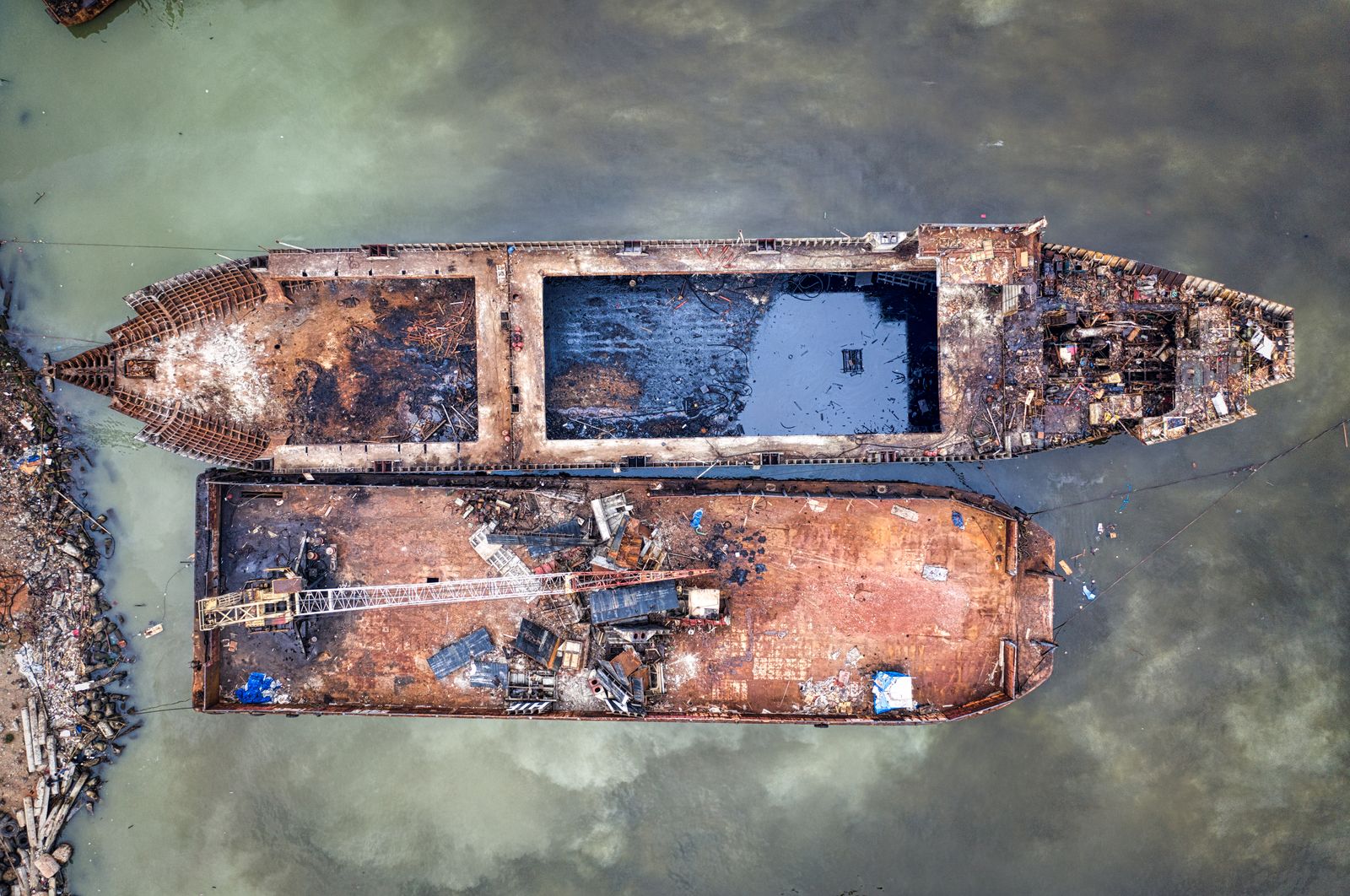
The Hong Kong Convention came into force in June 2025 — and it binds ships in service, not just at the yard. A retrofit changes the inventory.
The recycling rules start long before the yard. The Hong Kong Convention entered into force on 26 June 2025, and its central obligation applies to ships in service: every vessel of 500 gross tonnage and above on international voyages must carry and maintain an Inventory of Hazardous Materials. Maintain is the operative word. Fit new equipment to a car deck and the inventory changes.
What actually came into force
A documentation regime, not a demolition regime. The Hong Kong International Convention for the Safe and Environmentally Sound Recycling of Ships, 2009, requires ships of 500 GT and above trading internationally to hold an Inventory of Hazardous Materials identifying the hazardous materials in the ship's structure and equipment, with their location and approximate quantities. That is Part I, and it is a living document carried aboard.
Parts II and III only get completed when the ship is actually going for recycling — Part II covering operationally generated wastes, Part III covering ship's stores. The certificate timetable is what owners need in the calendar: existing ships obtain an International Certificate on Inventory of Hazardous Materials, or a Statement of Compliance, at the first renewal survey on or after 26 June 2025, with all internationally trading vessels of 500 GT and above required to carry the certificate by 26 June 2030 and surveys harmonised by that date.
The EU list is the stricter one, and it names PFOS
For anything EU-flagged or calling at EU ports, a second regime sits on top. Regulation (EU) No 1257/2013 has applied since 30 December 2013 to every EU and EEA-flagged ship and to non-EU ships calling at EU and EEA ports. Its hard edge is the destination: ships must be recycled only at facilities on the European List, established by Commission Implementing Decision (EU) 2016/2323. The 15th edition, adopted 27 February 2026, covers 41 facilities and added the first German yard.
The substance list differs too, and one entry should be familiar. The EU regulation requires recording PFOS and HBCDD where they are present in the ship's structure or fitted equipment — substances not in the Convention's original core list — and PFOS aboard is prohibited for EU-flagged vessels. PFOS reporting is mandatory for EU-flagged ships and not required for third-country ships.
A retrofit is an inventory event
This is the part that catches operators out, and it has nothing to do with scrapping. Part I of the inventory covers materials in the ship's structure and equipment, and it is maintained through the ship's life rather than compiled at the end of it. Anything added to the structure or to fitted equipment is capable of changing what that document should say.
Run the list of what a car carrier is having done to it right now. Heat detection added to vehicle spaces under the amended FSS Code. Video monitoring fitted to ro-ro and special category spaces. Drencher work. New cable runs, new enclosures, new fixed equipment with its own materials declaration. Each of those is a change to fitted equipment on a ship that is required to keep an accurate inventory.
The practical failure is mundane. Retrofit scopes get quoted for hardware, installation and commissioning. The inventory update is nobody's line item, and it does not announce itself — it surfaces at the next renewal survey, or later and more expensively when a buyer or a recycling yard asks for a document that no longer matches the ship. Ask for the materials declaration as part of the supply, and ask who is updating Part I, before the work starts rather than after.
What a car carrier brings to the yard
More fitted systems per tonne of steel than most segments. A vehicle carrier is largely enclosed deck: extensive lighting and ventilation, ramps and hydraulics, a large fixed fire-extinguishing installation, foam and its stocks, and on the newest hulls LNG fuel systems with ammonia-ready and methanol-ready arrangements built in for a conversion that may never happen. The 2026 detection and monitoring amendments add another layer of fitted electronics across every deck.
The timing is about to get awkward
The segment's recycling wave is forecast to arrive just as the regime tightens. Vehicle carrier newbuilding orders stand at around 26% of the current fleet, with Chinese yards accounting for close to 80% of the 276 PCTCs delivered or due between 2023 and 2028. Demand growth of roughly 5% a year against fleet growth of 8–9% is the arithmetic behind expectations that older tonnage starts going for recycling from 2026. Globally, recycling volumes already rose 65% year on year in 2025, reaching 7.9 million gross tonnes against 4.7 million in 2024.
For owners, that makes the inventory an asset-value question rather than a compliance chore. A ship whose Part I is complete and current can go to any yard its flag permits. A ship whose inventory has drifted out of date through a decade of undocumented retrofits has a narrower buyer set and a slower sale, and the gap is discovered at precisely the moment it is hardest to fix.
For underwriters, the useful question at renewal is not whether an operator intends to recycle responsibly. It is whether the ship's hazardous materials inventory has been maintained alongside the safety retrofits the same operator is proudly reporting — because those two facts are produced by different teams, and only one of them is usually being audited.
How RoRoSAFE helps
Any retrofit changes the ship's hazardous-materials inventory, so it should be documented from the start. RoRoSAFE installs without drilling or hull modification, so the retrofit adds equipment to the ship without changing its structure, which makes it a simple entry to record. What it adds in service is per-vehicle thermal and battery-vent gas detection that alerts before visible smoke, for the rest of the ship's trading life.
Pilot: one deck · installed alongside the berth · no drydock · 6 months of dashboard access
Sources
- 1. IMO — Hong Kong International Convention for the Safe and Environmentally Sound Recycling of Ships, 2009: entered into force 26 June 2025; ships of 500 gross tonnage and above engaged in international voyages required to carry and maintain an Inventory of Hazardous Materials identifying hazardous materials in the ship's structure and equipment with location and approximate quantities; Part I maintained in service, Parts II (operationally generated wastes) and III (ship's stores) completed when the ship is to be recycled; existing ships to obtain an International Certificate on Inventory of Hazardous Materials or Statement of Compliance at the first renewal survey on or after 26 June 2025, with all internationally trading vessels of 500 GT and above to carry the certificate by 26 June 2030 and surveys harmonised by that date.
- 2. Regulation (EU) No 1257/2013 on ship recycling: in force since 30 December 2013; applies to ships flying an EU or EEA flag and to non-EU ships calling at EU or EEA ports; ships destined for recycling must go to facilities on the European List published under Article 16, established by Commission Implementing Decision (EU) 2016/2323 of 19 December 2016; the Regulation additionally requires recording PFOS and HBCDD where present in the ship's structure or fitted equipment, substances not in the Hong Kong Convention's original core list; PFOS aboard prohibited for EU-flagged vessels, with PFOS reporting mandatory for EU-flagged ships and not required for third-country ships.
- 3. European List of ship recycling facilities — 15th edition, reported as adopted 27 February 2026, covering 41 facilities and including the first German shipyard.
- 4. Market data on the vehicle carrier segment and global recycling volumes: vehicle carrier newbuilding orders equivalent to about 26% of the current fleet; Chinese yards accounting for nearly 80% of the 276 PCTCs delivered or due between 2023 and 2028, with an orderbook above one-fifth of global PCTC capacity; PCTC demand growth of about 5% per annum against fleet growth of 8–9%, behind expectations that older tonnage begins going for recycling from 2026; global ship recycling of 7.9 million gross tonnes in 2025 against 4.7 million in 2024, a 65% year-on-year rise.
Questions, answered
Does the Hong Kong Convention only apply when a ship is scrapped?+
No. Its central obligation applies in service. Ships of 500 gross tonnage and above on international voyages must carry and maintain an Inventory of Hazardous Materials covering materials in the structure and fitted equipment. Only Parts II and III — operationally generated wastes and ship's stores — are completed when the vessel actually goes for recycling. The Convention entered into force on 26 June 2025.
When does a car carrier need its IHM certificate?+
Existing ships obtain an International Certificate on Inventory of Hazardous Materials, or a Statement of Compliance, at the first renewal survey on or after 26 June 2025. All internationally trading vessels of 500 GT and above must hold the certificate by 26 June 2030, with surveys harmonised by that date. Confirm the exact position with the ship's flag administration.
How is the EU regime stricter than the Convention?+
In two ways. Ships flying an EU or EEA flag may only be recycled at facilities on the European List — 41 facilities in the 15th edition adopted in February 2026. And the EU requires recording PFOS and HBCDD where present in structure or fitted equipment, which were not in the Convention's original core list, with PFOS aboard prohibited for EU-flagged vessels.
Does fitting new detection equipment affect the inventory?+
It can. Part I covers hazardous materials in the ship's structure and fitted equipment and is maintained through the ship's life, so adding fixed equipment is capable of changing what the document should record. Retrofit scopes rarely price that update. Ask the supplier for a materials declaration and settle who maintains Part I before the work starts.
Continue the thread

What the 2026 PFOS Foam Ban Means for RoRo
From 1 January 2026 SOLAS II-2 bans PFOS firefighting foam above 10 mg/kg. RoRo and car-carrier operators must swap and certify foam by first survey.

Is the Car-Carrier Fleet Too Old for EVs?
The newbuild wave isn't retiring old tonnage — a 26-year-old PCTC just sold for ~$42M. So EV cargo increasingly rides on 1990s-era fire detection.
Black Mass: The EV Cargo With No UN Number
Black mass has no dedicated UN entry. The EU makes it hazardous waste from 9 November 2026 — a waste rule, not a fire classification.

The Newbuild Wave Scaling EV-Fire Exposure
The car-carrier fleet is on track to grow ~40%, concentrating roughly €250m of cargo value per hull — and EV-fire exposure is scaling with it.