
Is the Car-Carrier Fleet Too Old for EVs?

The newbuild wave isn't retiring old tonnage — a 26-year-old PCTC just sold for ~$42M. So EV cargo increasingly rides on 1990s-era fire detection.
Parts of it are, and the market is making that worse rather than better. The record PCTC newbuilding programme now delivering is adding capacity, not replacing it: scrapping of older car carriers stays limited, and a 26-year-old vehicle carrier recently changed hands for around $42 million. So the newest, best-equipped ships and the oldest, least-equipped ones are both carrying electric vehicles — and only the new ones are covered by the 2026 detection rules.
The newbuild wave is adding, not replacing
The orderbook is the largest the sector has seen, but it is arriving alongside the old fleet rather than in place of it. PCTC deliveries have climbed steeply — roughly 12 vessels in 2023, 46 in 2024 and about 75 in 2025, with some 67 expected in 2026 before the programme tapers to around 50 in 2027 and 26 in 2028. On its own that reads as fleet renewal. It is not, because the other half of renewal is not happening: scrapping of older car carriers remains limited, and delayed retirements mean the deliveries translate into net capacity growth instead of turnover. The result is a fleet that is getting both younger and older at the same time — a growing cohort of purpose-built, EV-ready tonnage at one end, and a stubborn tail of 1990s and early-2000s ships at the other that were designed around a very different cargo.
Why nobody is scrapping
Because an old car carrier is currently worth far too much to demolish. The clearest signal is the sale of a 26-year-old PCTC for roughly $42 million — an unusually strong price for tonnage of that age, in a market tight enough that reported interest came from major operators. When a vessel two decades past delivery still earns at those levels, the economics of recycling collapse: an owner comparing scrap value against another few years of firm earnings will keep trading the ship. This is not unique to car carriers. Scrapping across shipping sits at a twenty-year low, and the share of container ships over 20 years old has risen from about 16% at the start of 2020 to roughly 24% — the highest since the early 1970s. Vehicle carriers are riding the same dynamic, with the added pull of a vehicle-export boom that rewards anything able to load cars.
The regulatory floor rises where the risk is lowest
The 2026 detection requirements bind new vehicle carriers, which are the ships least likely to need them. Amended SOLAS Chapter II-2 requires individually identifiable fire detection in vehicle spaces on new vehicle carriers from 1 January 2026 — so a ship contracted today arrives with per-zone or per-position detection, modern drencher zoning, and a design brief that assumed lithium cargo. A vessel delivered in 1999 has what its original class notation required: ceiling smoke detection across large undivided spaces, typically resolving to a deck or a section rather than a vehicle. Both ships load the same EVs from the same terminal. Only one of them was designed for the cargo, and the regulation reaches the one that was. That asymmetry is defensible as rulemaking — retrofit mandates are slow and contentious — but it means the practical exposure concentrates on the tonnage the rules do not reach.
The Auto Banner already ran this experiment
A thirty-year-old car carrier with a conventional cargo produced a near-total cargo loss alongside a pier. The Auto Banner was built in 1988 and burned at Incheon in May 2018 — 30 years old, loading used cars for export, with no electric vehicles aboard. The fire took 67 hours to extinguish with hundreds of firefighters and full shore resources immediately available, and destroyed roughly 1,500 of the 2,440 vehicles on board. That case is the honest test of the age argument in both directions. It shows that an ageing ship carrying dense, poorly-characterised vehicle cargo was already capable of catastrophic loss before electrification entered the picture — and it shows what the same hull now faces with cargo that develops faster, burns hotter and can reignite. Age did not cause that fire. It shaped how long the fire had to run before anyone could see it.
What owners and underwriters should do about it
- Treat detection vintage as a distinct underwriting variable from vessel age and PSC status. A clean inspection describes the ship as built; it says nothing about whether the detection can resolve a single vehicle.
- Ask what the existing arrangement can actually localise. On a large undivided deck, 'smoke somewhere on Deck 5' and 'this vehicle, this position' are different products, and only one of them supports a timely response.
- Price the fleet split, not the fleet average. A portfolio spanning 2026-built and 1999-built vehicle carriers carries two materially different EV exposures, and a single sector rate hides that.
- For owners keeping older tonnage on strong earnings, budget the detection retrofit against the earnings that justify the extension — the same economics keeping the ship trading are what fund closing the gap.
- Expect the asymmetry to persist. With deliveries tapering after 2026 and scrapping still suppressed, the old cohort will be carrying EVs for years, not months.
How RoRoSAFE helps
If 1990s tonnage keeps carrying EVs, its detection has to be brought forward without a rebuild. RoRoSAFE retrofits per-vehicle thermal and battery-vent gas detection alongside the berth, with no drilling and no drydock. It sits in front of the ship's existing SOLAS systems and flags a failing pack before visible smoke.
Pilot: one deck · installed alongside the berth · no drydock · 6 months of dashboard access
Sources
- PCTC delivery schedule — approximately 12 vessels delivered 2023, 46 in 2024, ~75 in 2025, ~67 expected 2026, ~50 in 2027 and ~26 in 2028; scrapping of older car carriers remains limited and delayed retirements keep increasing net fleet capacity — vehicle-carrier market analysis via Baird Maritime / Xinde Maritime News coverage.
- Xinde Maritime News — reports of a 26-year-old pure car and truck carrier selling for around $42 million, described as an unusually strong price for ageing tonnage in a tight vehicle-carrier market — xindemarinenews.com.
- The Loadstar — 'Scrapping at 20-year low: owners cling to ageing tonnage'; container-ship comparator: share of vessels over 20 years old rising from ~16% at the start of 2020 to ~24%, the highest since the early 1970s — theloadstar.com / market commentary.
- IMO — amended SOLAS Chapter II-2 requiring individually identifiable fire detection in vehicle spaces on new vehicle carriers from 1 January 2026 — imo.org.
- RoRoSAFE case study — 'Auto Banner: 67 Hours Alongside a Pier': 1988-built PCTC, fire at Incheon 21 May 2018, 67 hours to extinguish, roughly 1,500 of 2,440 vehicles destroyed, no EVs involved (sourced there to Maritime Executive and contemporaneous trade reporting).
- Data gap worth noting: no current published figure for the vehicle-carrier fleet's average age or its share over 20 years old was located. The most recent PCTC-specific datapoint found was historical — about 12% of the PCTC fleet older than 20 years at end-2019, against over 30% at end-2009/2010.
- Companion RoRoSAFE analysis — 'Car-Carrier Newbuild Wave: EV Fire Exposure' (the new-tonnage side of the same wave), 'SOLAS 2026: The Existing-Ship Detection Deadline' (what the rules do reach), and 'Detection Retrofit ROI vs One Fire Claim' (the economics of closing the gap).
Questions, answered
Is the car-carrier fleet getting older or younger?+
Both, at opposite ends. A record newbuilding programme is delivering — roughly 75 PCTCs in 2025 and about 67 expected in 2026 — but scrapping of older car carriers stays limited, so the deliveries add net capacity rather than replacing old tonnage. The fleet is splitting into a growing cohort of modern, EV-ready ships and a persistent tail of 1990s and early-2000s vessels.
Why aren't old car carriers being scrapped?+
Because they are worth too much to demolish. A 26-year-old PCTC reportedly sold for around $42 million, an unusually strong price for tonnage of that age, in a market tight enough to reward anything able to load cars. When an old vessel still earns well, scrap value cannot compete. Scrapping across shipping generally sits at a twenty-year low.
Do the 2026 detection rules apply to older ships?+
The individually identifiable detection requirement in amended SOLAS Chapter II-2 applies to new vehicle carriers from 1 January 2026. A vessel delivered in the 1990s carries what its original notation required — typically ceiling smoke detection over large undivided spaces that resolves to a deck rather than a vehicle. Both ships load the same EVs; only the newer one was designed for them.
Does an older ship actually mean higher EV fire risk?+
Age is not a proxy for condition — old tonnage is often well maintained, and a clean port state inspection describes the ship as built. What age reliably predicts is the vintage of the detection design, which is the variable an EV cargo tests. The Auto Banner, 30 years old with no EVs aboard, still burned 67 hours alongside a pier and lost ~1,500 vehicles.
Continue the thread

The Newbuild Wave Scaling EV-Fire Exposure
The car-carrier fleet is on track to grow ~40%, concentrating roughly €250m of cargo value per hull — and EV-fire exposure is scaling with it.

Auto Banner: 67 Hours Alongside a Pier
A 2018 used-car cargo burned for 67 hours alongside in Incheon, destroying ~1,500 vehicles. No EVs involved — the car-deck problem predates them.

Does the 2026 SOLAS Rule Reach Old Ships?
Only if it is a passenger ship. MSC.550(108) catches existing ro-pax at the first survey on or after 1 Jan 2028; an existing car carrier is not named.
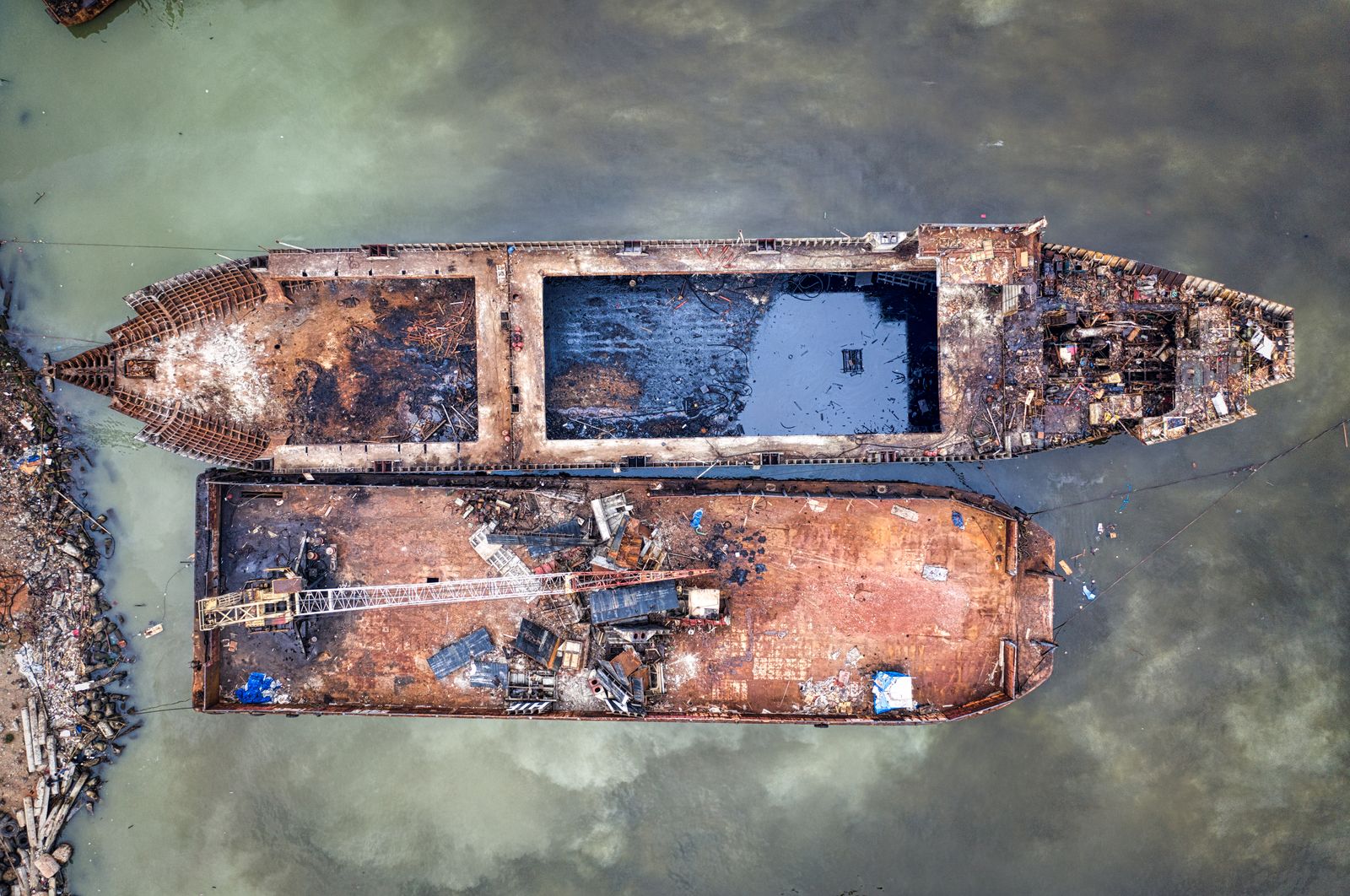
What Happens When a Car Carrier Is Scrapped?
The Hong Kong Convention came into force in June 2025 — and it binds ships in service, not just at the yard. A retrofit changes the inventory.