
Do E-Trucks and E-Buses Change PCTC Fire Risk?

Unit for unit, yes. One e-truck or e-bus carries 6–12 times a car's battery energy, on decks up to 6.5 m tall where ceiling alarms sit far above it.
Unit for unit, yes. The average new battery-electric car sold in 2024 carried a 65 kWh pack, according to the IEA. A 12 m Yutong E12 city bus carries 423 kWh, and a Mercedes-Benz eActros 600 truck carries 621 kWh. On a pure car and truck carrier those vehicles ride the heavy decks, where the clear height reaches 6.5 m and ceiling detectors sit far above the pack.
The debate about EV fires at sea is almost entirely about cars, because cars are most of the cargo. But the trade in heavy electric vehicles is growing. Chinese builders exported 15,444 new-energy buses in 2024, up 28.3% on the year, and electric trucks with 500–800 kWh packs are now in series production in Europe. Every one of those vehicles crossing an ocean goes as high-and-heavy cargo on a ro-ro or car carrier. For an owner, a charterer or a cargo underwriter, one bus is not just one more unit on the manifest.
How much more battery does one heavy EV carry?
Between about 6 and 12 times a car's. The IEA put the sales-weighted global average for battery-electric cars at 65 kWh in 2024. In 2025 the figure was close to 70 kWh in the EU and about 90 kWh in the United States. Heavy vehicles start several times higher:
- Yutong E12, a 12 m city bus: 422.87 kWh, liquid-cooled.
- Volvo FH Electric truck: 360–540 kWh installed across four to six packs, with up to 460 kWh usable.
- Mercedes-Benz eActros 600 truck: 621 kWh from three 207 kWh lithium iron phosphate (LFP) packs.
- Volvo FH Aero Electric, announced in 2026: about 780 kWh installed across eight packs.
Battery energy is not the same as fire size, but it is a fair measure of how much cell material is in one place. More cells mean more electrolyte to vent as flammable gas, and more stored energy to keep a fire going or bring it back after it seems to be out. Many heavy EVs use LFP chemistry, which is harder to push into thermal runaway than the nickel chemistries common in cars. That lowers the chance of a fire. It does not shrink the pack once one cell has gone.
How many are going to sea?
Enough to be a regular cargo, not a curiosity. China's new-energy bus exports rose 28.3% to 15,444 units in 2024, led by BYD with 3,582 and Yutong with 2,700, according to China Bus data reported by electrive. One industry estimate puts 2025 at a record 17,645 units. Yutong's notable 2025 overseas deliveries included 400 battery-electric buses for Pakistan, 372 for Chile and 100 for Greece. Those are markets a bus reaches from China only by sea.
Order sizes matter as much as totals. A fleet order ships together, so one voyage can carry dozens of identical buses parked side by side. Twenty Yutong E12s hold about 8.5 MWh of battery, as much as about 130 average electric cars, all on one deck and often in one block. That is the accumulation problem car carriers already have with EVs, concentrated into a smaller area.
Where do they ride, and why does that matter?
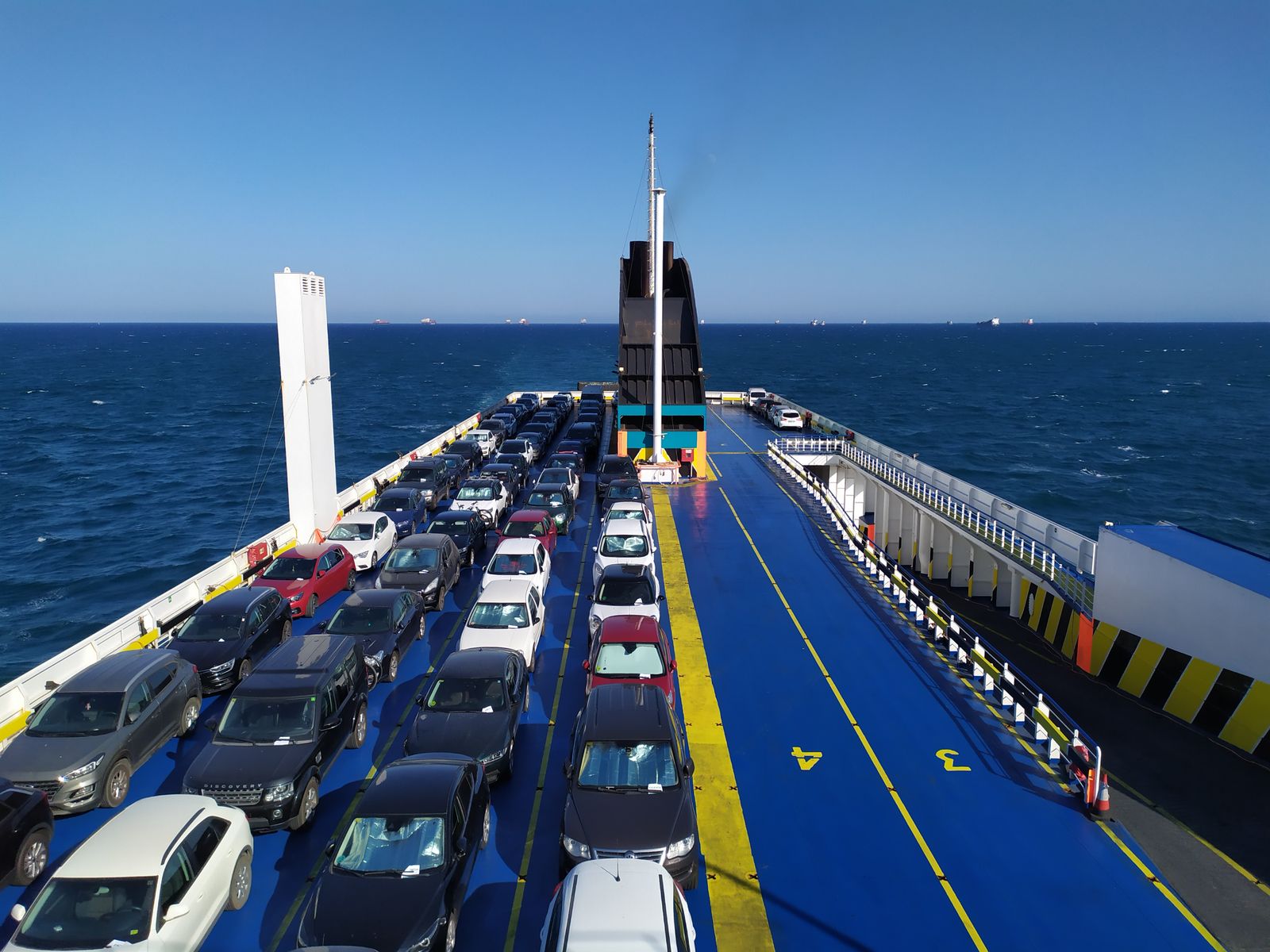
On the tall, strengthened decks, where detection sits farthest from the battery. Höegh Autoliners' Aurora class has 14 decks, 5 of them liftable, a maximum deck height of 6.5 m and a ramp rated to 375 tonnes. The liftable decks let the ship trade car capacity for headroom. Buses and trucks go where the headroom is.
On a car deck, a smoke or heat detector is never far above a car roof. On a heavy deck, a bus stands about half the deck height, and its pack sits under the floor or on the roof. Gas venting from an underfloor pack has to find its way around a 12 m body before it rises. It then has to travel several metres more to reach a ceiling detector. Our post on e-bus depot fires found the same lesson ashore. A 2026 insurer guideline for bus depots concluded that ceiling alarms barely change the outcome once a battery fire takes hold in a crowded hall.
How big can a heavy-vehicle fire get?
Much bigger than a car fire, but that is driven by the load more than the battery. In the 2003 Runehamar tunnel tests, mock-up heavy-goods trailers loaded with 2,850 to 11,010 kg of fuel reached peak heat release rates of 66 to 202 MW. A truck shipped on a car carrier is usually unladen, so it carries far less combustible load than those trailers. It still has tyres, a cab and a pack several times a car's.
The battery's role is mostly about duration and gas, not peak. RISE's large-scale car fire tests in 2023 found that peak heat release depended on the scenario and the vehicle model, not significantly on whether the car was electric or petrol. A heavy-vehicle pack adds what the crew fights longest: hours of re-ignition risk, toxic and flammable vent gas, and a fire seat inside a steel frame that hoses and blankets cannot reach.
What should operators and underwriters do?
Treat heavy EVs as a stowage decision, not a line on the manifest:
- Ask shippers for battery capacity, chemistry and state of charge per unit. Under IMDG Special Provision 961, a vehicle on a ro-ro usually travels without a dangerous-goods declaration, so nothing else will bring that data aboard.
- Count a block of heavy EVs as one accumulation. Twenty 12 m e-buses are about 8.5 MWh, and that number belongs in the stow plan and the cargo underwriter's file.
- Split large fleet orders across decks or bays where the voyage allows, instead of parking them as one block.
- Check what the heavy deck's detection can see. A ceiling grid sized for car decks may sit 3 m or more above a bus roof.
- Keep crew access around them. A bus or truck blocks sight lines and hose reach in a way a car does not.
How RoRoSAFE helps
A heavy EV puts several cars' worth of battery under one body, on a deck where ceiling detectors sit metres above the pack. RoRoSAFE puts infrared thermal and battery-vent gas sensing under each parked vehicle, so a bus or truck is watched at the battery, not from the deckhead. It sends tiered bridge and shore alerts naming the deck and bay before visible smoke. It complements SOLAS systems and holds no class type approval yet.
Pilot: one deck · installed alongside the berth · no drydock · 6 months of dashboard access
Sources
- 1. IEA — Global EV Outlook 2025, 'Electric vehicle batteries': sales-weighted global average battery of 65 kWh for battery-electric cars in 2024.
- 2. IEA — Global EV Outlook 2026, 'Electric vehicle batteries': average battery-electric car pack close to 70 kWh in the EU and about 90 kWh in the United States in 2025.
- 3. Yutong — E12 product page: 12 m battery-electric bus, 422.87 kWh liquid-cooled battery.
- 4. Daimler Truck — eActros 600 press materials: three 207 kWh LFP packs, 621 kWh installed capacity, more than 95% usable.
- 5. Volvo Trucks — FH Electric product page: 360–540 kWh installed across four to six batteries, up to 460 kWh usable.
- 6. electrive — 'Volvo Trucks boosts net battery capacity to record level', 11 June 2026: FH Aero Electric with about 780 kWh installed across eight packs.
- 7. electrive — 'Chinese manufacturers export over 15,000 electric buses', 22 January 2025, citing China Bus: NEV bus exports up 28.3% to 15,444 units in 2024; BYD 3,582, Yutong 2,700.
- 8. 36Kr — 2025 Chinese bus export figures: 17,645 new-energy buses exported.
- 9. Yutong — 'Yutong Bus reports continued sales growth in 2025', 28 January 2026: 400 battery-electric buses delivered in Pakistan, 372 in Chile and 100 in Greece.
- 10. Höegh Autoliners — Aurora class: 9,100 CEU, 14 decks with 5 liftable, maximum deck height 6.5 m, maximum ramp capacity 375 tonnes.
- 11. Ingason, H. and Lönnermark, A. — 'Heat release rates from heavy goods vehicle trailer fires in tunnels', Fire Safety Journal 40(7), 2005: Runehamar tests, peak heat release rates of 66–202 MW with fuel loads of 2,850–11,010 kg.
- 12. Hynynen, J., Willstrand, O., Blomqvist, P. and Andersson, P. (RISE) — large-scale fire tests of six vehicles including three EVs, 2023: peak and total heat release affected by scenario and vehicle model, not significantly by powertrain.
- 13. Bus-depot fire guideline (European fire-protection associations with insurers, 2026): ceiling alarms barely change the outcome in a crowded depot. As covered in RoRoSAFE's post 'What Can E-Bus Depot Fires Teach Car Decks?'.
- 14. IMDG Code Amendment 42-24, Special Provision 961: vehicles on ro-ro ships exempt from most of the Code. As covered in RoRoSAFE's post 'EVs Got a New UN Number — Does It Help?'.
Questions, answered
How big is an electric bus or truck battery compared with an electric car?+
Roughly 6 to 12 times bigger. The IEA put the global average battery in a new battery-electric car at 65 kWh in 2024. A 12 m Yutong E12 bus carries about 423 kWh, a Volvo FH Electric truck up to 540 kWh, and a Mercedes-Benz eActros 600 truck 621 kWh across three LFP packs.
Where are electric buses and trucks stowed on a car carrier?+
On the strengthened, taller decks, usually set up with liftable decks raised to give headroom. Höegh Autoliners' Aurora class, for example, offers up to 6.5 m of deck height and a 375-tonne ramp. That puts heavy EVs where ceiling-mounted detectors sit several metres above the vehicle and its battery.
Is an electric truck fire bigger than a diesel truck fire?+
Not necessarily at peak. RISE's 2023 vehicle fire tests found peak heat release depended on scenario and model more than powertrain, and heavy-vehicle fires are driven largely by their load. The battery changes the duration: a large pack adds flammable vent gas, hours of re-ignition risk and a fire seat that is hard to reach with water.
What should a car carrier ask before loading a fleet of electric buses?+
Battery capacity, chemistry and state of charge for each unit, because a ro-ro vehicle usually travels without a dangerous-goods declaration. It should count the block as one accumulation, about 8.5 MWh for twenty 12 m buses, split large orders across decks where possible, and check what the heavy deck's detection can actually see.
Continue the thread

What Can E-Bus Depot Fires Teach Car Decks?
Depots lose every bus in a burning fire compartment. A 2026 insurer guideline says ceiling alarms barely change that, and points to the battery.
Are Trucks the Bigger Fire Risk on a Ro-Pax?
On ro-pax ships, most fires with a known cause began in trucks, their cargo or reefer units, not cars. What drives freight fires, and where EVs fit.
Are Heavier EVs Outgrowing the Car Deck?
EVs run 10–30% heavier than petrol cars, so a car deck can hit its weight limit before its space limit — and much of the fleet wasn't designed for it.

Is a Car Carrier a Floating Accumulation Risk?
Yes — and wider than one hull. Felicity Ace lost ~$400M of cars on one ship, but accumulation also stacks up dockside and across a shared battery defect.

Does LFP vs NMC Chemistry Change Fire Risk?
Partly. LFP cells run cooler and don't release oxygen like NMC, so they burn less violently — but still vent toxic, flammable gas on a packed deck.
EVs Got a New UN Number — Does It Help?
From IMDG 42-24, lithium EVs ship as UN 3556, not the generic UN 3171. But SP 961 still exempts them on a ro-ro, so the code rarely reaches the deck.