
Are Heavier EVs Outgrowing the Car Deck?
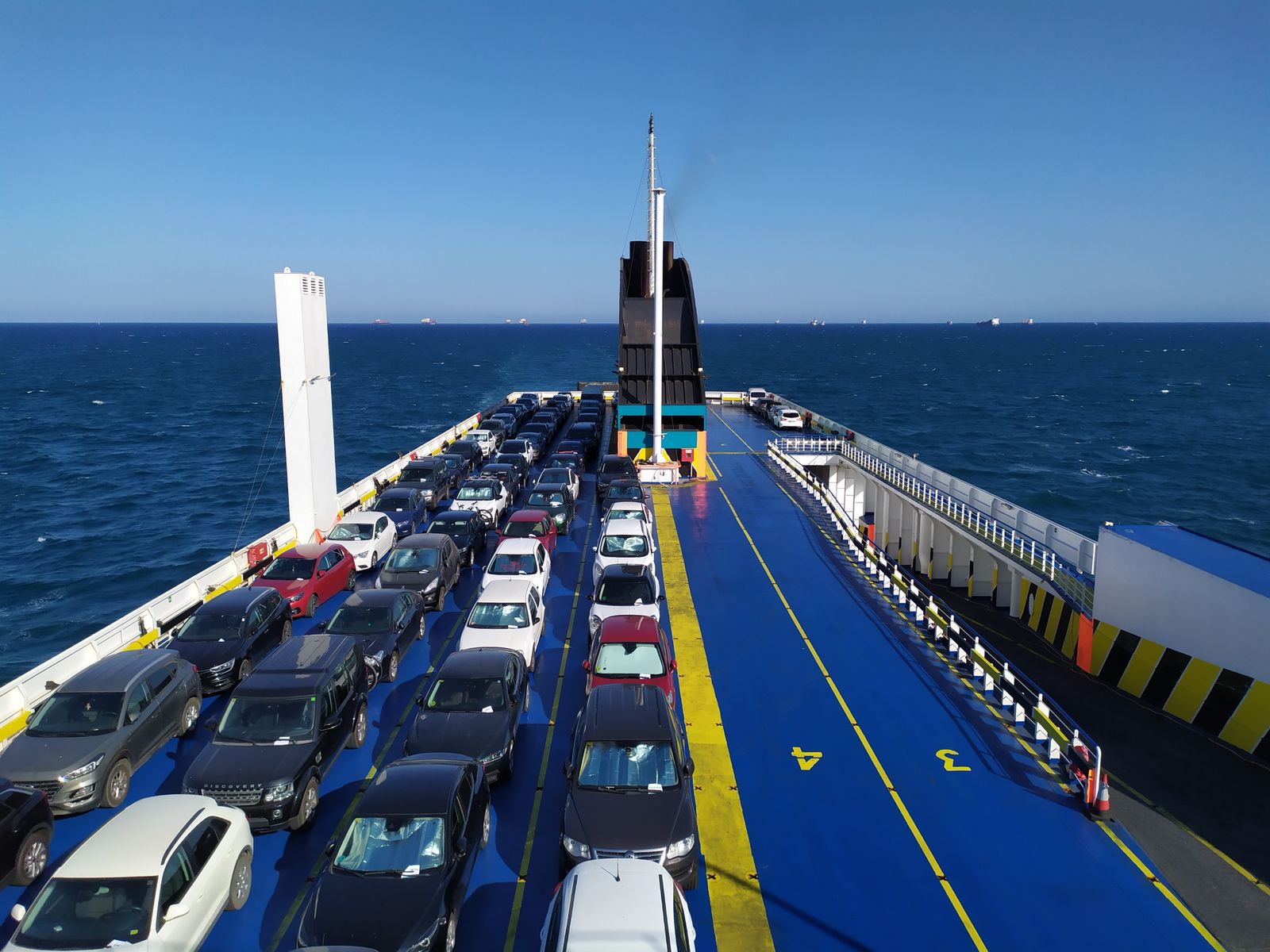
EVs run 10–30% heavier than petrol cars, so a car deck can hit its weight limit before its space limit — and much of the fleet wasn't designed for it.
On the existing fleet, increasingly yes. A car deck has two independent limits — how many vehicles fit, and how much weight the deck can carry — and for decades the footprint was what filled first. As the average vehicle gains 10–30% in mass over its petrol equivalent, the structural limit starts to bind before the space does. Newbuilds like the 9,100-CEU Höegh Aurora already strengthen every deck for it. Most ships in service were designed to lighter assumptions.
A car deck has two limits, and the binding one is changing
Capacity is quoted in car-equivalent units, but CEU measures footprint, not force. A pure car and truck carrier is rated two ways at once: the number of vehicles that physically fit, expressed in CEU against a small reference car, and the load each deck can bear, expressed as a design deck strength in tonnes per square metre plus the ship's total deadweight and stability envelope. Historically the footprint bound first — ordinary cars are light relative to a deck's structural rating, so a ship filled up on space with strength to spare. Raise the mass of the average unit enough and that reverses: the deck reaches its weight rating, or the ship its stability limit, while CEU slots still sit empty. Design deck strength is set per deck, which is exactly why loading possibility has to be checked deck by deck at the loading-plan stage, not assumed from the CEU figure.
How much heavier EVs actually are
Enough to move the calculation, and in a way charge policy cannot soften. An electric car is on average 10–30% heavier than a comparable internal-combustion vehicle, driven by a traction battery that alone averages around 454 kg — and can approach 900 kg — making up as much as a quarter of the car's mass. Two features make that a shipping problem rather than a road one. The mass is constant regardless of state of charge, so unlike a petrol car shipped on a near-empty tank, an EV brings its full battery weight aboard no matter what SoC policy is applied at loading. And it is concentrated: a deck loaded entirely with EVs carries far more tonnes per square metre than the mixed-car assumption many older decks were rated against.
What the newbuilds are telling you
That the industry already treats deck strength as a first-order EV design problem — for ships not yet built. The Aurora-class delivered to Höegh Autoliners from 2024, the largest car carriers in the world at delivery, carry 9,100 CEU across 14 decks, five of them liftable, and the yard's own description is explicit: every deck is laid out to house electric vehicles and strengthened to allow heavier project cargo. That is a deliberate departure from the previous generation, and it is a tell. If the newest and most expensive tonnage in the trade is being reinforced specifically so its decks can take EV mass, the constraint is real — and the exposure sits with the existing fleet, whose decks were dimensioned around lighter vehicles and older reference weights and cannot be re-rated after the fact.
What gets harder before the deck ever fails
The limit shows up as operational friction long before any structural event. A heavier vehicle needs heavier securing — steel chains and more lashing points where nylon straps once served, at higher securing loads under the IMO CSS Code — and lashing arrangements proven on 1.4-tonne cars are marginal on 2.3-tonne EVs in a seaway. More deadweight carried high in a multi-deck ship tightens the stability margin. And effective capacity falls twice over: once because each unit is heavier, and again because EV spacing and safety measures already reduce vehicles per voyage on some trades. The result is a ship that is 'full' by weight, or by GM, with CEU to spare — a commercial loss, not just an engineering note.
What owners, planners and underwriters should do
- Load to deck strength, not CEU. On EV-heavy stows the binding constraint is tonnes per square metre and the stability envelope — check loading possibility deck by deck at the plan stage, as the design assumes.
- Re-examine lashing for the actual unit mass. Securing rated for a light mixed-car deck under the CSS Code may be inadequate for a deck of 2+ tonne EVs; match chains and points to the real weight.
- Treat SoC policy and weight as separate levers. A low state-of-charge limit reduces fire energy but does not reduce a single kilogram of battery mass — the deck-strength problem is unaffected by it.
- For the existing fleet, know each ship's per-deck rating and reference vehicle weight before quoting EV-heavy cargo; older decks cannot be strengthened to match a newbuild.
- For underwriters, an operator loading EV-dense decks on tonnage designed for lighter vehicles is carrying a structural and stability exposure that the CEU figure on the fixture does not reveal.
How RoRoSAFE helps
A deck that hits its weight limit first carries more battery energy per square metre than it was planned for. That makes a fire's first minutes more valuable. RoRoSAFE's per-vehicle sensing installs without drilling the deck or touching vehicles, so it adds no structural work to a deck already near its limits. It gives the crew a located, early warning on the densest battery loads the ship has ever carried.
Pilot: one deck · installed alongside the berth · no drydock · 6 months of dashboard access
Sources
- Maritime Executive / Marine Link — 'World's Largest Car Carrier Höegh Aurora Delivered' and Baird Maritime vessel review of the Aurora class (Höegh Autoliners, from 2024): 9,100 CEU across 14 decks including five liftable decks; all decks laid out to house electric vehicles and strengthened to carry heavier project cargo; DNV ammonia- and methanol-ready notation — maritime-executive.com / marinelink.com / bairdmaritime.com.
- TRID / Transportation Research record — 'A Consideration of Loading Possibility in Design Deck Strength of PCTC': PCTC design deck strength is determined per deck, and assessing whether loading is possible at the loading-plan stage is important for hull integrity and safe voyage — trid.trb.org.
- EVBox / Motor1 — EV battery and vehicle weight explainers: EVs average roughly 10–30% heavier than comparable internal-combustion vehicles; traction batteries average around 454 kg (up to ~900 kg) and can be up to ~25% of vehicle mass; battery mass is independent of state of charge — evbox.com / motor1.com.
- IMO — Code of Safe Practice for Cargo Stowage and Securing (CSS Code): vehicle lashing method, number of securing points and equipment type vary with vehicle size and weight, with heavier vehicles requiring chains rather than straps — imo.org.
- IMO — SOLAS Chapter II-2 amendments in force from 1 January 2026 (vehicle, special category and ro-ro spaces): the current fire-safety baseline against which EV-dense decks are assessed — imo.org.
- Companion RoRoSAFE analysis — 'Car-Carrier Newbuild Wave: EV Fire Exposure' (the newbuild angle from the fire side), 'Lashing the Cargo vs Protecting It' (securing on a dense vehicle deck), and 'Multi-Fuel PCTC Changes the Deck' (how the deck itself is being redesigned).
Questions, answered
Are electric vehicles too heavy for car carriers?+
Not for purpose-built newbuilds, but they strain the existing fleet. An EV is on average 10–30% heavier than a comparable petrol car, so a deck loaded with EVs can reach its structural weight rating before all its car-equivalent-unit slots are filled. Newbuilds such as the Höegh Aurora strengthen every deck for it; older ships were dimensioned around lighter vehicles and cannot be re-rated.
Why doesn't a low state of charge reduce the weight problem?+
Because battery mass is fixed regardless of charge. A petrol car can ship on a near-empty tank, but an EV carries its full traction battery — averaging around 454 kg — whatever its state of charge. Limiting SoC at loading lowers the fire energy on the deck; it does not remove a single kilogram of weight, so the deck-strength and stability problem is entirely separate from charge policy.
What is a CEU and why doesn't it capture the weight issue?+
A car-equivalent unit measures footprint — how many reference-sized cars physically fit — not weight. A ship's decks also have a design strength in tonnes per square metre and a total deadweight and stability limit. As average vehicle mass rises, a ship can hit those structural limits while CEU slots remain empty, so the CEU capacity figure no longer reflects what can actually be loaded.
What changes for lashing when vehicles get heavier?+
Heavier vehicles need stronger securing. Under the IMO CSS Code the lashing method, number of securing points and equipment vary with vehicle weight — heavy units take steel chains rather than nylon straps, at higher securing loads. Arrangements proven on 1.4-tonne cars can be marginal for 2-tonne-plus EVs in a seaway, so securing has to be matched to the actual unit mass, not the deck's original assumption.
Continue the thread

The Newbuild Wave Scaling EV-Fire Exposure
The car-carrier fleet is on track to grow ~40%, concentrating roughly €250m of cargo value per hull — and EV-fire exposure is scaling with it.

Lashing the Cargo Isn't Protecting It
Lashing stops vehicles moving; it does nothing about ignition. With a 2026 PSC campaign on cargo securing, budget and drill the two separately.
How Multi-Fuel PCTCs Change the Deck
Ammonia detection alarms at 25 ppm, far below anything that burns. On a multi-fuel PCTC the sensing priority inverts from fire to toxicity.
Does a Car in a Container Escape the Rules?
Not after 2028. IMDG Amendment 43-26 ties the SP 961 exemption to SOLAS II-2/20 approved spaces — and a container stack is not one of them.
Who Can Refuse to Carry Your EVs?
Three parties can, and only one of them prices it. TOTE Maritime Alaska suspended EV carriage indefinitely in 2025 — a refusal no premium reopens.