
Does Transport Mode Blind an EV's Own BMS?

Largely, yes. A parked EV's BMS can be de-energised with its cooling off, and NHTSA says most single-cell fires start in exactly that state.
Largely, yes. A stowed EV sits in what UN GTR No. 20 calls usual parking mode: main software off, the battery's power line disconnected, the cooling system not operating and the battery management system not energised. Transport modes switch off more on top of that. NHTSA's FMVSS No. 305a proposal of 15 April 2024 found that most real-world single-cell thermal runaway fires started in exactly this state.
That matters for anyone designing detection for a vehicle deck, because it removes the one sensor that sits inside the battery. Loading guidance tells crews to isolate each vehicle at stow, for good reasons. The consequence is that the car's own monitoring is at its weakest during the voyage, which is when the ship most needs it, and the vehicle offers no signal a deck system can lean on.
What state is a stowed EV actually in?
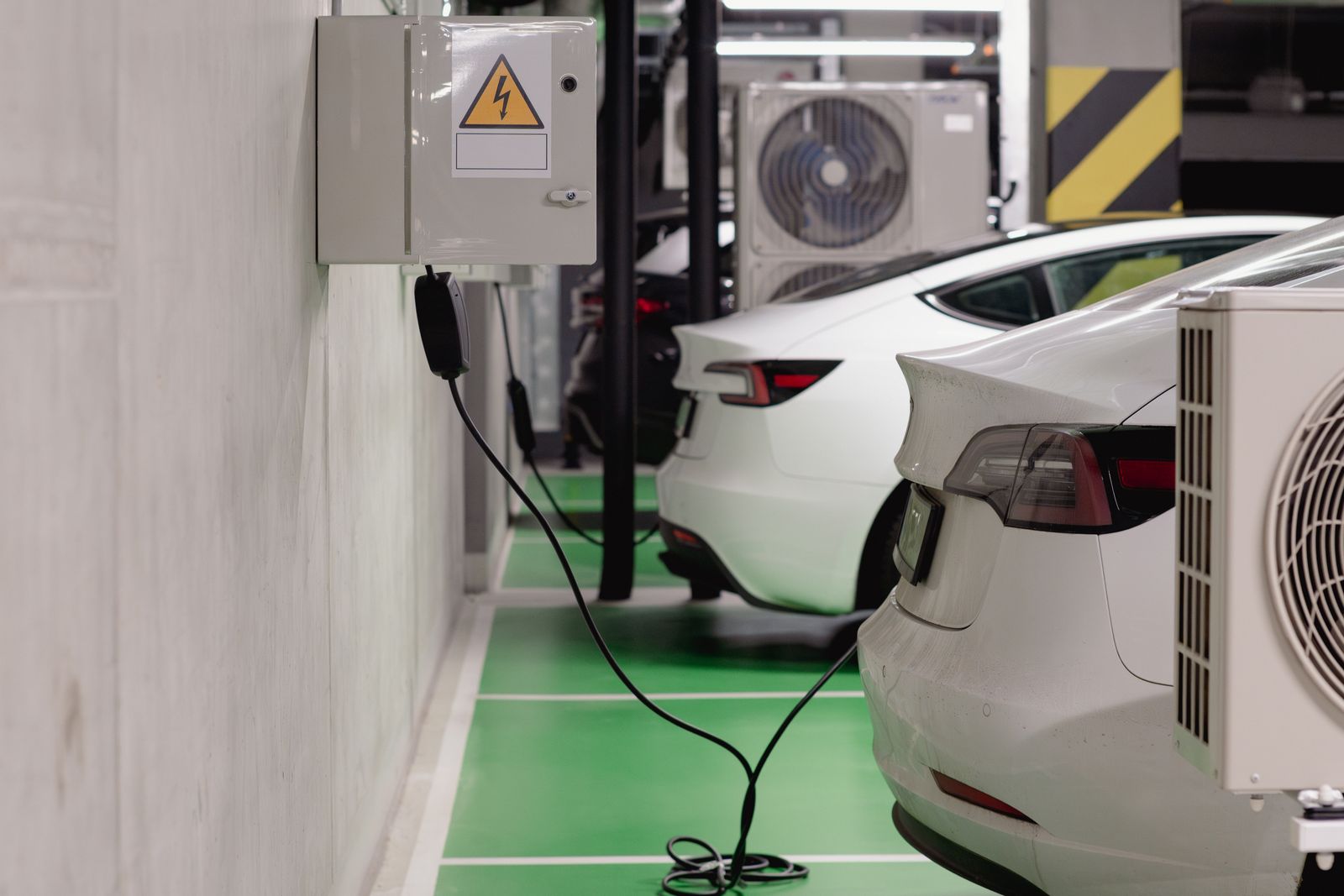
Switched off, isolated and, by definition, unattended. The ICS, International Group of P&I Clubs and TT Club Common Guidance on the Presentation and Loading of Vehicles asks for the ignition off and the key stored in the cabin. It also asks for an ignition-off confirmation for EVs and hybrids, and for transport isolation mode or a battery kill switch to be engaged where fitted. That is done in consultation with the manufacturer, because some transport modes also release the handbrake.
Vehicle regulation describes the same state in its own terms. NHTSA's proposal distinguishes three operational modes: active driving possible, external charging and parking. The usual parking mode it quotes is the vehicle with main software off, gear in park, energy supply and battery power line disconnected and cooling not operational. The controls that manage safe operation of the battery, the BMS included, are not energised, and occupants are typically not present. A car lashed to a deck fits every part of that definition.
What does transport mode switch off?
Whatever the manufacturer decides, and it is designed for the 12V battery, not for fire safety. Transport or shipping mode is a low-power state set at the factory before a new car leaves the plant, to stop dozens of control units draining the 12V battery during weeks of transit and storage. Ford's version, for example, disables the audio system, interior lights and accessory delay, and on some models switches itself off once the car exceeds a set speed. Dealers clear the mode during pre-delivery inspection.
What none of the published descriptions say is what happens to battery supervision. The functions a low-power mode is built to suppress are the ones that keep electronics awake: telematics, remote alerts and periodic wake-ups. Whether a given model keeps any BMS monitoring alive in transport mode is model-specific and largely undocumented outside the manufacturer. For a ship loading thousands of vehicles from dozens of brands, that means the vehicle's self-monitoring cannot be assumed on a single car.
Does a sleeping EV still check its own battery?
Some do, on their own schedule, and the schedule is not built around a fire. Kia's owner's manual describes Aux. Battery Saver+. With the car off and all doors, hood and tailgate closed, the car periodically uses the high-voltage battery to recharge the 12V battery, with 360 V present in the vehicle while it runs. Each activation lasts at most 20 minutes, and the function stops after ten consecutive activations, on the assumption the 12V battery is faulty. BMS designs in the patent literature range from fixed periodic wake-ups to low-power monitors that wake the controller when a voltage or temperature threshold is crossed. No standard sets an interval.
Even a car that wakes and sees a problem has no one to tell. UN GTR No. 20's thermal-propagation warning, and the 5-minute thermal-event alarm in China's GB 38031-2025, are aimed at occupants. On a car deck the cabin is empty and locked, and there is no data path from the vehicle's BMS to the ship.
Why NHTSA dropped the occupant warning
Because the fires it reviewed did not happen while anyone was driving. GTR No. 20's warning requirement exists to give occupants time to get out and is framed around active driving possible mode. In the FMVSS No. 305a proposal, NHTSA declined to adopt it. Most real-world single-cell runaway fires, it said, occurred with the vehicle parked, propulsion off and no occupants, in home garages, parking garages or on the street, with state of charge generally in the upper range. It cited South Korean records of 35 EV fires since 2018, of which 20 began in the battery of a parked vehicle at more than 90% state of charge.
NHTSA proposed something else instead: documentation of each manufacturer's risk assessment and mitigation for single-cell runaway across all three operational modes, parking included. Compliance would follow two years after a final rule. Its own wording is that a warning is a secondary mitigation that "would not prevent the thermal propagation from occurring in the first place." In regulatory language, that is an acknowledgement that the parked, de-energised car is the case in-vehicle warnings do not cover.
What this means for deck detection design
Treat every stowed EV as an unmonitored battery and detect from outside it, continuously. First, a detection layer should not depend on any vehicle being awake: coverage that only works when the car reports would fail in usual parking mode. Second, detection has to be continuous rather than sampled on an interval, because a vehicle's own wake cycles are measured in hours or days while a venting cell develops in minutes. Third, the baseline should expect legitimate events such as a car briefly energising its high-voltage system to top up its 12V battery, so thresholds key on the pattern of a venting cell rather than on any warm spot. Finally, state of charge still matters. The loading guidance's 30–40% target sits well below the >90% band in the Korean parked-fire data, and holding it is one of the few battery-side controls the ship keeps.
How RoRoSAFE helps
On a car deck every EV is parked, isolated and possibly running with its BMS asleep, so the vehicle cannot be relied on to report its own battery. RoRoSAFE watches from outside the car instead: infrared thermal and battery-vent gas sensing under each parked vehicle, running continuously and alerting the bridge and shore by deck and bay before visible smoke. It needs no connection to the vehicle and no vehicle modification, and it complements SOLAS detection.
Pilot: one deck · installed alongside the berth · no drydock · 6 months of dashboard access
Sources
- 1. NHTSA — Notice of proposed rulemaking, FMVSS No. 305a, Electric-Powered Vehicles: Electric Powertrain Integrity; Global Technical Regulation No. 20, Incorporation by Reference. 89 FR 26704, 15 April 2024, Docket NHTSA-2024-0012 (read from the GovInfo full text): three operational modes and their definitions (fn. 89–91); usual parking mode definition including BMS not energised and cooling not operational (fn. 96); most single-cell runaway fires occurred with the vehicle parked, propulsion off, no occupants (fn. 86); "NHTSA's Decision Not To Propose a Warning Requirement"; warning as a secondary mitigation strategy; documentation across all three modes; proposed compliance two years after the final rule.
- 2. South Korean EV fire records cited by NHTSA in the same notice (fn. 97: UNECE IWG EVS 23rd session, document EVS23-E1TP-0200, "EV Fire Records of Korea"): 35 EV fires since 2018, 20 originating in the REESS while parked at SOC above 90%.
- 3. UN Global Technical Regulation No. 20, Electric Vehicle Safety (UNECE WP.29): thermal-propagation warning to allow occupant egress, or 5 minutes before a hazardous situation in the passenger compartment.
- 4. ICS / International Group of P&I Clubs / TT Club — Common Guidance on the Presentation and Loading of Vehicles (Version 1.4): ignition off and key in cabin at stow; ignition-off confirmation for EVs and hybrids; transport isolation mode or battery kill switch per OEM advice; some transport modes release the handbrake; 30–40% SOC. Covered with its source in the linked post on the vehicle loading guidance.
- 5. Kia — owner's manual, "12V Aux. Battery Saver+" (ownersmanual.kia.com): cycle mode with the vehicle off and doors, hood and tailgate closed; high-voltage battery recharges the 12V battery; 360 V present during operation; maximum 20 minutes per activation; stops after ten consecutive activations.
- 6. Ford Transport Mode, as described by a Ford dealer (robsightford.com): disables audio, interior lights and accessory delay to reduce 12V drain; on some models exits automatically above a speed threshold; cleared before delivery.
- 7. US patent literature on BMS sleep and wake strategies (e.g. US 11,171,569, wake-up method and system for a battery management system; US 12,341,165, method for monitoring a battery system using threshold and predicted-value wake-ups): illustrates the range of designs; no common interval or standard.
- 8. GB 38031-2025 thermal-event alarm (5 minutes) is covered with its source in the linked article Does GB 38031 Change Marine Detection?.
Questions, answered
Does an EV monitor its battery while it is switched off?+
Sometimes, and not continuously. In what UN GTR No. 20 calls usual parking mode, the battery's power line is disconnected, its cooling is off and the BMS may not be energised. Some models wake periodically, for example to recharge the 12V battery, and some use low-power monitors that wake the controller on a threshold. No standard sets an interval, and many designs are not published.
What is transport mode on a new car?+
A factory-set low-power state that cuts the drain on the 12V battery during weeks of transit and storage by disabling non-essential functions such as audio, interior lights and keyless entry. Dealers clear it at pre-delivery inspection. It is designed to protect the 12V battery, not to supervise the traction battery, and its effect on BMS monitoring is model-specific.
Why did NHTSA not require an EV thermal-event warning?+
In its April 2024 FMVSS No. 305a proposal, NHTSA found that most real-world single-cell runaway fires happened with the vehicle parked, propulsion off and nobody inside. It cited Korean data showing 20 of 35 EV fires since 2018 began in a parked car's battery above 90% charge. A warning to occupants would not have helped, so NHTSA proposed risk documentation across all operating modes instead.
Can a ship read an EV's battery warnings during the voyage?+
No. There is no standard data path from a vehicle's battery management system to the ship, the cabin is empty and locked, and the vehicle is isolated at stow under loading guidance. Any warning the car raises stays inside it. Detection on a car deck therefore has to come from outside the vehicle and run continuously, without depending on the car being awake.
Continue the thread

The BMS Handshake: Pre-Fire Shutdown
In battery storage, off-gas sensors tell the BMS to shut a failing stack down within 2–30 minutes. On a car deck the ship can't reach the vehicle's BMS.
Does GB 38031 Change Marine Detection?
GB 38031-2025 makes an EV pack contain a cell runaway for 120 minutes with no fire. At sea that makes silent off-gas detection more vital, not less.

What the New Vehicle Loading Guidance Requires
ICS/IGP&I Common Guidance sets a booking-to-discharge data chain for vehicles: declared propulsion type, recorded SOC, and an OEM emergency guide.

The Argument Over State-of-Charge at Loading
EMSA recommends 20–50% on a PCTC and lines have made 50% a booking condition. What still does not exist is an international requirement.

Building Per-Vehicle Thermal Baselines
Anomaly detection is only as good as its baseline. How a per-vehicle rolling reference is built, warmed up, and held steady across a voyage.
The Loose Terminal a Breaker Cannot See
A loose joint changes resistance, not current — so overcurrent protection is blind by construction. MAIB 24/2011: 25 A through a 32 A breaker, and a fire.