
The Fire Boundary the Crew Couldn't Close
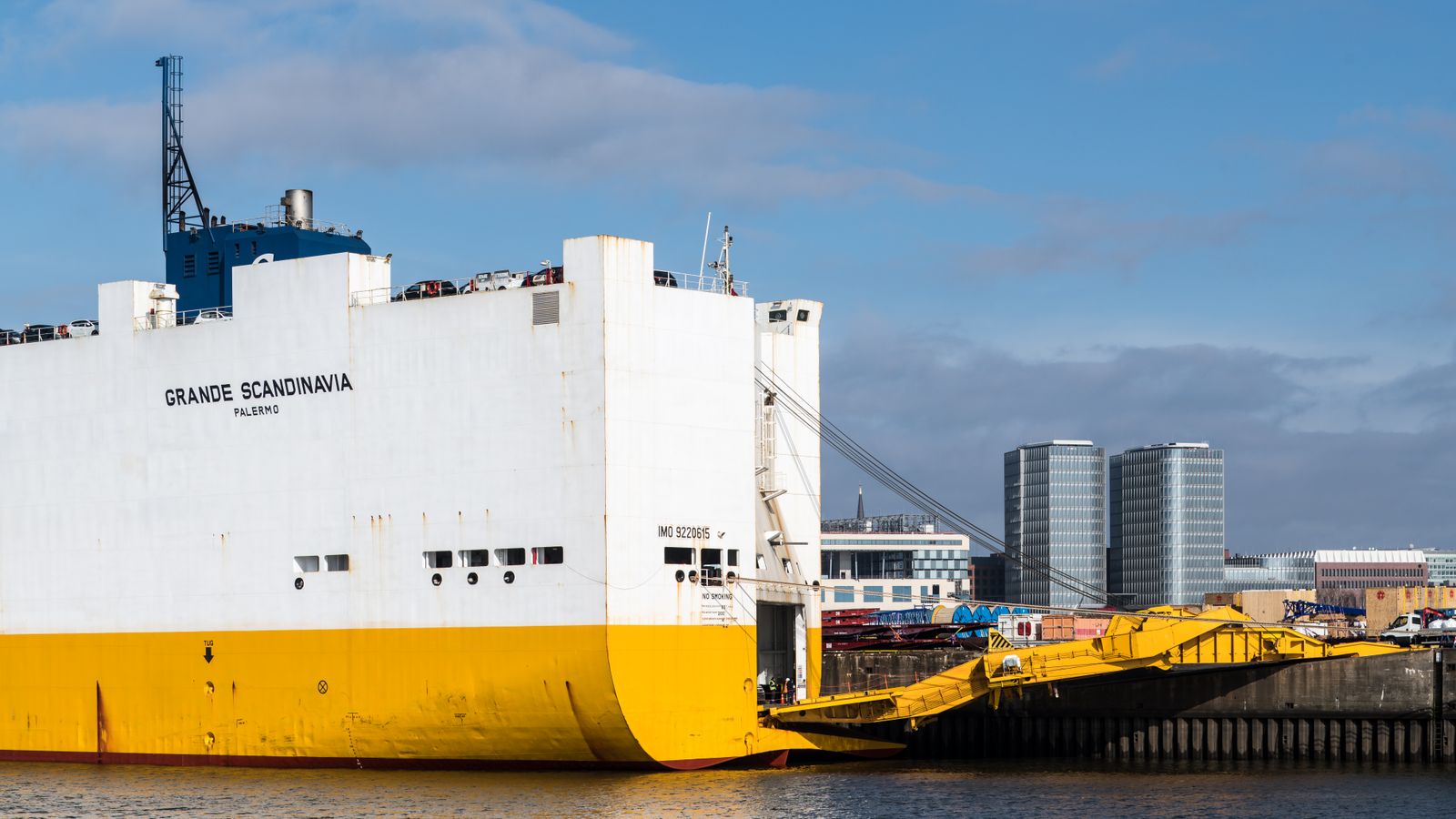
On the Grande Costa d'Avorio the crew couldn't seal the CO₂ zone — the door control sat inside it — so the fixed fire system was defeated.
A fixed fire-suppression system only works if you can seal the space it protects. On the Grande Costa d'Avorio — the Grimaldi ro-ro/container vessel that burned at Port Newark on 5 July 2023, killing two firefighters and causing over US$23 million in damage — the crew could not close a fire-boundary door because its control panel sat inside the CO₂-protected zone. The NTSB found the fixed system was defeated before the fight even began.
What defeated the fixed CO₂ system
A boundary door that could not be closed from a safe position. A fixed gas system extinguishes by flooding a sealed compartment and holding the agent concentration long enough to smother the fire; if a boundary opening stays open, the CO₂ disperses and the fire keeps its air. The NTSB's report (MIR-25/16) found that the control for a large rampway boundary door was located inside the space the CO₂ would flood — so the crew could not operate it without entering a compartment about to be inundated with carbon dioxide. The door stayed open, the agent leaked away, and the fixed system was effectively neutralised. The ignition itself was mundane: a 2008 Jeep Wrangler used as a 'pusher' vehicle to move non-running cargo, whose transmission fluid overheated, boiled over and ignited on a hot engine surface. It was the inability to seal the boundary that let a single-vehicle ignition grow into a multi-deck fire.
Why boundary integrity is the whole game
Fixed suppression is a boundary problem as much as an agent problem. A CO₂ system rated for a space is only rated if that space can actually be closed and held — and ro-ro vehicle decks, with large ramp doors, ventilation openings and constant vehicle access, are among the hardest volumes on any ship to seal quickly. The pattern recurs across recent casualties. On the MV Delphine at Zeebrugge in April 2025 the CO₂ worked as designed and 60–70 vehicles still burned, because detection came too late to matter. On the Felicity Ace in 2022 the fixed system also failed to hold the fire. Different failures, one common assumption: that the boundary will be sealed and held when it counts. On the Grande Costa d'Avorio, that assumption broke at a single door control.
What the NTSB told class, flag and IMO
Fix the boundary, not only the training. Alongside its well-reported call for marine-firefighting training for land-based responders, the NTSB aimed a set of recommendations upstream at vessel design and regulation. It asked Grimaldi Deep Sea to inventory the fire boundaries across its fleet and modify them so openings can be operated from outside the protected space. It asked RINA Services — the classification society that reviewed the ship — to revise its plan-review procedures so a boundary control located inside its own protected zone is caught on the drawing board. And it asked the US Coast Guard to propose amendments at the IMO to the fire-boundary regulations themselves, so that closures must be operable without entering the space the agent will flood. That is a design-and-regulation fix, sitting upstream of the firefighting response everyone focused on.
Where detection changes the sequence
Earlier detection is the one control that does not depend on sealing. Because a fixed system's effectiveness hinges on closing a boundary fast, the value of catching an event early — while it is still one vehicle, before the deck is smoke-logged and while boundary doors can still be reached and shut — is exactly the margin the Grande Costa d'Avorio never had. A single-vehicle thermal event, flagged and located early, is one the crew can act on or seal against before it becomes a whole-deck fire no fixed system can hold. Detection does not replace the boundary; it buys the time to use it. On a fire that began with one overheating vehicle and escalated while a door stayed open, minutes of early warning are the difference between a contained incident and a US$23 million total loss.
What it means for owners, class and ports
For owners, a fixed-system certificate is not a guarantee if the boundary cannot be sealed under fire conditions — audit where every boundary control physically sits, which is precisely what the NTSB asked Grimaldi to do fleetwide. For class and flag, plan review has to treat boundary-control location as a fire-safety item, not a layout detail; the recommendations to RINA and the Coast Guard make that explicit. For ports, the land-firefighting-training gap is real but downstream: the fire that reaches shore responders is one the vessel's own boundary and detection already failed to contain. The cheapest fixes sit earliest — detect sooner, and make every fire boundary closable from safety.
How RoRoSAFE helps
Sealing a CO2 zone takes time, and the crew only gets that time if the fire is found early. RoRoSAFE flags a battery event at the vehicle before visible smoke, so boundary closure can start while the fire is still small and access is still possible. It changes the order: detection first, then boundary, then suppression.
Pilot: one deck · installed alongside the berth · no drydock · 6 months of dashboard access
Sources
- NTSB — Marine Investigation Report MIR-25/16, 'Fire aboard Roll-on/Roll-off Container Vessel Grande Costa d'Avorio' (public meeting 15 April 2025): probable cause the use of a 2008 Jeep Wrangler pusher vehicle whose transmission fluid overheated and ignited; contributing factor that a fire-boundary rampway door control was located inside the CO₂-protected space, preventing safe closure and rendering the fixed CO₂ system ineffective — ntsb.gov.
- NTSB press release NR20250415 and safety recommendation letter M-25-001 to -011 — recommendations to Grimaldi Deep Sea (fleet-wide fire-boundary inventory and modification), RINA Services (vessel plan-review procedures), and the US Coast Guard (proposal to the IMO on fire-boundary regulations), plus marine-firefighting training recommendations to Newark Fire Division, the Port Authority of NY/NJ, AAPA, IAFF, IAFC and NVFC.
- NTSB / gCaptain / WorkBoat coverage of the Grande Costa d'Avorio investigation — fire on 5 July 2023 at Port Newark; two Newark fire captains (Augusto Acabou, Wayne Brooks Jr.) killed, six responders injured; damage over US$23 million.
- NTSB — MV Delphine (Zeebrugge, April 2025): 60–70 vehicles lost despite the CO₂ system operating as designed, cited here as the contrasting failure mode (agent worked, detection was late).
Questions, answered
What caused the Grande Costa d'Avorio fire at Port Newark?+
A 2008 Jeep Wrangler being used as a 'pusher' vehicle to move non-running cargo overheated; its transmission fluid boiled over and ignited on a hot engine surface. The fire broke out on 5 July 2023, killed two Newark fire captains, injured six responders and caused over US$23 million in damage. The NTSB detailed it in report MIR-25/16.
Why did the ship's fixed CO₂ system fail to put out the fire?+
Because a fire-boundary door could not be closed. The NTSB found the control for a large rampway boundary door was located inside the CO₂-protected space, so the crew could not operate it without entering a compartment about to be flooded with carbon dioxide. The door stayed open, the agent dispersed, and the fixed system was effectively defeated before firefighting began.
What did the NTSB recommend after the Grande Costa d'Avorio fire?+
Design and regulatory fixes, not just training. It asked Grimaldi Deep Sea to inventory and modify fire boundaries so openings are operable from outside the protected space, asked classification society RINA Services to revise plan-review procedures, and asked the US Coast Guard to propose IMO amendments to fire-boundary rules. It also urged marine-firefighting training for land-based responders.
Does this mean CO₂ systems don't work on car carriers?+
No. A fixed CO₂ system works when the space can be sealed and the agent concentration held. The Grande Costa d'Avorio failure was boundary integrity — a door that couldn't be closed from safety — not the agent itself. The contrasting case is the Delphine, where CO₂ worked as designed yet vehicles still burned because detection came too late.
Continue the thread

Can FSS CO₂ Extinguish a Li-Ion Fire?
A Li-ion cell in thermal runaway is self-oxidising. The FSS Code 45% CO2 concentration suppresses conventional fires but cannot extinguish the cell itself.

Are Ports Ready to Fight a Ship Fire?
Mostly not. The NTSB's 2025 safety alert found land firefighters lack the marine training in-port vessel fires demand — after deaths at Port Newark.

Why 70 Vehicles Burned on the Delphine
MV Delphine lost 60–70 vehicles in the April 2025 Zeebrugge fire even though CO2 suppression worked as designed. Detection timing is the gap.
Al Salam Boccaccio 98: Sunk by Firewater
A car-deck fire the crew fought. Blocked scuppers held the water, free surface took the stability, and 1,031 of 1,418 aboard were lost.