
Is EV Fire Safety Now a Car-Carrier Spec?

Increasingly yes: NOCC Pacific is the first PCTC delivered with DNV's EV fire-safety notation, making early detection a newbuild spec, not a retrofit.
Increasingly, yes. In November 2025 Norwegian Car Carriers took delivery of NOCC Pacific — a 7,000-CEU, 68,903-GT PCTC built by Yantai CIMC Raffles and reported as the first vehicle carrier to class with DNV's electric-vehicle fire-safety notation. Fire detection was specified at the order stage, not bolted on later. A notation that is voluntary on paper is becoming a commercial buying criterion.
What notation did NOCC Pacific actually earn?
DNV granted the ship an EV fire-safety notation certifying compliance with standards for the maritime transport of electric vehicles, alongside an Ammonia-ready notation for a future low-carbon fuel. The notation sits on top of base class; it does not replace SOLAS, which IMO writes. What changed in 2026 is timing: DNV's July 2025 rules edition entered into force on 1 January 2026, so surveys from that date reference the updated fire-safety requirements.
Why a "voluntary" notation shows up on a newbuild order
Because the people who carry the ship's risk now ask for it by name.
- Charterers increasingly name fire-safety notations in fixture terms.
- Underwriters cite them in renewal questionnaires and price accordingly.
- A hull without the notation stands out negatively in chartering and underwriting markets.
- Building the capability into a newbuild is cheaper than proving equivalent capability on an existing hull later.
It is not only DNV — the notation race is on
ClassNK has published the world's first AMEVC(EV) notation, covering additional evacuation measures for vehicle carriers during a cargo-hold fire, while Lloyd's Register and ABS carry their own fire-protected ro-ro cargo-space descriptors. The pattern is consistent: classification societies are codifying EV-era fire capability faster than IMO. IMO's SSE sub-committee has prioritised interim guidelines for vehicle-carrier fire safety and for video monitoring and detection before drafting any SOLAS amendments — so a class notation is the near-term signal, not the treaty text.
What the notation asks for on the deck
In capability terms, an EV fire-safety notation pushes toward early detection and verification rather than reliance on smoke or flame alarms that trigger late. IUMI's 2025 best-practice review calls early detection and verification critically important and points to thermal imaging and AI-assisted systems for that reason. Multi-modal detection — thermal plus gas plus video confirmation — is the direction of travel; a notation rewards documented, testable capability, not a single sensor type.
The catch: a buying criterion only helps the buyer
A notation specified at order helps the roughly 40% of car-carrier capacity now on the orderbook — not the majority of hulls that will trade through 2035. Those existing ships were built against detection rules written for a lower-EV era, and a newbuild notation does nothing for them. For the trading fleet the equivalent lever is retrofit: independent early detection an underwriter can price against, fitted to hulls already at sea.
What this means for owners and underwriters
- For owners ordering tonnage: a fire-safety notation is now part of the charter and resale value of the hull, not just a safety line item — spec it at order.
- For owners of existing tonnage: the notation gap is a retrofit question, and demonstrable early-detection capability is what closes it.
- For underwriters: a named notation — or an equivalent documented detection layer — is a priceable variable, and its absence increasingly is too.
Where RoRoSAFE fits
RoRoSAFE targets the retrofit side of the same requirement: non-invasive vapour-phase and thermal detection that flags a cell in trouble ahead of smoke or flame, with continuously logged data — the kind of testable, auditable capability a notation or an underwriter asks for, fitted to hulls already trading rather than only to newbuilds.
How RoRoSAFE helps
If early detection is becoming a newbuild spec, existing tonnage needs a route that does not wait for the next build. RoRoSAFE installs alongside the berth on new or existing ships, with no drydock. It adds per-vehicle thermal and gas detection above the SOLAS floor. It holds no class notation or type approval yet; the pilot's joint class review is where that work starts.
Pilot: one deck · installed alongside the berth · no drydock · 6 months of dashboard access
Sources
- DNV — "Now available: July 2025 edition of DNV class rules and documents for ship and offshore" (into force 1 January 2026).
- Baird Maritime — "Vessel Review | NOCC Pacific — Norwegian Car Carriers acquires LNG dual-fuel PCTC" (7,000 CEU, 68,903 GT, Yantai CIMC Raffles, DNV EV and Ammonia-ready notations).
- International Fire & Safety Journal — "ClassNK publishes guidance and first notation for safe vehicle carrier evacuation" (AMEVC(EV)).
- IUMI — "Risk mitigation for the safe ocean and short-sea carriage of electric vehicles," 2025 best-practice review (early detection and verification critically important).
Questions, answered
Is a DNV EV fire-safety notation mandatory?+
No. It is a voluntary notation earned on top of base class — IMO, not the class society, writes SOLAS. In practice it is becoming expected: charterers name fire-safety notations in fixture terms and underwriters price them in renewal questionnaires. NOCC Pacific is reported as the first PCTC to carry DNV's EV notation, and DNV's July-2025 rules edition entered into force on 1 January 2026.
What is NOCC Pacific?+
A 7,000-CEU, 68,903-GT LNG dual-fuel, ammonia-ready pure car and truck carrier built by Yantai CIMC Raffles and delivered to Norwegian Car Carriers in November 2025. It is reported as the first vehicle carrier to class with DNV's electric-vehicle fire-safety notation, and NOCC ordered three sister vessels of the same series.
Does a newbuild fire notation help the existing fleet?+
No. A notation specified at order only benefits new tonnage — roughly 40% of car-carrier capacity is on the orderbook, but most hulls trading through 2035 are existing ships built against detection rules written for a lower-EV era. For those vessels the equivalent lever is retrofit: independent early detection an underwriter can price against.
Are other classification societies doing this too?+
Yes. ClassNK published the world's first AMEVC(EV) notation for additional evacuation measures on vehicle carriers, and Lloyd's Register and ABS carry fire-protected ro-ro cargo-space descriptors. IMO's SSE sub-committee has prioritised interim guidelines for vehicle-carrier fire safety and video monitoring, so class notations are moving ahead of the SOLAS text.
Continue the thread
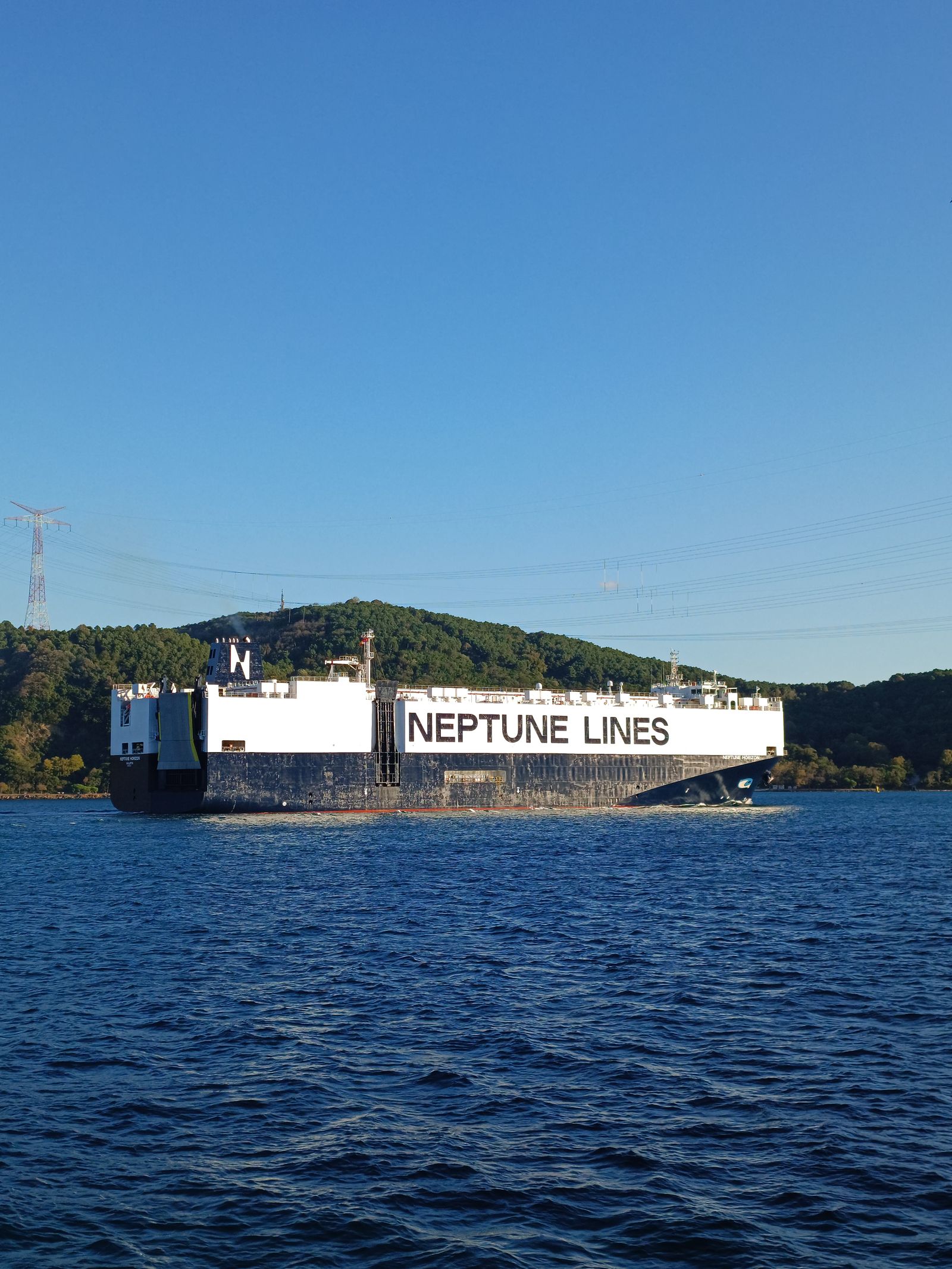
Class Fire Notations Beyond the SOLAS Floor
SOLAS is the floor. Class notations like DNV's F-AMC and ClassNK's AFVC(FD)(EV) certify the early detection and evacuation owners add above it.

The Newbuild Wave Scaling EV-Fire Exposure
The car-carrier fleet is on track to grow ~40%, concentrating roughly €250m of cargo value per hull — and EV-fire exposure is scaling with it.

How Multi-Fuel PCTCs Change the Deck
Ammonia detection alarms at 25 ppm, far below anything that burns. On a multi-fuel PCTC the sensing priority inverts from fire to toxicity.