
Do Flame Detectors Work on a Car Deck?

UV/IR flame detectors alarm in seconds and reject sunlight, but they fire only after ignition and need a line of sight the packed car deck blocks.
Partly — and only at the wrong end of the fire. A UV/IR flame detector reads the optical radiation of an open flame and alarms within seconds, and modern dual-band designs reject sunlight and welding arcs that fool cruder detectors. But on a vehicle deck it hits two structural limits: it triggers only after ignition, missing the pre-flame window that decides an EV fire, and it needs a clear line of sight the packed cargo blocks. It is a confirmation layer, not early warning.
How a flame detector actually sees fire
It reads radiation bands, not heat or smoke. Three families are used at sea: solar-blind ultraviolet (roughly 185–260 nm), single-frequency infrared tuned to the 4.3-micron CO₂ emission band of a hydrocarbon flame, and combined UV/IR or multi-spectrum (triple-IR) detectors that alarm only when several bands agree. Ultraviolet responds in milliseconds; the alarm is then usually delayed a few seconds — commonly cited as 4–8 seconds — to reject flickering transients. Once an open flame is in the detector's field of view, no other detection modality is faster.
Why sunlight doesn't fool a good one
This is the problem flame detection solved. Open weather decks are flooded with sunlight, and vehicle spaces see welding, hot exhausts and reflections — the classic false sources for optical detectors. A dual-band UV/IR detector rejects them by requiring both a UV and an IR signature before it alarms: a solar flare emits UV but not the 4.3-micron CO₂ signature of combustion, so the detector ignores it. The IR band itself sits where atmospheric absorption keeps solar irradiance low, so a filtered IR sensor does not respond to the sun. That immunity is exactly why flame detection is a credible open-deck modality where a plain smoke detector would nuisance-alarm constantly.
The first limit: it fires after ignition
This is the decisive limit for EV cargo. A flame detector needs a flame — flaming combustion — and that is the late stage of a lithium-ion event, not the early one. Thermal runaway begins with internal cell heating, moves through off-gassing and venting, then visible smoke, and only then reaches open flame. By the time a flame detector can legitimately see a flame, the pre-ignition window that gas sensing and thermal-anomaly detection are built to catch is already gone. On a deck where the entire object is to find the fault before it flames, a modality defined by waiting for flame is structurally late — fast within its stage, but starting its clock too far along.
The second limit: line of sight the cargo blocks
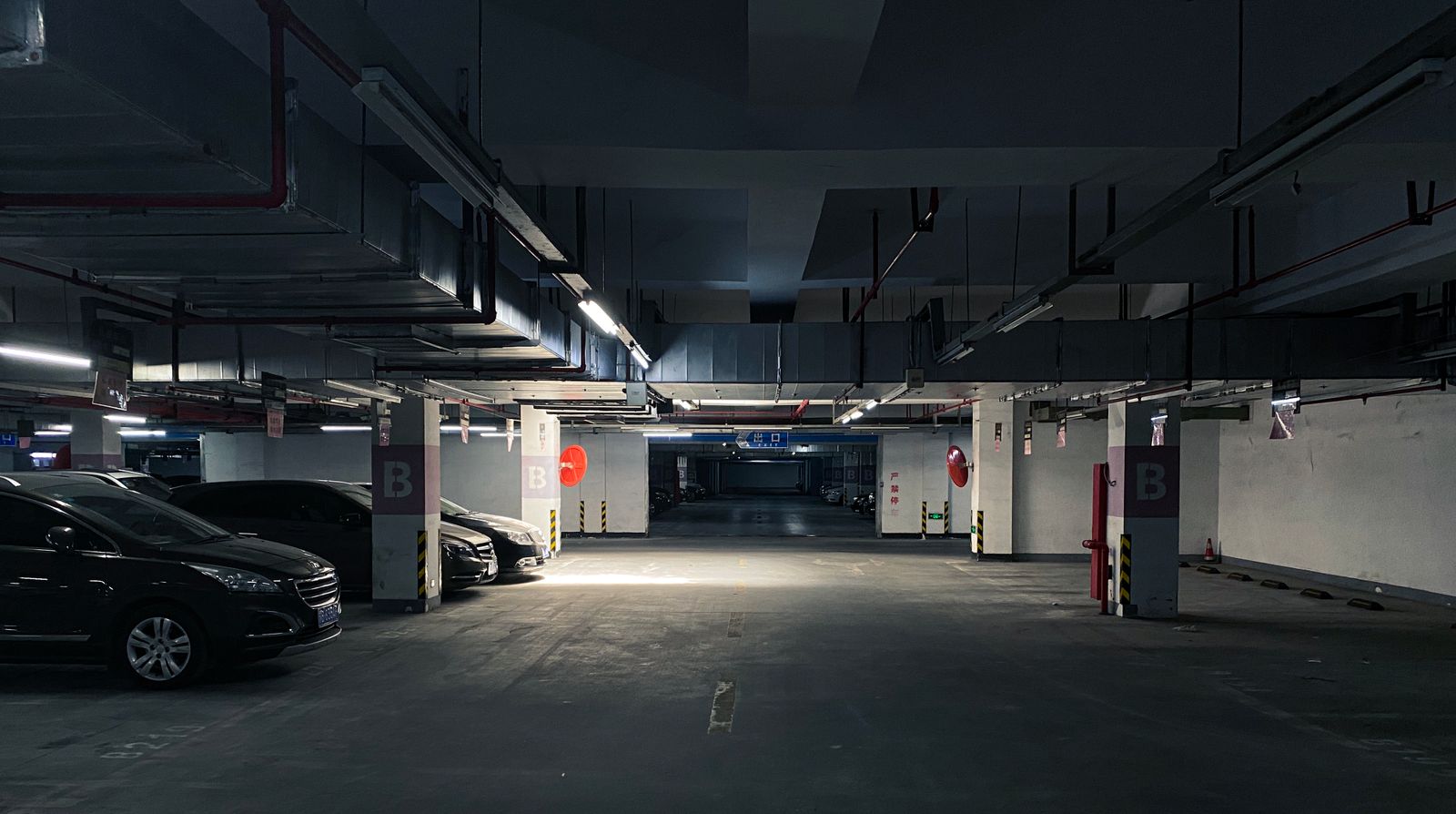
A flame detector only protects what it can see. It needs an unobstructed optical path to the flame, or a strong reflection, and a loaded vehicle deck is a near-solid field of steel bodies parked 10–30 cm apart. A fire starting under a chassis or between two cars is invisible to a perimeter- or deckhead-mounted flame detector until it grows tall enough to clear the roofline — which is precisely the growth the detector was supposed to pre-empt. The open, undivided decks where flame optics work best in an empty space are the same decks whose cargo, once loaded, defeats those optics.
Where flame detection earns its place
As a fast confirmation layer on open volumes, fused with an earlier layer. EMSA's FIRESAFE work assessed detection for open ro-ro and weather decks, where large open volumes and daylight favour optical approaches, and multi-spectrum IR flame detectors are in fact fitted around the perimeter of vehicle spaces on real ships and monitored by the ship's fire-alarm panel. That is the honest role for the modality: confirm a developed fire quickly and reliably where it has a clear view — a weather deck, a ramp, a large open hold — sitting behind a gas and thermal-anomaly early layer that catches the EV fault before there is any flame to see. Flame detection is a complement to early detection, not a replacement for it.
- Open weather decks and ramps: strong daylight rejection and seconds-fast alarm where the detector has a clear sightline.
- Large open holds and machinery-adjacent spaces: flame detection confirms a developed fire fast where line of sight exists.
- Enclosed, fully-loaded vehicle decks: poor fit as a primary layer — cargo blocks the optics and the flame comes too late.
- EV-dense stows: behind a gas/thermal early layer that sees the pre-flame off-gas and heating stages a flame detector cannot.
How RoRoSAFE helps
Flame detectors fire after ignition and need a clear view that cargo blocks. RoRoSAFE covers both gaps: it senses from under each parked vehicle, with no line of sight needed, and it targets the pre-ignition stage of thermal drift and battery venting. It is the layer before a flame detector has anything to see.
Pilot: one deck · installed alongside the berth · no drydock · 6 months of dashboard access
Sources
- 1. EMSA — FIRESAFE and FIRESAFE II studies on fire detection for open ro-ro and weather decks: optical detection assessed for large open-volume / weather-deck environments, with early detection and rapid response the decisive factors.
- 2. Flame-detector operating principles and product standards — NFPA 72 (National Fire Alarm and Signaling Code), FM 3260 / UL 2 / EN 54-10: UV (~185–260 nm), single-IR (4.3-micron CO₂ band), UV/IR and multi-spectrum IR detection, and the line-of-sight requirement.
- 3. Public-domain lithium-ion thermal-runaway staging — internal heating → off-gas/vent → smoke → open flame — the sequence at whose end a flame detector's flame requirement sits (see RoRoSAFE, 'The Four Stages of Li-ion Thermal Runaway').
- 4. Industry ro-ro deployment notes (e.g. Fike) — multi-spectrum IR flame detectors fitted around the perimeter of vehicle decks and monitored by the ship's fire-alarm system (background context; manufacturer source, not an approved primary).
Questions, answered
Do UV/IR flame detectors work on a ship's vehicle deck?+
They work, but as a confirmation layer, not early warning. A UV/IR flame detector alarms within seconds of an open flame entering its field of view and rejects sunlight and welding. On a loaded vehicle deck, though, it triggers only after ignition and needs a clear line of sight that packed cars block, so it is best fitted on open decks and perimeters behind an earlier gas and thermal layer.
Why can't a flame detector give early warning of an EV fire?+
Because it needs a flame, and flame is the late stage of a lithium-ion event. Thermal runaway runs from internal heating through off-gassing and venting to smoke before it reaches open flame. By the time a flame detector can see a flame, the pre-ignition window that gas and thermal-anomaly detection target is already spent — so on EV cargo a flame detector starts its clock too late.
Do flame detectors false-alarm on sunlight?+
A well-chosen one does not. Dual-band UV/IR detectors require both a UV and an infrared flame signature to alarm, and the 4.3-micron CO₂ band an IR sensor watches sits where atmospheric absorption keeps solar irradiance low. A solar flare emits UV but not the CO₂ IR signature of combustion, so the detector ignores it — which is why flame detection suits open, sunlit decks where smoke detectors nuisance-alarm.
Where should flame detection be used on a car carrier?+
On open volumes with clear sightlines — weather decks, ramps and large open holds — as a fast confirmation layer, fused with earlier detection. It is a poor primary layer on enclosed, fully loaded decks, where parked vehicles block the optical path and the flame arrives too late. Behind a gas and thermal-anomaly early layer, it confirms a developed fire quickly where it can actually see one.
Continue the thread

How Long Is the Off-Gas Window, Really?
Vendors say up to 30 minutes. Their own range starts at 2, the abuse mode sets where you land — and a car deck skews toward the short end.

Aspirating vs Point Smoke on Vehicle Decks
Point detectors alarm only once diluted smoke reaches the deckhead; aspirating (ASD) systems sample air continuously and trip far earlier.

FIRESAFE II: Open-Deck Detection Lessons
EMSA's 2018 study full-scale tested two detection technologies, not five, and named ventilation as what both delays and displaces an alarm.
Why Fire Detection Is Difficult on Ro-Ro Vehicle Decks
Ventilation dilutes the smoke, cargo hides the source, loading mutes the detectors, and a fire can spread car to car in about 20 minutes. Here is why.