
Who Pays When a Carmaker Owns the Ship?
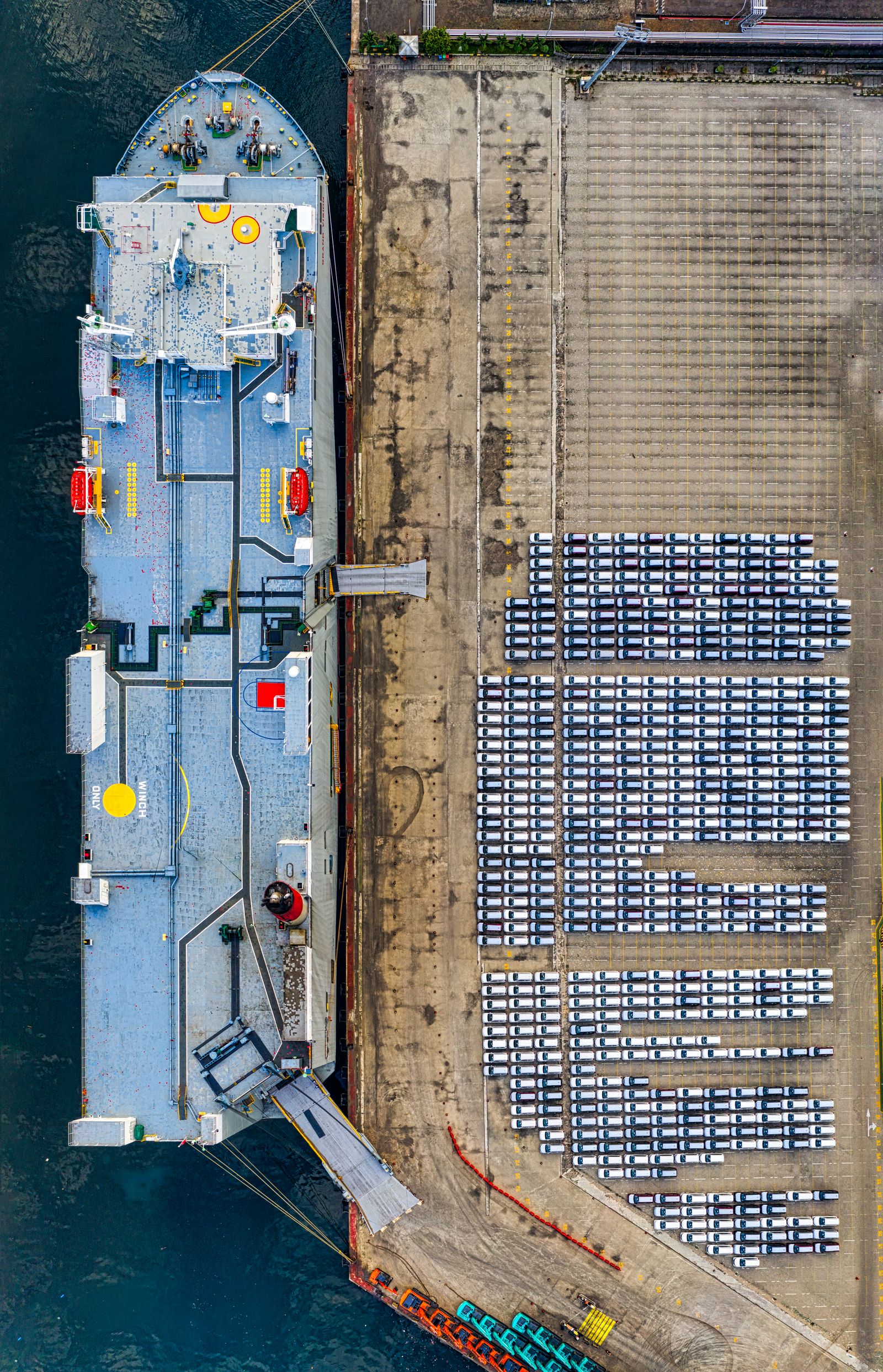
Increasingly the carmaker itself. BYD and SAIC now run their own car carriers, and owning both hull and cargo dismantles the usual risk transfer.
Increasingly, the carmaker itself. BYD has completed an eight-ship fleet with capacity to move more than a million cars a year, SAIC Anji is adding twelve ocean-going carriers through 2026, and BYD owns a licensed Chinese insurer outright. When the same group holds the hull, the cargo and part of the cover, the mechanisms that normally move a fire loss onto somebody else stop working.
How much tonnage is now carmaker-controlled
Enough that it is no longer a curiosity in the PCTC market. BYD reached eight vessels by the start of 2026 and an annual transport capacity above one million cars, having shipped more than 25,000 new-energy vehicles on its own hulls in the first quarter of 2025 alone; BYD Shenzhen, at 9,200 vehicles, is the largest car carrier afloat. SAIC Anji Logistics is taking twelve ocean-going carriers of 7,600, 7,800 and 9,000 vehicles between 2024 and 2026. Chery has formed a car-carrier joint venture with a state-owned shipping company in Anhui. The COSCO, Shanghai International Port Group and SAIC joint venture Guangzhou Yuanhai placed 24 RoRo newbuildings across four Chinese yards, taking it to a fleet of about 30 vessels as those deliveries complete.
The operational consequences of that shift have been argued elsewhere: a hull carrying one maker's vehicles concentrates the fire load and concentrates the knowledge at the same time. The contractual consequences have not. Marine risk transfer assumes the ship and the cargo are different people, and almost every recovery mechanism in a fire claim is built on that assumption. Remove it and the machinery still turns, but it moves money in a circle.
General average stops doing its job
General average only works when there are separate interests to share the sacrifice between. Under the York-Antwerp Rules the principle is that parties to a common maritime venture contribute proportionally to the value of what was saved, so a shipowner who floods a burning deck or hires salvage can recover a share from the cargo interests that benefited. On a voyage where one group owns the ship and every vehicle aboard, the adjustment becomes an internal transfer: the group funds its own sacrifice, and the average adjuster's arithmetic ends where it started.
This collapse is partial and depends entirely on the manifest. A carmaker's ship carrying only the parent's vehicles has nobody to call on; the same ship carrying a block of third-party cars, or trading with chartered space, restores the ordinary GA position for that portion. That makes the manifest a document with claims consequences rather than a purely commercial one, and it makes "who else was on this sailing" the first question on a carmaker-fleet casualty.
Subrogation has nowhere to go
An insurer cannot subrogate against its own assured. The recovery route the marine market has been slowly building — hull and cargo underwriters pursuing the vehicle or battery manufacturer after a defect-driven fire — depends on that manufacturer being a third party to the policy. When the manufacturer is also the carrier, the shipowner and the assured, the route closes: there is no external defendant, and the loss stays where it fell.
For underwriters this changes the shape of the exposure rather than its size. On an independent operator's ship, a defect-caused fire is a loss with a potential recovery attached, and that recovery prospect is part of how the risk is priced. On a carmaker's own ship it is a loss, full stop. The difference does not show up in the premium calculation unless the underwriter is explicitly modelling recovery expectations, which is precisely the assumption that vertical integration quietly invalidates.
The fire defence cuts differently
The carrier's strongest shield against cargo claims may be weaker in the hands of the company that built the cargo. Article IV rule 2(b) of the Hague-Visby Rules provides that neither the carrier nor the ship is responsible for loss or damage arising from fire "unless caused by the actual fault or privity of the carrier". English authority reads "carrier" as the directing mind and will of the company — usually top-level management — and places the burden of establishing fault and privity on the party alleging it. The defence is broad: it has been held to apply without qualification as to how the fire started.
Two limits matter here. First, the Article IV rule 2 exceptions do not protect a carrier where the loss was caused by unseaworthiness and the carrier cannot discharge its Article III rule 1 duty of due diligence. Second, and more pointedly for a carmaker-carrier with third-party cargo aboard, the directing mind that holds the design and field-failure history of a battery pack is the same directing mind operating the ship. A cargo claimant alleging actual fault or privity against an independent operator has to prove what a shipping company knew about someone else's product; against a manufacturer-carrier, the same allegation runs against a company that already holds the engineering record. That is a materially easier case to plead.
What it means for underwriters and independent owners
The group that retains the risk also decides what gets fitted, and that is a different decision-maker from the one the market is used to. BYD took 100% of the insolvent Yi'an Property and Casualty Insurance and renamed it Shenzhen BYD Property and Casualty Insurance in May 2023, becoming the first automaker to own an insurer in China; its licensed business scope covers cargo, property, liability and motor. In 2025 that arm booked RMB 2.871 billion of insurance revenue and RMB 93.62 million of net profit, with premiums up 112% year on year — but an underwriting loss ratio of 97.28%, meaning the profit came from investment income on the float rather than from the policies. Retained risk is not free, and it is not obviously cheaper.
For independent owners the practical read is competitive rather than legal. A carmaker-controlled fleet answers to an internal risk function, not to a hull underwriter's survey conditions, so the fire-safety standard on those hulls is whatever the parent decides it is — which may be higher than the market minimum or lower, and is far less visible from outside. For underwriters, three questions now sit ahead of the usual ones on a carmaker-fleet submission: what proportion of each sailing is third-party cargo, whether any recovery prospect survives the ownership structure, and how much of the risk is genuinely transferred rather than recycled inside the group. None of those are answered by the vessel's class record.
How RoRoSAFE helps
When the carmaker owns hull and cargo, it carries the loss either way, so a small fire is worth the most to it. RoRoSAFE gives carmaker fleets per-vehicle thermal and battery-vent gas detection on every deck and a fleet-wide dashboard across their hulls. A developing event is flagged before visible smoke, whoever ends up paying.
Pilot: one deck · installed alongside the berth · no drydock · 6 months of dashboard access
Sources
- 1. Maritime Executive / Seatrade Maritime / CarNewsChina — BYD car-carrier fleet: eight vessels by early 2026 and annual capacity above one million cars; BYD Shenzhen 9,200 vehicles, the largest car carrier delivered; more than 25,000 NEVs carried on own hulls in Q1 2025.
- 2. CnEVPost / Malay Mail — SAIC Anji Logistics: twelve ocean-going carriers of 7,600, 7,800 and 9,000 vehicles added across 2024–2026; Chery car-carrier joint venture with an Anhui state-owned shipping company.
- 3. Comité Maritime International — York-Antwerp Rules 2016: general average as proportional contribution by the parties to a common maritime venture, assessed on saved values (comitemaritime.org).
- 4. Hague-Visby Rules, Article IV rule 2(b) and Article III rule 1 — the fire exception "unless caused by the actual fault or privity of the carrier", the reading of "carrier" as the directing mind and will, the burden on the party alleging fault, and the loss of the Article IV rule 2 exceptions where unseaworthiness and a failure of due diligence caused the loss; Steamship Mutual and Clyde & Co commentary on the fire defence.
- 5. Yicai Global / Business Insurance — BYD acquired 100% of the insolvent Yi'an Property and Casualty Insurance, renamed Shenzhen BYD Property and Casualty Insurance (approval May 2023), the first automaker-owned insurer in China; licensed scope includes cargo, property, liability and motor insurance. 2025 results: RMB 2.871bn insurance revenue, RMB 93.62m net profit, premiums up 112%, underwriting loss ratio 97.28%.
Questions, answered
Which carmakers now own their own car carriers?+
BYD completed an eight-ship fleet by early 2026 with capacity above one million cars a year, including BYD Shenzhen at 9,200 vehicles. SAIC Anji Logistics is adding twelve ocean-going carriers between 2024 and 2026, and Chery has formed a joint venture with a state-owned shipping company in Anhui. A COSCO, Shanghai International Port Group and SAIC venture ordered a further 24 RoRo newbuildings.
Does general average still apply if the carmaker owns the cargo too?+
Technically yes, practically much less. General average shares a sacrifice proportionally among the interests in a common venture, so it only redistributes anything when those interests are separate parties. Where one group owns the ship and every vehicle aboard, the adjustment is an internal transfer. If the same sailing carries third-party cargo, the ordinary position is restored for that share.
Can an insurer still subrogate against the manufacturer after a fire?+
Not when the manufacturer is the assured. Subrogation lets an insurer step into its assured's rights against a third party, so the route requires the manufacturer to be external to the policy. On a carmaker-owned ship carrying that carmaker's vehicles, the manufacturer is also the carrier and the assured, and no recovery target remains outside the group.
Is the Hague-Visby fire defence weaker for a manufacturer-carrier?+
Arguably, where third-party cargo is aboard. The defence fails if fire is caused by the actual fault or privity of the carrier, meaning its directing mind. Against an independent operator, a claimant must prove what a shipping company knew about another firm's product. Against a manufacturer-carrier, the same corporate mind already holds the design and field-failure record, which makes that allegation easier to run.
Continue the thread

Subrogation and the Cargo-Manufacturer Question
Can insurers recover an EV-fire loss from the carmaker? Stuttgart said no in May 2026: nobody could prove which car started the Felicity Ace fire.

Do Pure-EV Car Carriers Change the Risk?
Carmakers like BYD now run near-fully-electric car carriers — BYD Shenzhen holds 9,200 vehicles. That concentrates the fire load, but also the knowledge.

General Average: The Cost Cargo Owners Miss
When a car carrier declares general average, cargo that survives pays its share. Standard cargo cover includes GA; self-insured cargo pays in full.

Does China's EV Export Surge Raise Fire Risk?
China exported ~2.6 million new-energy vehicles by sea in 2025 — increasingly on carmakers' own dual-fuel fleets. The exposure is density, not defect.